How to Invest Your First $1,000: A Step-by-Step Plan for 2026
A thousand dollars won't make you rich overnight — but invested correctly, it builds habits and compounding returns that actually matter a decade from now. Here's exactly what to do with it, in order.
Last updated: July 2026 · 12 min read · Finance
Disclaimer: This article is for educational purposes only and does not constitute personalised financial advice. Investment involves risk, including possible loss of principal. Consult a licensed financial adviser before making investment decisions.
The hardest part of investing isn't picking the right stock or timing the market. It's starting. Most people who never build wealth don't fail because of bad investment choices — they fail because they kept waiting for the "right moment" that never came.
A thousand dollars is a meaningful first step. It's enough to open a brokerage account, buy a diversified index fund, and start building the habits that compound over time. But it's also small enough that where you put it matters less than simply getting it working for you.
This guide walks through every step — in order — so you don't waste your first $1,000 on the wrong thing at the wrong time.
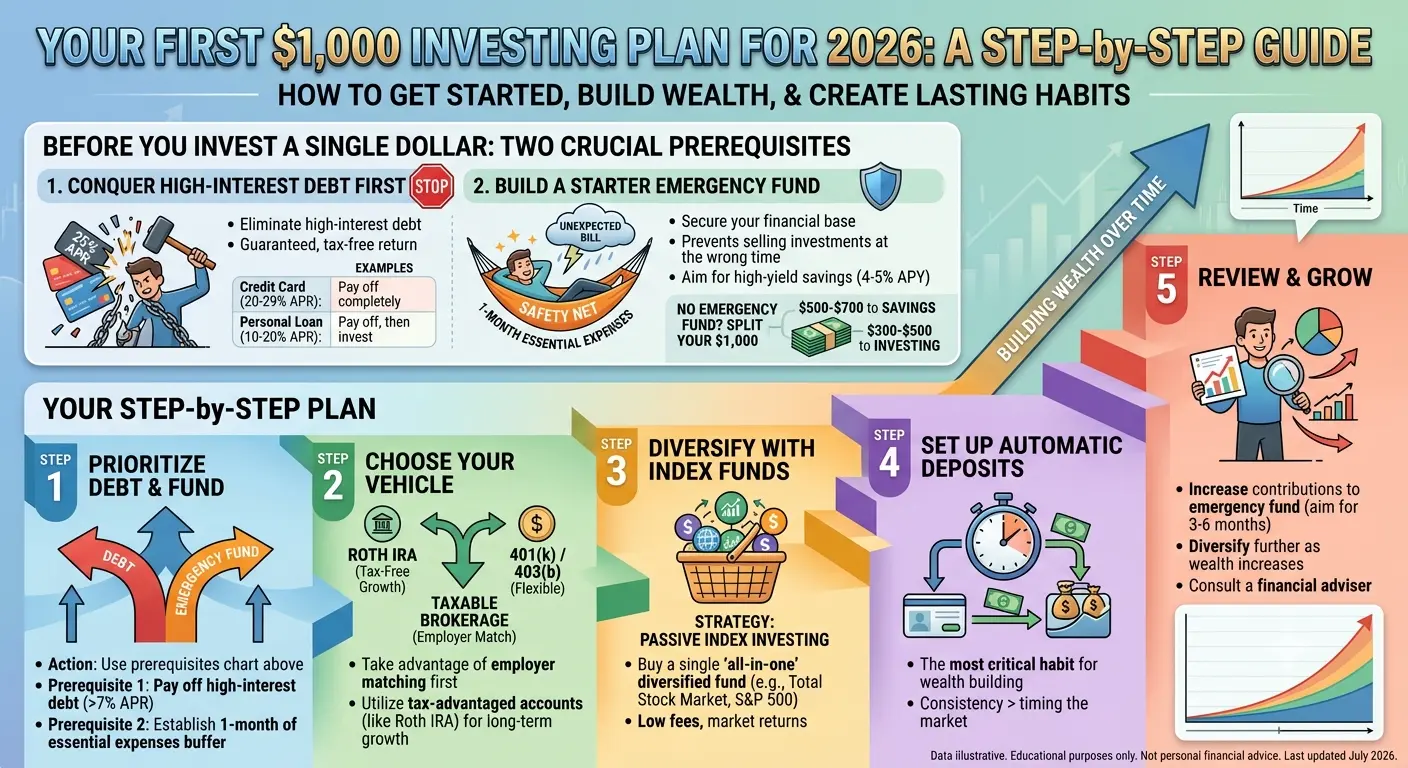
Before You Invest a Single Dollar: Two Prerequisites
Putting $1,000 into the stock market while carrying high-interest debt or no emergency fund isn't investing — it's gambling with money you can't afford to lose. Two things need to be in place first.
1. Pay off high-interest debt first
If you're carrying a balance on a credit card charging 20–29% APR, paying it off is the single best "investment" you can make. No index fund has reliably returned 25% per year. Eliminating that debt is a guaranteed, tax-free return equal to the interest rate.
| Debt type | Typical APR | What to do |
|---|---|---|
| Credit card | 20–29% | Pay off completely before investing |
| Personal loan | 10–20% | Pay off, then invest |
| Car loan | 5–10% | Can invest alongside — judgment call |
| Student loan (federal) | 5–7% | Minimum payments; invest the rest |
| Mortgage | 3–7% | Keep making payments; invest freely |
2. Build a starter emergency fund
You need at least one month of essential expenses sitting in a high-yield savings account before you invest anything. Without it, any unexpected bill — car repair, medical cost, job disruption — forces you to sell investments at potentially the worst time.
If you don't have that buffer yet, split your $1,000: put $500–$700 in a high-yield savings account (many offer 4–5% APY in 2026) and invest the rest. Then build the emergency fund to three months of expenses before increasing your investment contributions.
Rule of thumb: If you'd need to sell investments within the next 12 months to cover living expenses, you're not ready to invest yet. Build the cushion first.
Step 1: Choose the Right Account Type
Where you hold your investments matters almost as much as what you invest in. The right account can save you thousands in taxes over a decade. For most first-time investors in the US, this decision comes down to three options.
Roth IRA — the best starting point for most people
A Roth IRA lets you invest after-tax money that grows completely tax-free. When you withdraw in retirement, you pay nothing — no tax on decades of gains. In 2026, you can contribute up to $7,000 per year (or $8,000 if you're 50+), provided your income is below the phase-out threshold.
- Tax-free growth and tax-free withdrawals in retirement.
- Contributions (not earnings) can be withdrawn any time without penalty — useful flexibility for a first investor.
- Best suited for people who expect to be in a higher tax bracket in the future.
- Income limits apply: single filers start phasing out at $146,000 MAGI in 2026.
401(k) — use it if your employer matches
If your employer offers a 401(k) match, that match is a guaranteed 50–100% return on your contribution — nothing else comes close. Contribute at least enough to capture the full match before putting money anywhere else.
Example: your employer matches 50% of contributions up to 6% of salary. On a $50,000 salary, contributing $3,000 earns $1,500 in free employer money. That's a 50% return before the market does anything.
Taxable brokerage account — flexible but less tax-efficient
A standard brokerage account has no contribution limits and no rules about withdrawals, but you'll pay capital gains tax on profits. It makes sense once you've maxed out tax- advantaged accounts, or if you want access to the money before retirement age.
| Account | Tax benefit | 2026 limit | Early withdrawal |
|---|---|---|---|
| Roth IRA | Tax-free growth | $7,000 | Contributions anytime; earnings after 59½ |
| Traditional IRA | Tax-deductible contributions | $7,000 | 10% penalty before 59½ |
| 401(k) | Pre-tax contributions | $23,500 | 10% penalty before 59½ |
| Taxable brokerage | None | Unlimited | Anytime, no penalty |
For most first-time investors with $1,000: open a Roth IRA. If you have an employer match you're not capturing, fix that first.
Step 2: Pick a Brokerage
In 2026, all major brokerages offer commission-free trading, no account minimums, and fractional shares — so you can invest any amount in any stock or fund. The differences come down to interface quality, fund selection, and which features matter to you.
| Brokerage | Best for | Minimum | Notable feature |
|---|---|---|---|
| Fidelity | Most beginners | $0 | Excellent index funds, great UI |
| Charles Schwab | Hands-off investors | $0 | Strong robo-advisor (Schwab Intelligent Portfolios) |
| Vanguard | Long-term index investors | $0 | Lowest-cost funds, investor-owned structure |
| M1 Finance | Automated investing | $100 | Pie-based auto-rebalancing |
| Robinhood | Active traders | $0 | Instant deposits, simple interface |
If you're opening a Roth IRA and want to keep things simple, Fidelity or Vanguard are hard to beat. Both have been around for decades, hold trillions in assets, and offer the low-cost index funds you'll be buying.
Step 3: What to Actually Buy With Your $1,000
This is where most beginners overthink it. The evidence is clear: low-cost, diversified index funds outperform the majority of actively managed funds over 10+ year periods. You don't need to pick stocks, time the market, or follow financial news. You need broad diversification and low fees.
The one-fund solution
If you want to keep it maximally simple, a single total market index fund does everything you need. These funds hold thousands of companies across every sector and market cap, automatically rebalancing as markets shift.
| Fund | Covers | Expense ratio | Available at |
|---|---|---|---|
| FSKAX | Total US market (~4,000 stocks) | 0.015% | Fidelity |
| VTI | Total US market (~3,700 stocks) | 0.03% | All brokerages |
| FZROX | Total US market (zero fee) | 0.00% | Fidelity only |
| VT | Total world market (US + international) | 0.07% | All brokerages |
| FSKAX + FZILX | US + international split | ~0.01% | Fidelity |
Expense ratio is the annual fee expressed as a percentage of your investment. At 0.03%, you pay $0.30 per year on every $1,000 invested. At 1.0% (common in actively managed funds), you pay $10. That gap compounds dramatically over decades.
The three-fund portfolio
If you want slightly more control and broader diversification, the three-fund portfolio is the classic beginner approach — simple enough to manage in minutes per year, strong enough to hold for life.
Three-fund portfolio (example allocation for a 30-year-old)
US Total Market Index (e.g., VTI or FSKAX)
Core holding — US economy exposure
International Index (e.g., VXUS or FZILX)
Diversification outside the US
US Bond Index (e.g., BND or FXNAX)
Stability and downside cushion
Adjust the bond percentage to roughly match your age. Younger investors can hold less bonds; those closer to retirement typically hold more.
What about individual stocks and crypto?
Individual stocks and crypto aren't inherently wrong, but they're not where your first $1,000 should go. Both require research, risk tolerance, and time — and the evidence consistently shows that most individual investors underperform a simple index fund when trading individual securities.
If you want exposure to individual stocks or crypto, treat it as a small speculative allocation — no more than 5–10% of your portfolio — after your core index fund position is established. Don't start there.
Why Starting With $1,000 Actually Matters: The Compounding Numbers
Compounding returns are counterintuitive. The growth feels slow at the beginning and explosive at the end. Here's what $1,000 invested in a broad US index fund (assuming 7% average annual return, the rough historical real return of the S&P 500 after inflation) looks like over time:
| Years invested | $1,000 grows to | $1,000/yr added grows to |
|---|---|---|
| 5 years | $1,403 | $6,153 |
| 10 years | $1,967 | $14,784 |
| 20 years | $3,870 | $52,397 |
| 30 years | $7,612 | $122,709 |
| 40 years | $14,974 | $262,481 |
Assumes 7% average annual return. For illustrative purposes only — actual returns vary and are not guaranteed.
The "$1,000/yr added" column is where the real numbers come from. Your first $1,000 starts the clock. Adding to it regularly — even modest amounts — is what transforms a small nest egg into a meaningful one.
The Five Mistakes That Cost First-Time Investors the Most
Waiting for the market to 'calm down'
The market always seems uncertain. There's always a reason to wait — an election, an interest rate decision, a geopolitical event. Time in the market consistently outperforms attempts to time the market. The best day to start was yesterday; the second best is today.
Checking your portfolio constantly
Watching your investments daily creates anxiety and tempts you to make reactive decisions. Markets are volatile in the short term by design. Log in once per quarter to rebalance if needed, and otherwise leave it alone. Portfolios grow better when they're not being tinkered with.
Paying high fees on actively managed funds
A 1% annual expense ratio sounds small. Over 30 years, it can consume 20–25% of your final portfolio value compared to a 0.03% index fund. Always check the expense ratio before buying any fund. There is rarely a justification for anything above 0.20% for a long-term holding.
Selling during a downturn
Every significant market drop feels like the beginning of a permanent decline. It never has been. Selling during a correction locks in losses and means you miss the recovery. The investors who fared worst through every major crash were those who sold near the bottom and waited too long to buy back in.
Treating investing as a one-time event
Your first $1,000 matters, but the habit of contributing regularly matters far more. Set up automatic monthly transfers to your investment account — even $50 or $100 per month — so investing becomes a background process rather than a decision you have to make every month.
How to Allocate Based on Your Timeline
The right investment mix depends on when you'll need the money. The longer your timeline, the more risk you can absorb — because short-term volatility becomes irrelevant over long enough periods. The shorter your timeline, the more stability you need.
Need the money within 1–2 years
Don't invest in stocks. Put this money in a high-yield savings account or a short-term CD. Market downturns can take years to recover; you can't afford that if you'll need the funds soon.
3–5 year horizon
Conservative mix: roughly 40–60% stocks, 40–60% bonds or cash equivalents. You can handle some volatility but need enough stability to weather a downturn without being forced to sell.
5–10 year horizon
Moderate mix: 70–80% stocks, 20–30% bonds. Long enough to recover from most downturns; short enough to still want some cushion.
10+ years (retirement, long-term wealth)
Aggressive growth: 90–100% stocks, minimal bonds. Time is your biggest advantage. Volatility in year one doesn't matter if you won't touch the money for 20 years. Let compounding do its work.
Your $1,000 Investment Action Plan: Step by Step
Concrete steps, in order. Most people can complete this in under an hour.
- 1
Check your debt
List every debt and its interest rate. Pay off anything above 10% APR before proceeding.
- 2
Build a one-month buffer
If you don't have $500–$1,000 in an accessible savings account, split your $1,000 between savings and investment. Emergency fund first.
- 3
Capture any 401(k) match
If your employer matches contributions and you're not getting the full match, redirect enough to capture it — that's a 50–100% instant return.
- 4
Open a Roth IRA
If you're under the income limit, open a Roth IRA at Fidelity or Vanguard. Takes about 15 minutes online.
- 5
Deposit your $1,000
Fund the account via bank transfer. It typically clears in 1–3 business days (many brokerages offer instant deposit).
- 6
Buy a total market index fund
Purchase FSKAX, VTI, or your brokerage's equivalent. If you want global diversification, add an international fund (FZILX or VXUS).
- 7
Set up automatic contributions
Automate a monthly transfer — even $50 — from your bank to your investment account. Automation removes the decision.
- 8
Set a calendar reminder to rebalance
Once per year, check that your allocation still matches your target. Rebalance by buying more of whichever fund has fallen below its target percentage.
What Comes After Your First $1,000
Once the first $1,000 is invested and automatic contributions are running, the next steps are about building on the foundation.
- →Max out your Roth IRA: The $7,000 annual limit is your most tax-efficient investment vehicle. Prioritise filling it before moving to a taxable account.
- →Build the emergency fund to 3–6 months: Increase the safety net so a larger financial shock doesn't force you to liquidate investments.
- →Increase contributions with income growth: Every raise, bonus, or freelance payment is an opportunity to increase your investment rate before lifestyle inflation absorbs it.
- →Learn, then add complexity only if it adds value: Index funds require no ongoing management. Only add individual stocks, real estate, or other assets when you understand them — not out of boredom.
Frequently Asked Questions
Is $1,000 enough to start investing?
Yes. Most brokerages have eliminated account minimums entirely. $1,000 is enough to buy a meaningful position in any index fund, and fractional shares let you invest any dollar amount in any security. The amount matters less than starting.
Should I invest a lump sum or spread it out?
Research consistently shows that investing a lump sum immediately outperforms spreading it out (dollar-cost averaging) about two-thirds of the time, because markets trend upward over time. However, dollar-cost averaging reduces regret risk — if the market drops right after you invest your lump sum, it's easier to stay invested if you committed gradually. With $1,000, the difference is small either way. Just invest it.
What if the market crashes right after I invest?
This will probably happen at some point. A market crash is not a loss unless you sell. If the S&P 500 drops 30% the month after you invest $1,000, your account shows $700 — but you haven't lost anything until you sell. History shows that every major market decline has eventually recovered and gone on to new highs. The investors who fared worst were those who panicked and sold.
Can I invest if I'm not a US citizen?
Many US brokerages accept non-resident alien investors, though the process varies by country and tax treaty. Outside the US, equivalent tax-advantaged accounts exist — ISAs in the UK, TFSAs in Canada, PEAs in France. The underlying principle of low-cost index fund investing applies regardless of country; the account wrapper is what varies.
What's the difference between an ETF and a mutual fund?
Both can track the same index, but ETFs trade like stocks throughout the day while mutual funds execute once at end-of-day pricing. For a long-term investor buying and holding, the difference is minor. ETFs are often slightly more tax-efficient in taxable accounts. In a Roth IRA, it doesn't matter — use whichever has the lower expense ratio.
The Only Move That Actually Matters
There is no perfect first investment. The gap between a good investment and a great one is small compared to the gap between investing anything and investing nothing.
Open the account. Buy the index fund. Set up the automatic contribution. Then step back and let time do the work. The investors who build real wealth aren't the ones who found the best stock — they're the ones who started early and kept going.
Do these three things this week:
- Open a Roth IRA at Fidelity or Vanguard if you don't have one.
- Deposit your $1,000 and buy a total market index fund (VTI, FSKAX, or FZROX).
- Set up a recurring monthly contribution — any amount — so it happens automatically.

Finance & Fintech Research Team
The Kodivio team analyzes financial tools, investment platforms, and fintech trends based on independent research and market data.
Learn more about us →