Index Fund vs ETF: Are They Actually the Same Thing?
The short answer is: sometimes yes, often no. Both can track the same index and hold the same stocks — but how they're structured, traded, and taxed creates real differences that matter depending on where and how you invest.
Last updated: July 2026 · 16 min read · Finance
Disclaimer: This article is for educational purposes only and does not constitute personalised financial advice. Consult a licensed financial adviser before making investment decisions.
"Should I buy the index fund or the ETF version?" is one of the most common questions new investors hit almost immediately. Browse any brokerage and you'll find VTI and VTSAX sitting side by side — same underlying stocks, similar expense ratios, wildly different names. It looks like a trick question.
It isn't quite. The two terms describe different things, and understanding the distinction makes you a better investor — not because the choice dramatically changes your returns, but because each structure fits certain situations better than others.
This guide untangles the terminology, explains where the real differences lie, and gives you a clear framework for deciding which to use.
First: What Each Term Actually Means
The confusion starts because people use these terms as if they're alternatives to each other — but they describe different dimensions of a fund.
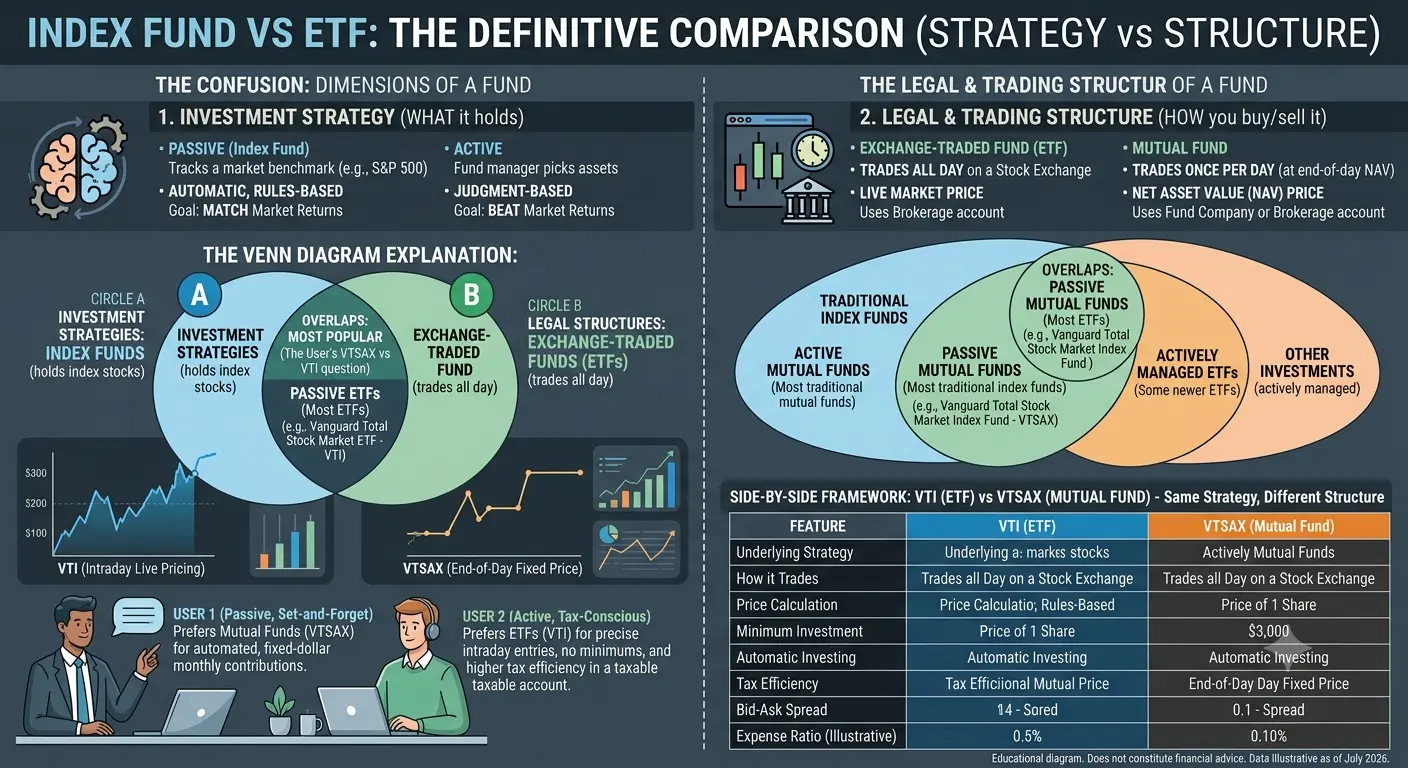
"Index fund" describes the investment strategy
An index fund is any fund that tracks a market index — the S&P 500, the total US stock market, the global bond market, or any other benchmark. Instead of a manager picking stocks, the fund simply holds what the index holds, in the same proportions.
This is a strategy, not a structure. An index fund can be structured as a mutual fund or as an ETF. Both are perfectly legitimate index funds if they track an index passively.
"ETF" describes the legal and trading structure
An ETF (Exchange-Traded Fund) is a fund that trades on a stock exchange throughout the day, just like a share of Apple or Google. You buy it through a brokerage at the current market price; the price updates in real time during trading hours.
An ETF can be an index fund (most are) or it can be actively managed. It can hold stocks, bonds, commodities, currencies, or other assets. The "exchange-traded" part describes how you buy and sell it, not what it holds or how it's managed.
The Venn diagram version:
- → Most ETFs are index funds (passive strategy, exchange-traded structure).
- → Some ETFs are actively managed (not index funds).
- → Most traditional index funds are mutual funds (passive strategy, mutual fund structure).
- → Mutual funds can also be actively managed (not index funds).
When most people say "index fund vs ETF," what they really mean is "index mutual fund vs index ETF" — two structures that achieve almost the same thing through slightly different mechanisms. That's the comparison this article focuses on.
Index Mutual Fund vs Index ETF: Side by Side
Here's a concrete example. Vanguard offers two products that both track the total US stock market:
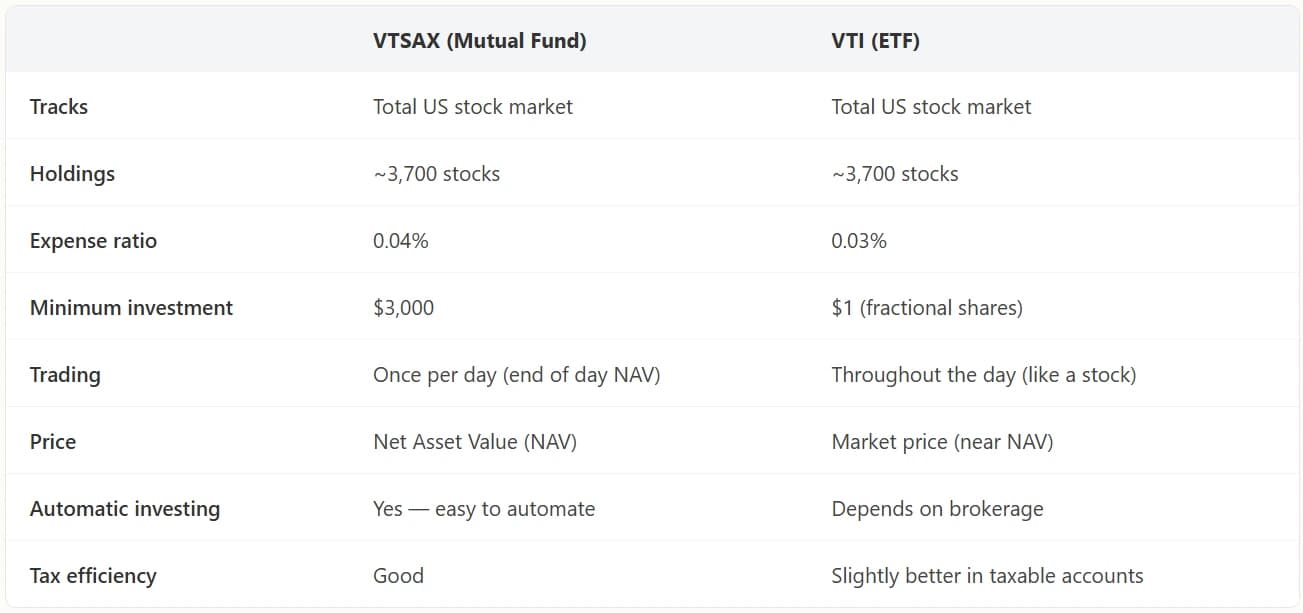
The performance difference over a lifetime of investing is tiny. The structural differences below are what actually matter for your decision.
The Real Differences That Actually Matter
1. Minimum investment
Traditional index mutual funds often carry minimum investment requirements. Vanguard's VTSAX requires $3,000 to open a position. Fidelity's FZROX has no minimum. Schwab's index funds start at $1.
ETFs traded as whole shares have a minimum of one share price — VTI was around $250–270 per share in 2026. But most major brokerages now offer fractional shares, letting you invest any dollar amount in any ETF. Effectively, minimums have become less of a differentiator than they used to be.
Practical note: If you're just starting out with a small amount and your brokerage supports fractional ETF shares, the minimum-investment advantage of mutual funds largely disappears. Check what your brokerage supports before letting this factor drive the decision.
2. How and when they trade
This is the most structurally distinct difference between the two.
Index mutual funds execute once per day, at the closing Net Asset Value (NAV). When you place a buy or sell order, it goes through at that day's end-of-day price regardless of when you submitted it. You always get a fair price based on the actual value of the underlying holdings.
ETFs trade continuously throughout the day at market prices. The price fluctuates based on supply and demand, usually staying close to the underlying NAV but occasionally deviating slightly — this gap is called the premium/discount. For long-term investors, this intraday liquidity is largely irrelevant; for active traders, it matters a lot.
ETFs also have a bid-ask spread — the difference between what buyers will pay and what sellers will accept. For large, liquid ETFs like VTI or SPY the spread is negligible (typically $0.01). For smaller or less-traded ETFs, it can be wider and adds a small transaction cost on every trade.
3. Tax efficiency in taxable accounts
This is the most substantive difference for investors holding funds in a taxable brokerage account (outside a Roth IRA or 401k).
When investors redeem shares of a mutual fund, the fund may need to sell holdings to raise cash. If those holdings have appreciated, the fund realises capital gains — and distributes them to all shareholders, even those who didn't sell anything. You could receive a taxable capital gains distribution simply because other investors exited the fund.
ETFs handle redemptions differently through a mechanism called in-kind creation and redemption. When large institutional investors (called authorised participants) redeem ETF shares, they receive a basket of the underlying securities rather than cash. This means the ETF rarely needs to sell holdings to meet redemptions, which dramatically reduces capital gains distributions to ordinary shareholders.
| Account type | Index mutual fund | Index ETF |
|---|---|---|
| Roth IRA | No difference — growth is tax-free either way | No difference — growth is tax-free either way |
| 401(k) | No difference — tax-deferred either way | No difference — tax-deferred either way |
| Taxable brokerage | May distribute capital gains annually | Rarely distributes capital gains — more tax-efficient |
The takeaway: inside a Roth IRA or 401(k), the tax difference is irrelevant — use whichever has the lower expense ratio. In a taxable account, ETFs have a meaningful structural tax advantage that compounds over time.
One important caveat: Vanguard holds a now-expired patent that allowed its mutual funds to use the same in-kind redemption mechanism as ETFs. VTSAX has been notably tax-efficient as a result. That patent expired in 2023, and other fund companies have been working to implement similar structures — so this gap may narrow over time.
4. Automatic investing and dollar-cost averaging
Setting up automatic monthly contributions is seamless with mutual funds. You specify a dollar amount, set a date, and the fund executes the purchase regardless of whether it results in a fractional share. This makes regular investing frictionless.
With ETFs, automatic investing depends heavily on your brokerage. Fidelity, Schwab, and M1 Finance support automatic ETF purchases with fractional shares. Some older platforms still require you to place orders manually or can only purchase whole shares automatically. If you plan to invest a fixed dollar amount each month, confirm your brokerage handles it correctly before committing to an ETF.
5. Expense ratios
Both structures can be extraordinarily cheap. The differences are small enough that they rarely drive the decision on their own, but it's worth checking.
| Fund pair (same index) | Mutual fund / ER | ETF / ER |
|---|---|---|
| Total US market (Vanguard) | VTSAX — 0.04% | VTI — 0.03% |
| Total US market (Fidelity) | FZROX — 0.00% | FZROX not available as ETF |
| S&P 500 (Fidelity) | FXAIX — 0.015% | IVV (iShares) — 0.03% |
| Total international (Vanguard) | VTIAX — 0.12% | VXUS — 0.07% |
| US bonds (Vanguard) | VBTLX — 0.05% | BND — 0.03% |
On $10,000 invested, a 0.04% vs 0.03% difference costs $1 per year. Don't agonise over it.
A Word on Actively Managed Funds
So far this article has focused on passive index funds in both structures. But not all mutual funds or ETFs are passive — and the difference matters enormously.
Actively managed funds employ portfolio managers who try to beat a benchmark by selecting specific securities. They charge higher fees (typically 0.5–1.5% expense ratio) to pay for that management. The problem: the evidence for active management consistently outperforming passive indexing over long periods is weak.
The S&P Dow Jones SPIVA reports — which track how actively managed funds perform against their benchmark — consistently show that 80–90% of active funds underperform their index over a 15-year period. Higher fees are the primary reason: even a skilled manager needs to beat the index by more than their fee just to break even with an index fund.
Simple rule: When you see an expense ratio above 0.20%, ask why. For a passively managed index fund or ETF, there's no good answer. For an actively managed fund, you need evidence that the management team's track record justifies the cost — and that evidence is rarer than the marketing implies.
Which One Should You Choose?
The honest answer is that for most long-term investors, the choice makes very little practical difference. Picking either and investing consistently will put you in the top tier of investors by outcome. But here's how to think through it:
You're investing inside a Roth IRA or 401(k)
Either works — pick whichever has the lower expense ratio at your brokerage. Tax efficiency is irrelevant inside a tax-advantaged account. If your brokerage offers a zero-fee index mutual fund (like Fidelity's FZROX), that's hard to beat.
You're investing in a taxable brokerage account
ETFs have a meaningful structural tax advantage. The in-kind redemption mechanism reduces unexpected capital gains distributions, which matters more as your account grows. Prefer ETFs in taxable accounts.
You want to set up automatic monthly investing
Mutual funds are slightly easier to automate with exact dollar amounts. ETFs work if your brokerage supports fractional share automatic purchases (Fidelity and Schwab do; not all platforms do). Check first.
You're just starting and have less than $1,000
ETFs with fractional shares or a no-minimum index mutual fund (FZROX at Fidelity starts at $1). Don't let minimum investment requirements be the reason you don't start.
You want to trade intraday or use limit orders
ETFs only — mutual funds execute once per day at NAV with no ability to set a price. For a buy-and-hold index investor this is irrelevant, but if precise execution timing matters for any reason, ETFs are the only option.
Common Misconceptions Worth Clearing Up
Myth: ETFs are riskier than mutual funds
Reality: The risk comes from what a fund holds, not how it's structured. A bond ETF is far less volatile than an equity mutual fund. VTI and VTSAX carry virtually identical risk because they hold the same stocks.
Myth: ETFs are for traders; mutual funds are for long-term investors
Reality: ETFs can absolutely be — and increasingly are — long-term buy-and-hold vehicles. The intraday trading capability is a feature some people use; it doesn't mean you have to. Most ETF investors never trade intraday.
Myth: Index funds are guaranteed to make money
Reality: No investment is guaranteed. Index funds eliminate manager risk and reduce costs, but they still track the market — and markets go down. A broad index fund will likely recover from declines over long periods, but there are no guarantees. Diversification reduces risk; it doesn't eliminate it.
Myth: You need to pick the 'best' index
Reality: The difference in long-term performance between a total US market index, an S&P 500 index, and a global index is small compared to the difference between investing and not investing, or between low-cost and high-cost funds. Don't let index selection paralysis delay you.
Myth: More diversification is always better
Reality: A total US market fund holding 3,700 stocks is already extremely well-diversified. Adding 50 more funds tracking overlapping indices doesn't meaningfully reduce risk and adds complexity. Adding international exposure through one fund is a genuine diversification improvement; beyond that, diminishing returns set in quickly.
Popular Index Fund and ETF Pairs in 2026
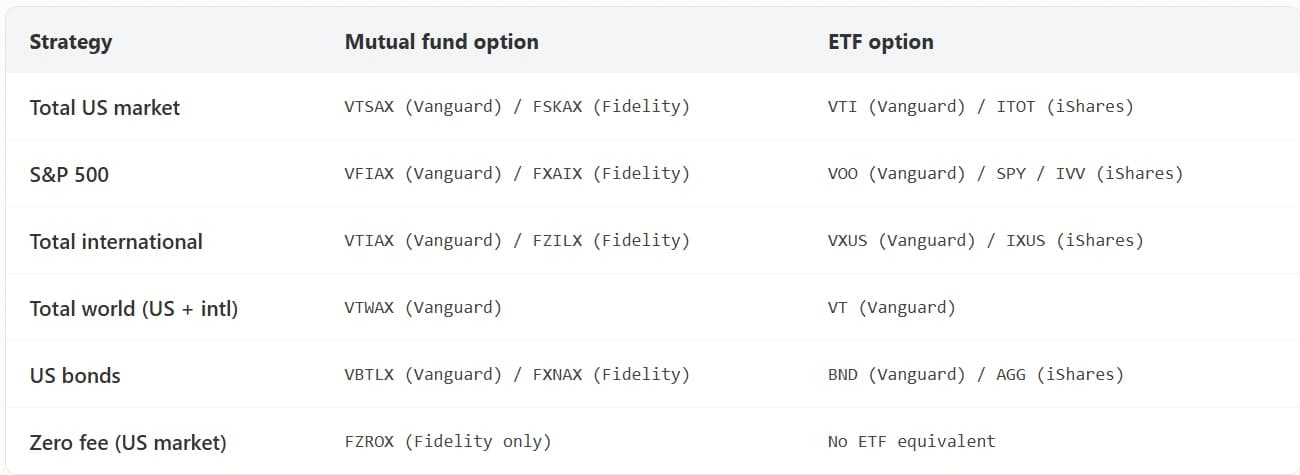
If you're trying to find the right fund for a given strategy, here are the most commonly used options across the major brokerages. Each pair tracks the same index through different structures.
Frequently Asked Questions
Can I hold both an index mutual fund and an ETF tracking the same index?
Yes, but there's usually no reason to. You'd be duplicating exposure without gaining additional diversification. If you hold VTSAX and VTI in the same account, you effectively have one position spread across two products. Pick one and consolidate.
Are ETFs or index funds better for a Roth IRA?
Inside a Roth IRA, the tax efficiency difference is irrelevant — all growth is tax-free regardless. Choose based on expense ratio and convenience. If your brokerage offers a zero-fee index mutual fund, that's a strong option. If you prefer ETFs and your brokerage supports fractional shares for automatic investing, ETFs work just as well.
Do ETFs pay dividends?
Yes. ETFs pass through dividends paid by their underlying holdings, just like mutual funds. You can choose to have dividends paid out as cash or automatically reinvested (DRIP — dividend reinvestment plan). Most brokerages support automatic dividend reinvestment for both ETFs and mutual funds.
What is an ETF's NAV and why does it differ from the market price?
NAV (Net Asset Value) is the per-share value of the fund's underlying holdings, calculated once per day after markets close. During trading hours, the ETF's market price fluctuates based on supply and demand. Authorised participants (large institutions) keep the market price very close to NAV through an arbitrage mechanism — when the price diverges meaningfully, they profit by creating or redeeming shares. For widely traded ETFs like VTI, the premium/discount to NAV is typically less than 0.1%.
Is there an equivalent to index funds outside the US?
Yes. Most developed markets have low-cost index products. In the UK, investors use ISAs to hold global index funds from providers like Vanguard UK or iShares. In Europe, UCITS ETFs are the standard structure. In Canada, the iShares and Vanguard Canada ranges offer similar products. The underlying principle — buy the whole market cheaply — is universal; the specific products and tax wrappers vary by country.
The Bottom Line
An index ETF and an index mutual fund tracking the same benchmark are nearly identical in what they give you: broad diversification, low costs, and returns that match the market. The structural differences — trading mechanics, tax efficiency, automation — are real but situational.
For most people investing in tax-advantaged accounts and wanting simple automation, an index mutual fund is slightly easier to work with. For people with taxable accounts or who want flexibility across any brokerage, ETFs are marginally more tax-efficient and universally available.
Quick decision guide:
- Roth IRA / 401(k):→ Pick whichever has the lowest expense ratio. Tax structure doesn't change the outcome.
- Taxable brokerage:→ ETFs. The in-kind redemption mechanism gives a real, compounding tax advantage.
- Automatic monthly investing:→ Index mutual fund or ETF at a brokerage with fractional share automation.
- Starting with under $1,000:→ ETF with fractional shares, or Fidelity's FZROX (zero fee, $1 minimum).
- Active trading / limit orders:→ ETFs only — mutual funds can't be traded intraday.
The most important thing isn't which structure you pick. It's that you pick one, invest consistently, and keep fees low. A lifelong habit of low-cost index investing — whether through mutual funds or ETFs — will outperform most other approaches simply by staying in the market and not paying unnecessary intermediaries.

Finance & Fintech Research Team
The Kodivio team analyzes financial tools, investment platforms, and fintech trends based on independent research and market data.
Learn more about us →