
Digital vs. Physical Scarcity
In 2026, the choice between Gold and Bitcoin is no longer ideological—it is technical. This guide compares their scarcity models, storage costs, and verification protocols.
For millennia, gold was the only asset that could not be printed into infinity by a central authority. In 2026, Bitcoin exists as a digital competitor with even stricter supply rules. To understand which asset fits your portfolio, we must look past the "crypto vs. metal" debate and analyze the technical mechanics of scarcity.
| Feature | Gold (XAU) | Bitcoin (BTC) |
|---|---|---|
| Total Supply | Infinite (Relative to Mining Cost) | 21,000,000 (Hard Cap) |
| Verification | Physical Test (Acid, Melt, Weight) | Cryptographic (Full Node) |
| Divisibility | Low (Requires Melting) | High (100M Satoshis per BTC) |
| Portability | Heavy (1kg ≈ $70k in 2026) | Weightless (12-word seed phrase) |
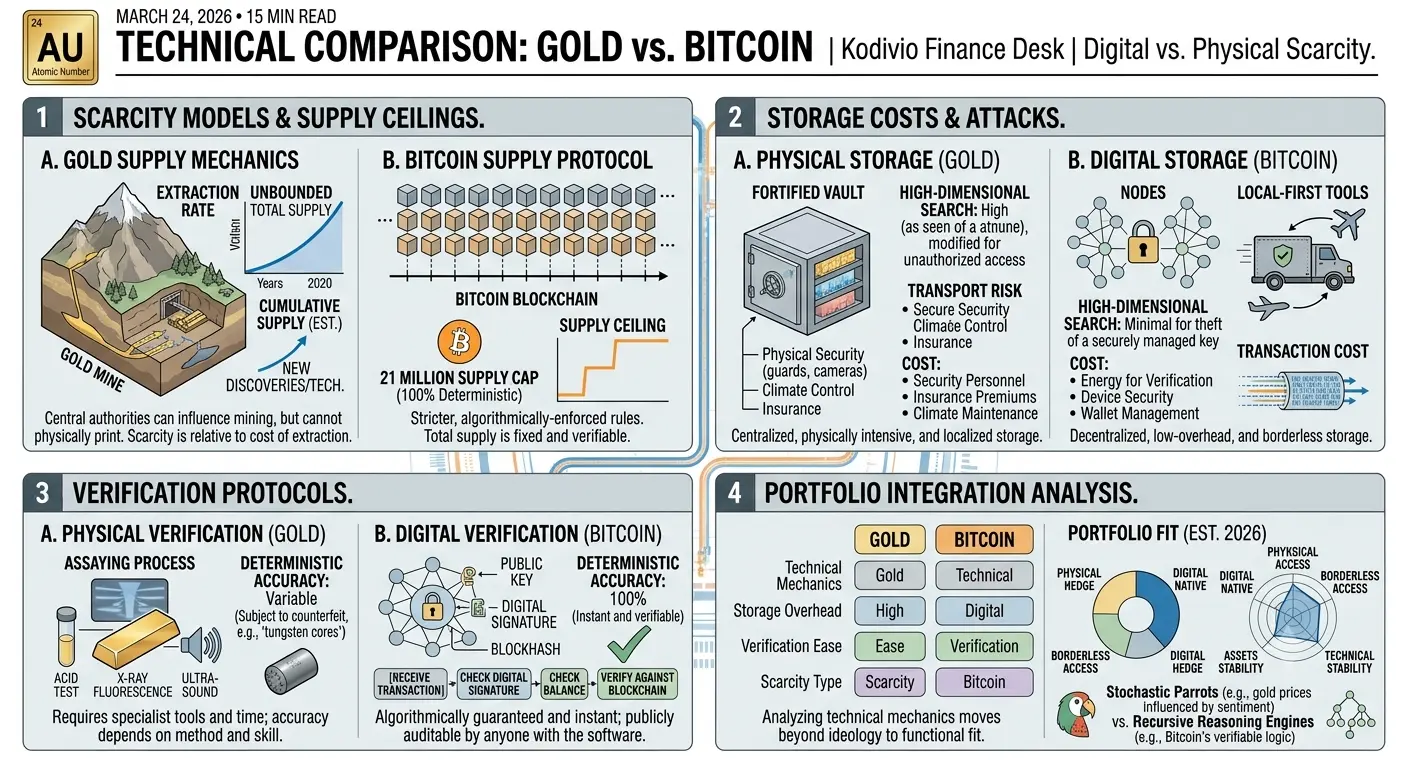
1. Scarcity: Relative vs. Absolute
Gold's scarcity is relative. If the price of gold rises to $5,000/oz, it becomes profitable to mine lower-grade deposits or even explore deep-sea mining. This increase in price leads to an increase in supply, which eventually stabilizes the price.
Bitcoin's scarcity is absolute. The network's "Difficulty Adjustment" ensures that even if 10x more energy is dedicated to mining, the issuance of new Bitcoin remains exactly as programmed. This makes Bitcoin the first asset in history where an increase in demand cannot trigger an increase in supply.
2. Verification: How do you know it's real?
The "Trust" factor is solved differently by each asset:
- Verifying Gold: To be 100% sure a gold bar is real, you need specialized equipment. "Tungsten-filled" bars are a real threat in the physical market. Most individuals trust a centralized refinery stamp (like PAMP or Heraeus).
- Verifying Bitcoin: Any user with a cheap laptop can run a "Full Node." This software independently verifies every transaction and every coin ever created. You don't trust a "stamp"; you trust your own copy of the math.
3. Storage Risks: Theft vs. Loss
Storing wealth outside the banking system comes with significant responsibility:
The risk is theft. A gold bar is a self-verifying asset; anyone who holds it, owns it. You need a physical safe, insurance, or a third-party vault service.
The risk is loss of access. Your Bitcoin is tied to a 12-word recovery phrase. If you lose that phrase, the coins are gone forever. If someone sees that phrase, they can steal your coins instantly from anywhere in the world.
4. Global Settlement Speed
If you need to send $1 million to a supplier in Singapore today:
- Gold: You must ship literal weight. It takes days, involves customs, and requires armored transport.
- Bitcoin: You broadcast a transaction. It completes in 10-60 minutes on the base layer, or instantly on the Lightning Network.
The 2026 "Barbell" Approach
Sophisticated investors are increasingly using both. Gold provides "lindy" protection against a total internet or electrical failure, while Bitcoin provides "liquidity" protection against local bank failures or currency collapses.
Conclusion: Data vs. Atoms
Gold is an asset of atoms—it is heavy, physical, and durable across five millennia. Bitcoin is an asset of data—it is light, digital, and verifiable across the entire internet. In a world moving toward digital identity and local-first sovereignty, both play a role in a modern financial architecture.
Hard Money FAQ
S2F measures scarcity by dividing existing supply (stock) by annual production (flow). Gold's S2F is ~62 (it would take 62 years of mining to double the supply). After the 2024 halving, Bitcoin's S2F exceeds 120, making it mathematically scarcer than gold. Critics note that S2F doesn't account for demand-side dynamics, but its value lies in quantifying supply scarcity independent of market sentiment — a purely supply-side metric.
Both Bitcoin Spot ETFs (approved Jan 2024) and Gold ETFs (like GLD) provide exposure without physical custody. Key differences: Bitcoin ETFs have lower expense ratios (0.20-0.25% vs. GLD's 0.40%), no storage/insurance costs, and enable instant settlement during market hours. However, ETF holders don't control private keys or physical metal — they hold a custodian's promise. For true sovereignty, self-custody (hardware wallet for BTC, allocated vault for gold) is essential.
Bitcoin mining consumes approximately 150 TWh annually (comparable to a small country). Gold mining consumes approximately 240 TWh annually when accounting for extraction, refining, and transportation. Critically, 60%+ of Bitcoin mining uses renewable energy sources (hydroelectric, solar, stranded gas) because miners are economically incentivized to find the cheapest power — which is increasingly renewable surplus energy.
Every ~4 years, the block reward is halved (most recently in April 2024: 6.25 → 3.125 BTC). This reduces the daily supply entering the market while demand remains constant or grows. Historically, each halving has preceded a bull market within 12-18 months. The mechanism is simple: when supply issuance drops 50% and demand stays flat, price must adjust upward to maintain miner profitability and economic equilibrium.
Research from Fidelity and BlackRock suggests a 1-5% Bitcoin allocation improves the Sharpe Ratio (risk-adjusted return) of a traditional 60/40 portfolio. Gold allocation of 5-15% provides inflation hedging and crisis protection. The "Barbell" approach allocates 5% to Bitcoin (high volatility, high potential) and 10% to gold (low volatility, proven stability), with the remaining 85% in equities, bonds, and cash.
CBDCs are government-issued digital currencies that are fully centralized and programmable — the exact opposite of Bitcoin's decentralized, permissionless design. CBDCs enable the government to track, freeze, or expire currency. This makes both gold and Bitcoin more attractive as "exit assets" for individuals who want financial instruments beyond state control. In regions deploying CBDCs, demand for both gold and Bitcoin has historically increased.
Build Your Sovereign Environment
Financial independence starts with privacy. Use our local-only tools to manage your digital footprint securely.
Financial Disclaimer & Sources
Strict Disclaimer: The information provided in this article is for educational and informational purposes only and does not constitute financial, investment, or legal advice. Cryptocurrency and precious metals are highly volatile asset classes. Readers should conduct their own research and consult with a licensed financial advisor before making any investment decisions. Kodivio and its authors assume no responsibility for any financial losses.
- Federal Reserve Economic Data (FRED): Historical M2 Money Supply
- World Gold Council: Annual Gold Production & Supply Trends (2025-2026)
- Bitcoin Network Core Data: Block Reward & Halving Mechanics (RFC/BIP standards)
Related guides

Finance & Fintech Research Team
The Kodivio team analyzes financial tools, investment platforms, and fintech trends based on independent research and market data.
Learn more about us →