
Stop Using Simple Passwords
Complexity rules (symbols and numbers) are outdated. In 2026, length and entropy are the only defenses against hardware-accelerated cracking.
The old advice of "add a symbol and a capital letter" has actually made our accounts less secure. Why? Because humans are predictable. We use "P@ssword1" and think we're safe. But for a modern GPU-based cracking tool, that pattern takes less than a millisecond to guess.
In 2026, security is about Entropy—the mathematical measurement of randomness. If you want to protect your financial or professional identity, you need to shift your focus from complexity to raw length.
1. The Diceware Method: Better than a Brain
The "Diceware" method is the gold standard for creating a master password you can actually remember but no computer can guess. You roll a physical die to pick random words from a list.
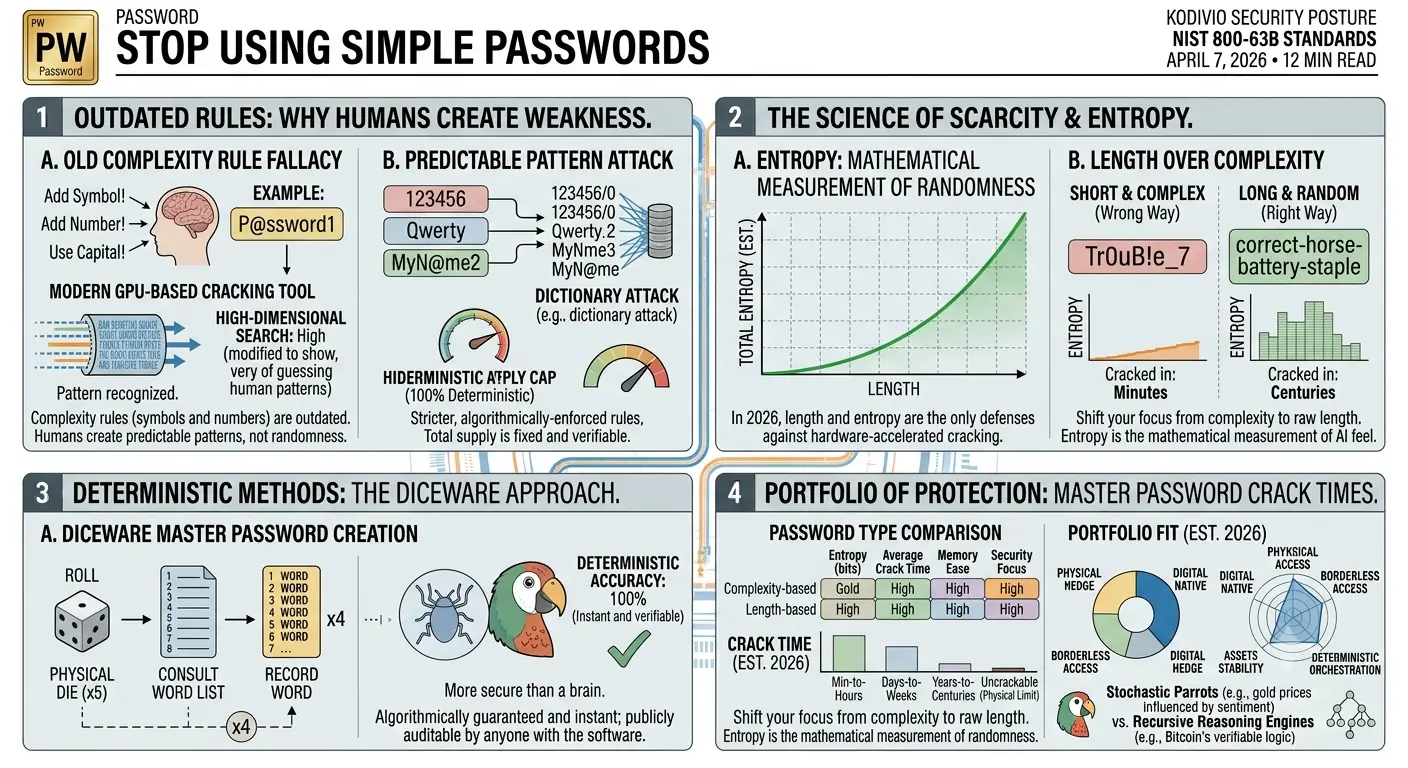
Four random, unrelated words are far more secure than one short complex string.
Wrong Way (Complex but Short)
Tr0uB!e_7Cracked in: Minutes
Right Way (Long and Random)
correct-horse-battery-stapleCracked in: Centuries
2. GPU Cracking: The RTX 4090 Threat
Password cracking isn't someone typing at your Google login screen. It's an automated tool running billions of guesses per second against a stolen database of "hashed" passwords.
A modern RTX 4090 cluster can test every possible 8-character password in a few hours. If your password is 16 characters or longer, the "search space" becomes so large that even with all the computers on earth, it would take longer than the age of the universe to brute-force. Length is your armor.
3. NIST Guidelines: Stop the 90-Day Rotation
For years, companies forced employees to change passwords every 90 days. The National Institute of Standards and Technology (NIST) now recommends against this.
Forced rotation leads to "Predictable Progression." If your password is Summer2025!, your next one is likely Autumn2025!. Criminals know this. You should only change your password if you suspect a breach.
4. Moving to Passkeys: The Phishing Killer
Passkeys (WebAuthn) are the future of security. Instead of a password, your device (phone or laptop) creates a unique digital signature for the website you are visiting.
- 1Impossible to Phish: A passkey only works on the real website. If you land on a fake "G00gle.com" site, your device will refuse to sign the login.
- 2No Data Leaks: The website never sees your private key. Even if the website's database is hacked, there are no passwords for the hacker to steal.
5. The Password Manager Risk
Password managers (like Bitwarden, 1Password, or Keychain) are essential, but they create a Single Point of Failure. If someone gets your Master Password, they have everything.
Edge Case: Master Password Loss. If you lose your master password, most "Zero-Knowledge" managers cannot reset it for you. Your data is encrypted with that password. We recommend writing your 12-word recovery seed on a physical piece of paper and storing it in a fireproof safe.
Credential Security FAQ
Shannon Entropy is calculated as E = L × log₂(N), where L is the password length and N is the size of the character pool. A 12-character password using lowercase only (N=26) has ~56 bits of entropy. Adding uppercase, digits, and symbols (N=95) raises that to ~79 bits. However, true entropy requires genuine randomness — human-chosen patterns dramatically reduce effective entropy regardless of character pool size.
Credential stuffing uses leaked username/password pairs from one breach to attempt logins on other sites. It exploits password reuse — the #1 security vulnerability for individuals. Defense: use a unique password for every account (password manager required), enable MFA everywhere, and check haveibeenpwned.com periodically to detect if your credentials appear in any known breach database.
Argon2id is the current OWASP recommendation for password hashing. It is resistant to both GPU-based brute-force (memory-hard) and side-channel attacks. Legacy algorithms like MD5 and SHA-1 should never be used — they are so fast that modern GPUs can compute billions of hashes per second. bcrypt remains acceptable but is gradually being superseded by Argon2id in new deployments.
Both can achieve equivalent entropy, but passphrases have a critical usability advantage: they are memorable without writing down. A 5-word Diceware passphrase (~64 bits) is equivalent in security to a random 10-character mixed-case password. For master passwords that you must type frequently (password manager vault, disk encryption), a 6-word passphrase (~77 bits) offers the optimal balance of security and memorability.
Hardware keys (FIDO2/U2F) are strictly superior to TOTP authenticator apps. They are phishing-proof (bound to the domain origin), can't be remotely intercepted (no shared secret transmitted), and resist SIM-swap attacks that defeat SMS-based MFA. The main tradeoff is cost ($25-$55 per key) and the need to carry a physical device. For high-value accounts (email, banking, cloud admin), hardware keys are the gold standard in 2026.
Kodivio's generator uses the browser's crypto.getRandomValues() API, which draws from the operating system's cryptographic random number generator (CSPRNG). This produces true cryptographic-grade randomness, unlike Math.random() which uses a predictable PRNG. The generated password never leaves your browser's RAM — no network request is made and no value is logged.
Trust the Math.
We built our Local-First Generator so you don't have to trust our servers. It flips bits in your browser's local RAM, ensuring your new high-entropy password is never transmitted across the wire.

Cybersecurity & Tech Research Team
The Kodivio team covers cybersecurity best practices, threat analysis, and digital safety tools based on hands-on testing and industry sources.
Learn more about us →