
The Local-First Revolution
In 2026, sending your data to a remote server for a simple transformation is no longer just slow—it is a security liability.
For a decade, the web moved toward "The Cloud." We were told that centralized servers were the only way to get power, scale, and convenience. We got used to pasting sensitive JSON, binary blobs, and even private keys into random "online tools" just to format a string or decode a token.
The cost of that convenience was our data sovereignty. Every time you hit "Submit" on a cloud-based formatter, your data enters a server you don't control, logs you don't see, and potentially a database that can be breached.
At Kodivio, we've spent two years building a **"Zero-Server" architecture**. We believe that the most secure server is the one that never sees your data.
1. The FinTech Developer Scenario
Consider Sarah, a senior engineer at a major European bank. She is debugging a production issue involving a corrupted JWT. Under **GDPR** and her bank's internal security policy, she is strictly forbidden from pasting live customer data into any third-party website.
If she use a "Standard Cloud Tool," she is technically committing a data breach. But if she uses a **Local-First Tool**, the JWT is decoded entirely within her own browser's memory. The network tab shows 0 bytes transmitted. Sarah remains compliant, the bank stays secure, and the problem is solved in seconds. **This is the human value of local-first.**
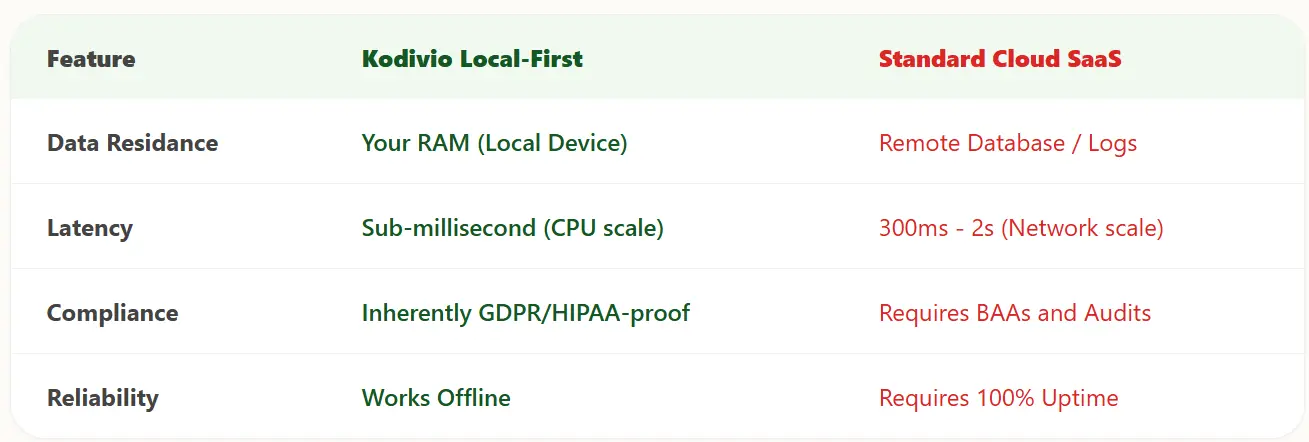
2. Local vs. Cloud: A Critical Comparison
3. How It Works: The "Zero-Server" Engine
How do we perform complex operations like massive JSON formatting or 1099 tax calculations without a server? We leverage three modern web pillars:
- Web Workers (Threading)
If you paste a 50MB JSON file, your browser would normally freeze while trying to format it. We spin up a background thread (Web Worker) that does the heavy lifting without blocking your UI. Your mouse keeps moving, but the data is being crunched at native speed.
- Web Crypto API
Passwords and keys are hashed using your computer's built-in hardware security module (HSM) accessed via the browser. We don't "implement" crypto; we use your device's own hardened security logic.
- IndexedDB (Local State)
Your preferences and tool history are stored in a local, encrypted database inside your profile. We never sync this to a cloud, meaning if you switch browsers, the data stays on the original machine.
4. The Cost of Free: The SaaS Trap
When a cloud tool is "free," you are paying with your data. Many online utility sites survive by selling their traffic data or, worse, by harvesting "useful" strings (like accidentally pasted API keys) for malicious use.
By choosing Local-First, you eliminate the middleman. You are using the web exactly as it was intended: as a powerful, distributed computer where you own the inputs and the outputs.
5. The Sync Problem: How CRDTs Let Local-First Apps Collaborate
The obvious objection to local-first design is collaboration: if my data lives in my browser, how do two people edit the same document at once? The answer many local-first tools reach for is a Conflict-Free Replicated Data Type (CRDT) — a data structure engineered so that changes made independently, on two different devices, always merge back into the same final state without a central authority arbitrating who "wins."
Instead of locking a record while one person edits it, each device keeps its own copy and applies edits locally, instantly. When devices reconnect, they exchange the small deltas of what changed. Libraries like RxDB and Yjs implement this pattern for browser apps, using techniques like vector clocks or Lamport timestamps to determine causal order without needing synchronized wall-clock time. The practical effect: your notes app keeps working on a plane, and when you land, it reconciles automatically — no "conflict.txt" file, no manual merge.
6. Case Study: A Field Inspection Team Offline
A utilities company we spoke with equips inspectors with tablets to log equipment faults across rural sites with no reliable signal. Their earlier cloud-only tool required a live connection to save a single inspection record — inspectors resorted to writing notes on paper and re-entering them back at the depot, doubling the work and introducing transcription errors.
Switching to a local-first data layer meant every inspection was written to on-device storage the instant it was captured, complete with photos and GPS coordinates. Sync happened opportunistically whenever a signal appeared — a parking lot, a coffee shop, a drive past a cell tower — with no inspector action required. The lesson generalizes well beyond utilities: any workflow that happens where connectivity is unreliable benefits from treating the network as an optimization, not a dependency.
7. The Edge Computing Shift: Moving Computation Closer to the User
For years, developers believed that every computation belonged inside a centralized data center. The rise of edge computing has fundamentally changed that assumption. Instead of forcing every request to travel thousands of kilometers to a cloud region, modern applications increasingly execute logic directly inside the browser, at network edges, or on local devices.
Local-first architecture embraces this principle by treating the user's device as the primary execution environment rather than a passive terminal. JSON parsing, image compression, token generation, encryption, data validation, and even machine-learning inference can now run entirely within modern browsers. Technologies such as WebAssembly, WebGPU, and Service Workers allow developers to achieve performance levels that would have seemed impossible only a few years ago.
The advantages extend far beyond speed. Reduced latency improves user experience, lower bandwidth requirements decrease operational costs, and eliminating unnecessary network transfers significantly reduces the attack surface available to malicious actors. Instead of assuming that the network is always available, resilient systems assume that connectivity is temporary and design around that reality.
In many ways, edge computing represents a return to the original philosophy of the internet: distributed computation performed as close to the source of information as possible.
8. WebAssembly: Bringing Native Speed to the Browser
Languages such as Rust, C++, and Go can be compiled directly into WebAssembly modules and executed safely inside modern browsers.
Applications gain access to exceptional performance while remaining isolated from the underlying operating system.
WebAssembly (WASM) has become one of the most significant innovations in modern web engineering. Traditional JavaScript engines have improved tremendously over the past decade, but some computational workloads remain extremely demanding. Video processing, cryptographic operations, scientific simulations, machine-learning inference, and large-scale data analysis all benefit enormously from the efficiency of compiled languages.
Instead of sending sensitive information to remote infrastructure, developers can now compile high-performance algorithms directly into browser-executable modules. This approach dramatically reduces latency while maintaining complete control over the data lifecycle. A password generator implemented with WebAssembly, for example, performs every operation locally while exposing no information to external services.
The combination of WebAssembly and local-first architecture signals an important transition in software engineering. The browser is no longer merely a document viewer; it is evolving into a complete application platform.
9. Threat Modeling in a Local-First World
Security professionals often describe modern cybersecurity using a simple principle: assume compromise. Every system component should be designed under the assumption that attackers will eventually discover vulnerabilities, intercept communications, or gain unauthorized access to infrastructure. Local-first architecture aligns naturally with this philosophy because it reduces the amount of information exposed to external systems in the first place.
Traditional cloud services centralize risk. A single database breach can expose millions of records simultaneously. In contrast, local-first systems distribute both data and responsibility across individual devices. An attacker must compromise many endpoints instead of attacking a single, centralized target. The economics of the attack become significantly less attractive.
Effective threat modeling also requires developers to ask difficult questions. What information leaves the browser? How long is it stored? Which third-party libraries are involved? What telemetry is collected? By designing systems around these questions from the beginning, engineering teams create products that are not only more secure but also more transparent and easier to trust.
Ultimately, privacy is not a feature that can be added later. It is an architectural decision that influences every layer of the software stack.
Conclusion: Join the Infrastructure Shift
The future of engineering is **sovereignty**. As professional developers, we have a responsibility to protect the data we touch. Moving to a "Zero-Server" model is the simplest, most effective step you can take to harden your workflow against data leaks and compliance failures.
Your RAM, Your Rules.
Explore our full suite of professional tools. No trackers, no servers, no nonsense. Just the power of your browser, unlocked.
Experience Digital Sovereignty
Stop leaking your data to the cloud. Use our professional suite of developer utilities designed for maximum privacy and zero-latency performance.

Cybersecurity & Tech Research Team
The Kodivio team covers cybersecurity best practices, threat analysis, and digital safety tools based on hands-on testing and industry sources.
Learn more about us →