
Blockchain is one of those technologies that arrived wrapped in so much financial speculation and marketing noise that its actual engineering breakthroughs got buried under price charts and Twitter arguments. Strip all of that away, and what remains is one of the most elegant solutions to a decades-old problem in computer science: how do you get a group of strangers — some of whom may be actively trying to deceive each other — to agree on a single version of the truth?
This guide ignores the price action entirely. Instead, it walks through the cryptographic primitives, the consensus algorithms, and the structural choices that give a blockchain its defining property: immutability without a trusted middleman. By the end, you'll understand not just what a blockchain is, but why every design decision it makes exists — and what the real engineering tradeoffs are.
"For the first time in history, we have a mechanism for achieving trustless consensus at a global scale — no banks, no central servers, no single point of failure. That's the engineering achievement worth understanding."
The Root: Solving the Byzantine Generals' Problem
Every distributed system eventually faces a classic dilemma formalised by computer scientists Lamport, Shostak, and Pease in 1982: the Byzantine Generals' Problem. Imagine several army generals surrounding a city. To win, they must all attack simultaneously — but they can only communicate via messengers who may be intercepted, delayed, or replaced by traitors. How do you guarantee that every loyal general acts on the same plan when some of your communication channels are compromised by adversaries?
In distributed computing, the "generals" are server nodes spread across the globe. Each holds a copy of a shared ledger. The problem isn't just network latency — some nodes may be actively malicious, broadcasting conflicting information to different parts of the network to cause a split and exploit the confusion. If node A tells Europe the correct history and tells Asia a fraudulent one, you end up with two incompatible versions of reality. The system breaks.
The standard academic answer before Bitcoin was: you can tolerate up to one-third of your nodes being traitors before the system collapses. Satoshi Nakamoto's 2008 insight was structurally different. Rather than trying to identify and exclude traitors, you make betrayal economically irrational. Any node attempting to forge history must expend enormous real-world resources — electricity, capital, specialised hardware — with a high probability of gaining absolutely nothing. The traitor's rational move becomes honest participation.
Key Insight
Byzantine fault tolerance doesn't require eliminating bad actors. It requires making bad behaviour more expensive than good behaviour. Blockchain achieves this through cryptographic proof of work or staked collateral — creating aligned economic incentives at a global, permissionless scale.
The Building Block: Cryptographic Hashing
Before you can understand a blockchain, you need to internalise what a cryptographic hash function actually does. Specifically SHA-256 — the function underpinning Bitcoin and dozens of other networks. A hash function takes an arbitrary amount of input data (a single word, a legal contract, a 4K video) and produces a fixed-length output: a 256-bit number represented as 64 hexadecimal characters.
Three properties make it cryptographically useful. Determinism: the same input always produces the same output, letting anyone verify a hash independently without communicating with its creator. One-way function: given only the output hash, it is computationally infeasible to reverse-engineer the original input — you can only go forwards. Avalanche effect: changing even a single bit of input produces a completely different, unpredictable output. There is no gradient, no correlation between similar inputs and similar outputs.
The demo below computes a real SHA-256 hash using your browser's built-in crypto.subtle API — no server involved:
Live SHA-256 demo — computed in your browser
Now consider what this means for a chain of blocks. Each block contains the hash of the previous block in its header. Modify a transaction in Block #500 — even changing a single digit in an amount — and Block #500's hash changes entirely. That new hash is no longer what Block #501 stored in its own header, invalidating Block #501. Which cascades to invalidate Block #502, and so on, all the way to the chain's current tip.
To successfully rewrite history, an attacker would need to recalculate every subsequent block and outpace the entire global network's ongoing computation simultaneously. On Bitcoin today, with roughly 600 exahashes per second of combined mining power, this is not just practically difficult — it is physically impossible with current technology.
Consensus Mechanisms: Proof of Work vs. Proof of Stake
Hashing explains why tampering is detectable. But in a decentralised network with thousands of nodes independently assembling the chain, a new question emerges: who gets to decide which new block is the valid one? If two nodes simultaneously propose conflicting valid blocks, how does the network pick one and discard the other without a central referee?
This is the job of the consensus algorithm — the protocol by which the network achieves unanimous agreement on a single canonical chain. Two models dominate in practice:
Nodes (miners) compete to solve a brute-force puzzle: find a nonce value such that when hashed with the block data, the result has a specific number of leading zeros. The difficulty adjusts every 2,016 blocks to target a 10-minute interval. The first node to find a valid nonce broadcasts its block and earns the block reward.
Validators lock cryptocurrency as collateral ('stake') proportional to their desired influence in block proposal. A pseudo-random selection process weighted by stake chooses the next block proposer. A committee of validators then attests to it. If a validator acts dishonestly, their stake is 'slashed' — partially or fully destroyed automatically by the protocol.
Neither model is universally superior. PoW's security is backed by physics — you cannot fake energy expenditure, and the hardware investment itself acts as a long-term commitment to the network. PoS security is backed by economics — you cannot fake locked capital, and the slashing mechanism creates immediate financial consequences for misbehaviour. Both have proven robust in practice across trillions of dollars of secured value.
Data Integrity at Scale: The Merkle Tree
A single Bitcoin block can contain over 2,000 transactions. A naïve approach to verification would require downloading and checking each transaction individually — impractical for a mobile wallet on a metered connection, and absurd for the full 500GB+ blockchain history. Blockchain engineers solve this with a data structure invented by cryptographer Ralph Merkle in 1979: the Merkle tree.
The construction is recursive and elegant. Every transaction in a block is hashed individually (the leaf nodes). Those hashes are paired and hashed together to produce parent hashes. The parents are paired and hashed again. This continues up the tree until a single hash remains at the apex: the Merkle Root. Only this root hash is stored in the block header — a 32-byte summary of every transaction in the block.
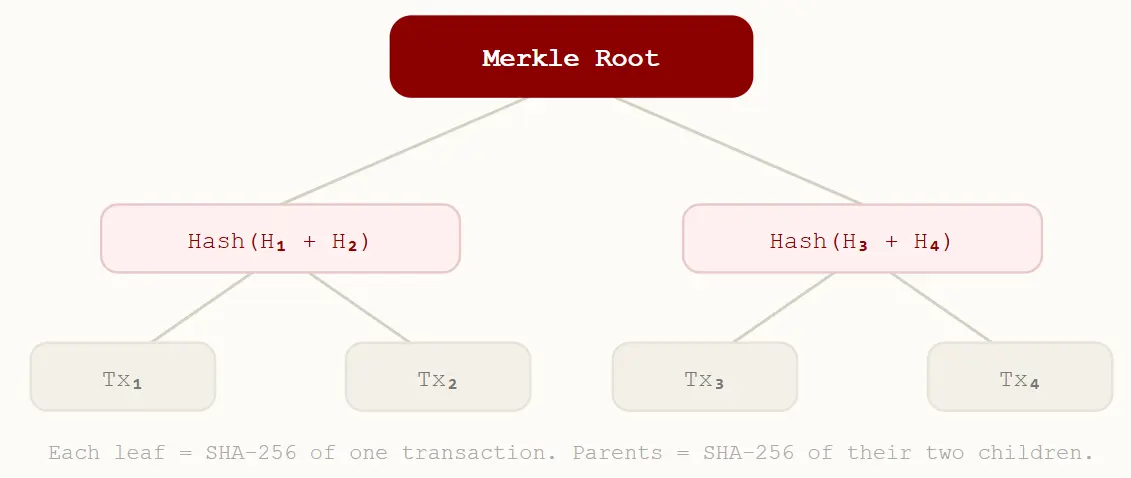
The power of this structure lies in Merkle proofs. To verify that a specific transaction exists in a block with 4,096 transactions, you need only 12 hashes — the sibling at each level along the path from your transaction to the root. That's logarithmic efficiency: O(log n) instead of O(n). A mobile SPV (Simplified Payment Verification) wallet can confirm its transaction without downloading any transaction data at all, only block headers and the relevant Merkle path.
Beyond Blockchain
Merkle trees are a foundational data structure used far beyond cryptocurrency. Git uses a variant to track every file change in a repository. IPFS uses them for content addressing, ensuring files haven't changed in transit. Certificate Transparency logs use them to detect fraudulent SSL certificates. Anywhere you need tamper-evident records with efficient partial verification, the Merkle tree is the right tool.
Smart Contracts: The Blockchain as a Computer
Bitcoin proved you could transfer value between strangers without a bank. Ethereum's foundational insight — articulated by Vitalik Buterin in 2013 — was that you could execute arbitrary computation without a server. Smart contracts are programs written in languages like Solidity or Vyper that are deployed permanently to the blockchain and executed by every node in the network simultaneously.
The critical engineering constraint is determinism. For any given input and blockchain state, every one of Ethereum's thousands of nodes must produce the exact same output — otherwise they can't reach consensus on the new state. This means smart contracts cannot access the internet, cannot generate random numbers natively, and cannot use floating-point arithmetic (which produces slightly different results on different CPU architectures). They are pure functions applied to a shared state machine: the Ethereum Virtual Machine (EVM).
This constraint unlocks a genuinely novel category of software: financial instruments, insurance policies, DAO governance, and property transfers that execute automatically and transparently when on-chain conditions are met — without any party trusting a counterparty, an escrow agent, or a legal system to enforce the outcome. A lending protocol that liquidates collateral the moment it falls below a health threshold. An NFT marketplace that splits royalties atomically. A multisig treasury that executes payments only when 3-of-5 keyholders sign.
The tradeoff is significant and should not be glossed over. Smart contracts are immutable once deployed — any bug is a permanent bug, exploitable forever, unless an upgrade proxy was built in from the start. The notorious 2016 DAO hack saw approximately $60 million drained through a re-entrancy vulnerability (a function that called back into itself before its balance was updated). The Ethereum community's controversial decision to hard-fork the chain to reverse the damage sparked a philosophical debate about immutability that continues today. The lesson remains: formal audit, conservative design, and upgrade mechanisms from day one are non-negotiable.
"Smart contracts don't trust the parties involved — they replace the need for trust entirely. The code is the contract, the network is the judge, and the outcome is mathematically enforced."
The Scaling Trilemma
Ethereum co-founder Vitalik Buterin popularised a framework that every serious blockchain architect eventually confronts: the Scalability Trilemma. It states that any blockchain system can only robustly optimise for two of three properties simultaneously: security, scalability, and decentralisation.
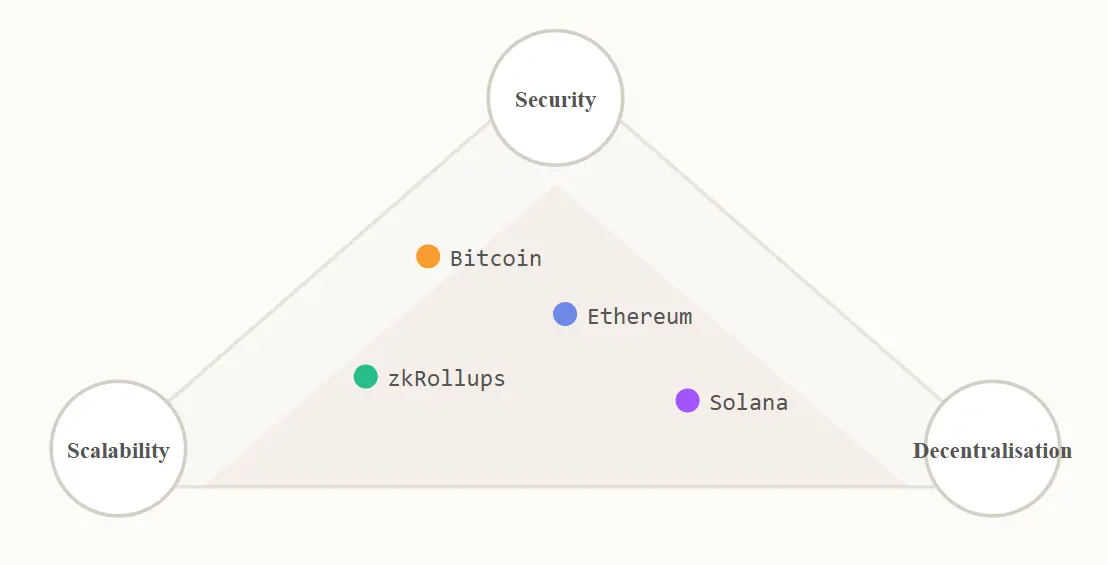
Bitcoin prioritises security and decentralisation at the expense of throughput — approximately 7 transactions per second, with 10-minute confirmation windows. Early Ethereum made similar choices. Networks like Solana sacrifice some decentralisation (relatively few validators, extremely high hardware requirements) to achieve tens of thousands of TPS. No chain has fully broken the trilemma from the base layer — but the most promising approach isn't trying to.
Instead, the current frontier is Layer 2 rollups: systems that batch thousands of transactions off-chain, execute them in a compressed environment, and post only a cryptographic proof back to the Layer 1 mainnet. ZK-rollups (zkSync, StarkNet, Scroll, Polygon zkEVM) use zero-knowledge proofs to verify correct execution in constant time — a revolutionary cryptographic primitive that allows one party to prove to another that a computation was performed correctly without revealing any of the underlying data. Optimistic rollups (Arbitrum, Optimism) assume transactions are valid and rely on a fraud-challenge window for anyone to dispute incorrect state transitions.
By 2026, these Layer 2 networks collectively process more daily transactions than Ethereum mainnet. The trilemma hasn't been solved — but it's bending.
A Brief History of the Technology
Blockchain didn't materialise from nowhere in 2008. The intellectual lineage stretches back decades, through cryptography research, distributed systems papers, and failed digital cash experiments that quietly laid every component Satoshi would need.
1991
Cryptographic timestamping
Haber and Stornetta publish a method for timestamping digital documents using a hash chain — the intellectual seed for blockchain's core immutability property.
2008
Bitcoin whitepaper
Satoshi Nakamoto publishes 'Bitcoin: A Peer-to-Peer Electronic Cash System', introducing the first practical blockchain with a working proof-of-work consensus mechanism.
2013
Ethereum proposed
19-year-old Vitalik Buterin proposes a general-purpose blockchain with a Turing-complete scripting language, laying the foundation for programmable money and smart contracts.
2015
Ethereum mainnet launches
The Ethereum network goes live, enabling developers to deploy decentralised applications for the first time. The ERC-20 token standard follows in 2017, triggering the ICO boom.
2022
The Merge
Ethereum completes its transition from Proof of Work to Proof of Stake, reducing the network's energy consumption by over 99.9% — the most complex live software migration in history.
2024–26
Layer 2 maturity
zkEVM rollups (Polygon, zkSync, Scroll) achieve near-Ethereum security with 100–1000x throughput. The scaling trilemma begins to bend for the first time.
The Infrastructure of Truth
Blockchain is, at its core, a protocol for establishing truth in the absence of trust. By shifting the burden of verification from fallible human institutions — banks, notaries, title registries, auditors — to immutable cryptographic laws that any computer on Earth can independently verify, the technology is building a new coordination layer for the internet.
The engineering problems are real and largely unsolved at scale. The scaling trilemma bends but hasn't broken. Smart contract security remains a persistent, expensive challenge. The user experience of self-custody is still far too hostile for mainstream adoption. None of these are fundamental barriers — they are engineering problems, and engineering problems have engineering solutions.
The underlying primitives — cryptographic hash chains, Merkle trees, Byzantine fault-tolerant consensus, deterministic virtual machines, zero-knowledge proofs — are now mature, well-understood components in the modern distributed systems toolkit. Whether the eventual applications are decentralised finance, sovereign digital identity, transparent supply chains, or something no one has imagined yet, understanding the engineering beneath the headlines is no longer optional for any software architect building for the next decade.
Secure Your Technical Foundation
From cryptographic security to high-performance web architecture, the Kodivio Engineering Series covers the core systems knowledge every modern developer needs — with working code examples and zero hype.
Common Questions
It's a logical puzzle where a group of generals must agree on a battle plan via messengers, but some may be traitors sending conflicting orders. In distributed computing, the 'generals' are server nodes. Blockchain solves this by making dishonesty economically irrational — the cost of cheating always exceeds any possible reward. The 2008 Bitcoin whitepaper was Satoshi's published solution to a problem computer scientists had wrestled with for decades.
SHA-256 is a one-way function that produces a unique 64-character fingerprint for any input. Change even a single character and the output changes completely — the 'avalanche effect'. Since every block stores the previous block's hash, altering any historical record would require recalculating every subsequent block faster than the entire global network can add new ones. On Bitcoin today, that's physically impossible.
A 51% attack occurs when one entity controls the majority of a network's hash rate, theoretically allowing them to reverse transactions or double-spend. On Bitcoin, achieving this would require more specialised mining hardware than every data centre on Earth combined — currently estimated to cost tens of billions of dollars with no guarantee of profit. The economic incentive simply doesn't exist at that scale.
It's a different security model, not a weaker one. Ethereum migrated to PoS in September 2022 and has since processed trillions in transaction value without a single consensus-layer failure. Rather than burning electricity, validators stake economic collateral that is automatically destroyed if they behave maliciously. The tradeoff is a slightly different threat surface around wealth concentration, but for most applications PoS is considered robustly secure.
Regular software runs on servers you have to trust. Smart contracts run simultaneously on thousands of independent nodes, and the output is only accepted if every node produces the same result. This makes them censorship-resistant and tamper-proof — but also inflexible. Bugs are permanent unless upgrade mechanisms are built in from the start. The 2016 DAO hack, where $60M was drained through a re-entrancy vulnerability, remains the canonical lesson: audit aggressively and keep contracts simple.

Finance & Fintech Research Team
The Kodivio team analyzes financial tools, investment platforms, and fintech trends based on independent research and market data.
Learn more about us →