
FIRE Movement Explained: How to Retire Early on a Normal Salary
FIRE isn't a get-rich-quick scheme, and it isn't reserved for six-figure earners. It's a framework — built on a surprisingly small amount of math — that lets ordinary people reclaim their time decades before traditional retirement age. Here's how it actually works.
This article is for informational purposes only and does not constitute financial advice. Consult a qualified financial advisor before making investment or retirement decisions.
What Is the FIRE Movement?
FIRE stands for Financial Independence, Retire Early. It's a personal finance philosophy centered on one idea: accumulate enough invested assets that your portfolio's returns can cover your living expenses indefinitely — making paid work optional rather than mandatory.
The concept isn't new. The intellectual foundation comes largely from Vicki Robin and Joe Dominguez's 1992 book Your Money or Your Life, which argued that money is really a representation of your life energy — and that spending it unconsciously means trading your time for things you don't actually value. The modern FIRE movement picked this up in the late 2010s, amplified by blogs and forums, and built a quantitative framework around it.
The goal isn't necessarily to stop working. Most FIRE adherents aren't looking to spend 40 years on a beach. They want to work on their own terms — take projects they care about, start businesses, volunteer, travel, or spend more time with family — without the constraint of needing a specific income to survive. Financial independence is the goal; early retirement is one of many possible outcomes.
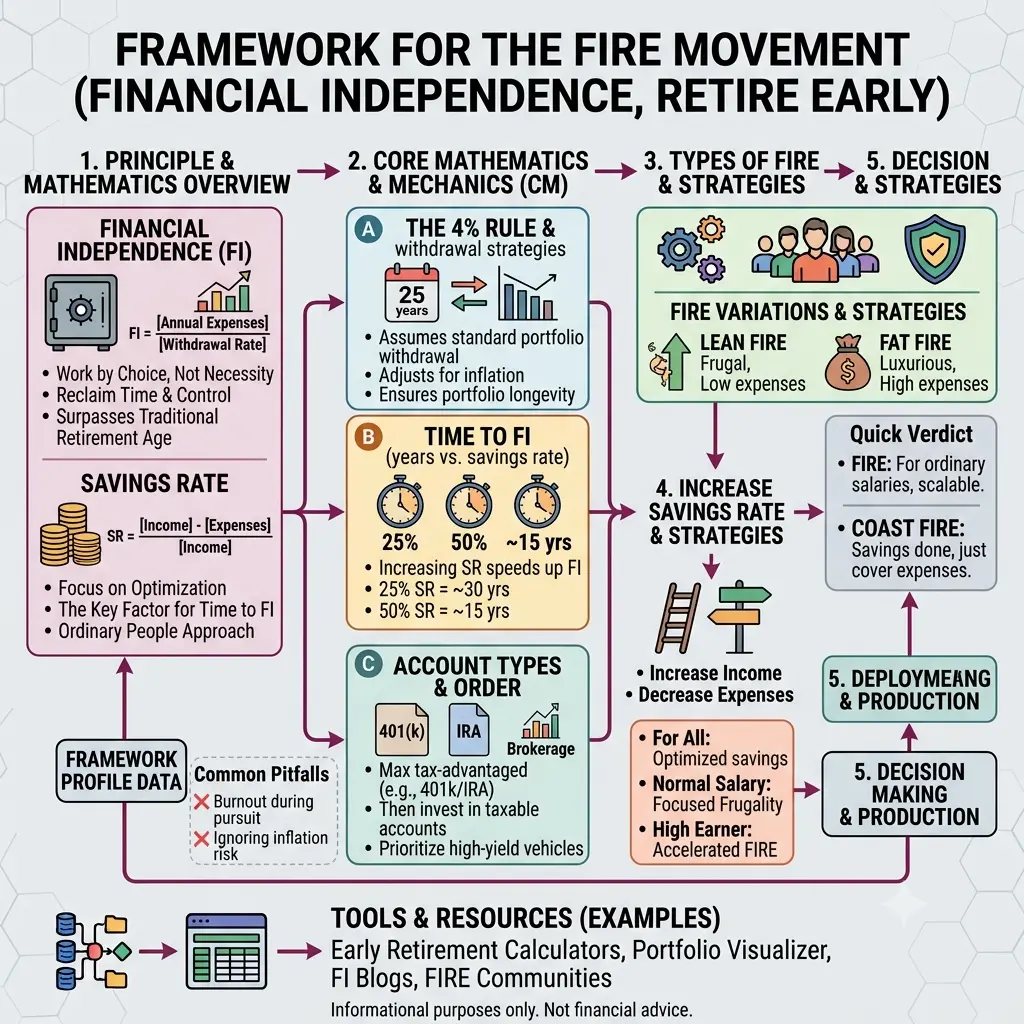
The Core Math: Savings Rate Determines Your Timeline
The single most important number in FIRE isn't your salary. It's your savings rate — the percentage of your take-home income you invest each month. Your savings rate determines how many years you need to work, and the relationship is dramatically non-linear.
Here's why: a higher savings rate does two things at once. It increases how much you invest each month, growing your portfolio faster. And it reduces your annual spending, which lowers the portfolio size you need to reach financial independence. Both effects compound together.
| Savings Rate | Years to FI* | What it means |
|---|---|---|
| 10% | ~43 years | Traditional retirement timeline |
| 20% | ~37 years | Slightly ahead of average |
| 30% | ~28 years | Start at 25, retire at 53 |
| 40% | ~22 years | Start at 25, retire at 47 |
| 50% | ~17 years | Start at 25, retire at 42 |
| 60% | ~12.5 years | Start at 25, retire at 37–38 |
| 70% | ~8.5 years | Start at 25, retire at 33–34 |
| 80% | ~5.5 years | Aggressive but achievable in LCOL areas |
*Assumes 7% real annual return (inflation-adjusted), starting from zero. Based on the framework popularized by Mr. Money Mustache.
The jump from 10% to 50% cuts your working years in half. The jump from 50% to 70% cuts them by more than half again. This is why FIRE discussions focus so heavily on savings rate — small increases have outsized effects on your timeline.
Your FIRE Number
Your FIRE number is the portfolio size at which you can stop working. The standard formula:
FIRE Number = Annual Expenses × 25
Example: $40,000/year in expenses → $1,000,000 FIRE number
The "× 25" comes from the 4% rule (discussed in the next section). It's a rule of thumb, not a guarantee — but it's been remarkably durable as a planning target.
The 4% Rule: Where It Comes From and What It Actually Means
The 4% rule originated from the Trinity Study, a 1998 analysis of historical market returns by three finance professors at Trinity University. They found that a portfolio invested in a mix of stocks and bonds had historically supported a 4% annual withdrawal rate for at least 30 years — across every 30-year period in their dataset, including periods that started right before major market crashes.
In practice: if you have $1,000,000 invested, you can withdraw $40,000 in year one, then adjust for inflation each subsequent year, and historical data suggests your portfolio survives for at least 30 years in nearly every scenario.
Important caveats for early retirees
- The Trinity Study was designed for 30-year retirements. If you retire at 35, you may need your portfolio to last 50+ years — a longer horizon that increases sequence-of-returns risk.
- Many FIRE practitioners use 3–3.5% as a more conservative withdrawal rate for very long retirements.
- The rule assumes a static withdrawal amount adjusted for inflation. Flexible spending (spending less in bad market years) dramatically improves portfolio survival rates.
- It does not account for Social Security, pensions, or any part-time income you might generate in early retirement.
The 4% rule is a starting point for planning, not a contract. Most people pursuing FIRE use it as a rough target and build in multiple layers of flexibility — geographic arbitrage, part-time work options, flexible spending — rather than treating it as a hard guarantee.
Types of FIRE: Finding the Right Flavor for Your Life
FIRE isn't one-size-fits-all. The community has developed several distinct variants based on different spending levels and lifestyle priorities.
Lean FIRE
Under $40,000/yearTarget: $1M or lessLiving frugally, often in a low cost-of-living area or with intentionally minimal expenses. Not about deprivation — lean FIRE practitioners are often genuinely content with less stuff. Requires the smallest portfolio, so you reach it fastest, but leaves the least buffer for unexpected expenses or lifestyle inflation.
Fat FIRE
$80,000–$200,000+/yearTarget: $2M–$5M+Financial independence without significant lifestyle sacrifices. Full travel budgets, private school for kids, nice restaurants. Requires a much larger portfolio, which typically means higher income, longer timeline, or both. The most common target for dual-income professional couples.
Barista FIRE
VariableTarget: Partial portfolio + part-time incomeYou've accumulated enough that a small amount of part-time income covers the gap between your portfolio's safe withdrawal and your actual expenses. Named for the idea of working a low-stress job (like a coffee shop) for the benefits and social connection, not because you need the money desperately. Very achievable on average incomes.
Coast FIRE
Normal during working yearsTarget: Smaller lump sum invested earlyYou've invested enough, early enough, that compound growth will carry your portfolio to your FIRE number by traditional retirement age without any additional contributions. Once you hit Coast FIRE, you only need to earn enough to cover current expenses — no more aggressive saving required. A powerful intermediate milestone.
Most people in practice aim somewhere between lean and fat FIRE, and many discover that Barista FIRE is the most realistic and appealing target once they do the actual math on their lifestyle. The labels matter less than understanding what tradeoffs you're actually making.
Making FIRE Work on a Normal Salary
The FIRE community has a visibility problem: the loudest voices are often software engineers or dual-income couples with combined incomes well above the median. This makes FIRE look like a high-income game. It isn't — though higher income does make it easier.
The key insight is that FIRE is fundamentally about the gap between income and spending, not about the absolute level of either. A household earning $60,000 and spending $30,000 has the same 50% savings rate — and the same FIRE timeline — as a household earning $200,000 and spending $100,000. The latter needs a much larger portfolio in absolute dollars, but the timeline is identical.
A Realistic Example on a Median Income
Illustrative Scenario
Take-home income: $55,000/year
Annual spending: $33,000
Annual savings: $22,000
Savings rate: 40%
FIRE number (×25): $825,000
Starting portfolio: $0
Years to FI (7% real return): ~22 years
Start at 25 → retire at: ~47
Assumptions: 7% inflation-adjusted annual return (consistent with long-run US stock market historical average), no salary increases modeled, contributions invested in low-cost index funds. Real outcomes will vary.
Retiring at 47 isn't as dramatic as the "retire at 30" headlines. But it's 18 years earlier than the standard 65, and it's achievable on a completely ordinary income without any side hustles or windfalls — just a consistent savings rate and low-cost index fund investing.
Add a modest salary increase over those 22 years, or a couple of years where your savings rate hits 50%, and that timeline compresses significantly.
Geographic Arbitrage
One lever that dramatically changes the math for normal-income earners: where you live. Housing costs are typically the largest single expense, and they vary by a factor of 3–5x between high-cost metros and mid-size cities or rural areas.
Choosing to live in a lower cost-of-living area — or retiring to one, or retiring abroad — reduces your FIRE number directly. A household that spends $60,000/year needs a $1.5M portfolio. The same household in a lower-cost area spending $35,000/year needs only $875,000. That's a $625,000 difference — potentially years off the timeline.
Where to Invest: Account Types and the Right Order
The investment vehicles you use matter almost as much as how much you invest. Tax-advantaged accounts compound faster than taxable accounts because you're not losing a slice to taxes each year on dividends and capital gains.
The general order of operations for FIRE-focused investing (US context):
- 401(k) / 403(b) up to employer match. This is a guaranteed 50–100% return on your contribution. Never leave it on the table.
- HSA if eligible. Triple tax advantage — contributions are pre-tax, growth is tax-free, withdrawals for medical expenses are tax-free. After age 65, withdrawals for any purpose are taxed like a traditional IRA. Often called the "stealth IRA" in FIRE circles.
- Roth IRA (or traditional IRA if high income). $7,000/year contribution limit (2024). Roth contributions — not earnings — can be withdrawn penalty-free at any time, which matters for early retirees who need to access funds before age 59½.
- Max out 401(k). $23,000 limit (2024). Traditional 401(k) reduces taxable income now; Roth 401(k) grows tax-free. Which is better depends on your expected retirement tax bracket.
- Taxable brokerage account. No contribution limits. Long-term capital gains rates are lower than income tax rates. This is often where FIRE investors put additional savings after maxing tax-advantaged accounts.
The Roth conversion ladder for early retirees
Early retirees face a challenge: most tax-advantaged retirement accounts have a 10% penalty for withdrawals before age 59½. The Roth conversion ladder is the standard FIRE workaround — you convert traditional IRA or 401(k) funds to a Roth IRA each year (paying income tax on the converted amount), then access the converted funds five years later penalty-free. Planning this ladder requires careful sequencing and is worth discussing with a tax professional.
What to Invest In
The FIRE community has largely converged on a simple answer: low-cost, broadly diversified index funds. A three-fund portfolio — total US stock market, total international stock market, and US bond market — covers essentially the entire investable universe at minimal cost.
Expense ratios matter enormously over long horizons. A 1% annual fee on a $500,000 portfolio costs $5,000/year — every year, in good markets and bad. Vanguard, Fidelity, and Schwab all offer index funds with expense ratios below 0.05%. That's $25/year on the same portfolio.
How to Actually Increase Your Savings Rate
Knowing that a 50% savings rate compresses your retirement timeline is one thing. Getting there on a median income is another. Here's where most of the use actually is.
The Big Three: Housing, Transportation, Food
These three categories typically account for 60–70% of household spending. Optimizing at the margins of everything else — cutting subscriptions, buying generic brands — produces noise. Moving the needle on housing, transportation, and food produces real change.
- Housing: The FIRE community's general target is housing costs below 25–30% of gross income, but many aggressive savers push it lower through house hacking (renting out rooms or a unit in a multifamily property), moving to a lower-cost area, or simply buying less house than the bank will lend you.
- Transportation: Cars are the second-largest expense for most households and the most reliably over-purchased. A reliable used car bought with cash, or eliminating a second car through biking and transit, can free up $300–$800/month including insurance, financing, and depreciation.
- Food: Cooking at home versus eating out regularly is a $400–$800/month difference for a family of four. Meal planning, buying in bulk, and reducing food waste capture most of this without requiring significant lifestyle sacrifice.
Income Growth Matters Too
FIRE discussion often over-indexes on frugality and under-indexes on income. A 10% raise invested rather than lifestyle-inflated directly increases your savings rate. The most powerful FIRE moves combine both: keep lifestyle costs stable as income grows, and every raise goes straight to the investment account.
Skills development, job-hopping (which statistically produces faster salary growth than staying at one employer), and building income-generating skills on the side all accelerate the timeline significantly. Income optimization is as much a FIRE lever as expense reduction.
Automate Everything
Willpower is a depleting resource. Set up automatic transfers on payday — before you see the money — to your investment accounts. What doesn't land in your checking account doesn't get spent. Most people who fail to save consistently do so because they save what's left over at month's end. There's rarely much left.
Common FIRE Pitfalls and Honest Criticisms
FIRE has real weaknesses that deserve honest treatment. Here are the most significant ones.
Sequence-of-returns risk
Retiring into a prolonged market downturn is the primary technical threat to a FIRE plan. If your portfolio drops 40% in year two of retirement and you're withdrawing at 4%, you're now withdrawing a much higher percentage of a much smaller portfolio — a hole that's hard to recover from. Mitigations include a cash buffer of 1–2 years of expenses, flexible spending during down years, and maintaining some income-generating ability.
Healthcare before Medicare eligibility
In the US, retiring before 65 means you're not eligible for Medicare. Healthcare on the individual market is expensive, and a serious illness or injury can devastate a FIRE plan. ACA marketplace plans are a common solution — subsidies are income-based, and with careful tax planning (keeping Roth conversion income low), some early retirees qualify for significant subsidies. This needs to be budgeted explicitly, not ignored.
Lifestyle creep and changing priorities
What you want at 30 may be very different from what you want at 45. Plans built around extreme frugality sometimes crumble when circumstances change — kids, aging parents, health issues, changing values. Build in some buffer and revisit your plan regularly rather than optimizing for a single future state that may not materialize.
The identity question
A significant minority of people who reach FIRE find that they're not prepared for the unstructured time, loss of professional identity, or social isolation that can come with leaving the workforce. FIRE works best when you're running toward something, not just away from a job you hate. Being clear about what you'll do with your time is as important as the financial planning.
Inflation uncertainty
Historical return projections use past data that may not reflect future conditions. Higher sustained inflation, lower equity returns, or major structural economic changes could shift the math significantly. Using conservative assumptions (5–6% real returns rather than 7%) and building in extra buffer is prudent.
Is FIRE Right for You?
FIRE isn't a religion and it's not a competition. The useful parts of the FIRE philosophy — spending intentionally, investing early and consistently, building financial resilience — are worth adopting regardless of whether you ever plan to retire before 65.
The people who thrive with FIRE tend to share a few characteristics: they derive meaning from things outside their job, they're genuinely comfortable with a relatively simple lifestyle, and they're able to tolerate uncertainty about the future without anxiety spiraling.
The people who struggle with it often discover that their expensive lifestyle is tied to things they actually value — that the nice dinners and travel and housing aren't waste but genuine sources of happiness — and that cutting them to 40% savings feels like punishment rather than freedom. That's also a valid conclusion. Optimizing for the fastest retirement isn't the same as optimizing for the best life.
A middle path that many people find works well: aim for a savings rate of 20–30%, invest in index funds, and let the math work. You won't retire at 40. But you'll reach genuine financial flexibility in your 50s with a comfortable lifestyle along the way — and you'll be in a far better position than the average American regardless.
Key Takeaways
- ✓ FIRE is about financial independence first, early retirement second — work becomes optional, not impossible.
- ✓ Your savings rate, not your income, determines your retirement timeline.
- ✓ The 4% rule (FIRE number = expenses × 25) is a durable planning heuristic, not a guarantee.
- ✓ Lean, Fat, Barista, and Coast FIRE offer different lifestyle tradeoffs — most people land somewhere in between.
- ✓ On a median income, a 40% savings rate can realistically mean retiring 15–20 years early.
- ✓ The Big Three (housing, transportation, food) are where the real savings use is.
- ✓ Tax-advantaged accounts (401k, Roth IRA, HSA) and low-cost index funds are the investment foundation.
- ✓ Plan explicitly for healthcare, sequence-of-returns risk, and what you'll actually do with your time.
This article is for informational purposes only and does not constitute financial, tax, or investment advice. Consult a qualified financial advisor for guidance specific to your situation.

Finance & Fintech Research Team
The Kodivio team analyzes financial tools, investment platforms, and fintech trends based on independent research and market data.
Learn more about us →