
FastAPI vs Flask in 2026: Which Python Backend Should You Choose?
Flask has been the dependable workhorse of Python web development for over a decade. FastAPI arrived in 2018 and changed the conversation entirely. Here's an honest look at where each framework stands in 2026 — and how to pick the right one for your project.
Quick Verdict
- ⚡ Choose FastAPI if you're building APIs, microservices, ML model endpoints, or anything where performance and automatic validation matter.
- 🧱 Choose Flask if you're building a traditional web app with server-rendered HTML, maintaining an existing Flask codebase, or working with a team that's already deep in the Flask ecosystem.
- 🤔 The real answer: for greenfield API work in 2026, FastAPI is the default choice. Flask remains excellent for what it was always designed to do.
A Brief History of Both Frameworks
Flask launched in 2010 as a microframework — intentionally small, with no database layer, no form validation, and no authentication built in. The philosophy was radical simplicity: give developers the routing and request handling they needed, then get out of the way. It was enormously successful. Flask became the most-starred Python web framework on GitHub and powered everything from startup MVPs to internal tools at major tech companies.
FastAPI arrived in late 2018. Its creator, Sebastián Ramírez, built it on top of Starlette (for async HTTP) and Pydantic (for data validation). The key insight was that Python's type hint system, introduced in Python 3.5, had matured enough to do real work: you could declare a function signature, and the framework could use it to validate inputs, serialize outputs, and generate OpenAPI documentation — all automatically.
By 2026, FastAPI has become one of the fastest-growing Python frameworks ever. It's the default choice for ML engineers serving models, teams building microservices, and most new API-first projects. Flask hasn't died — it's evolved, added async support, and retained a massive installed base — but the conversation around new projects has clearly shifted.
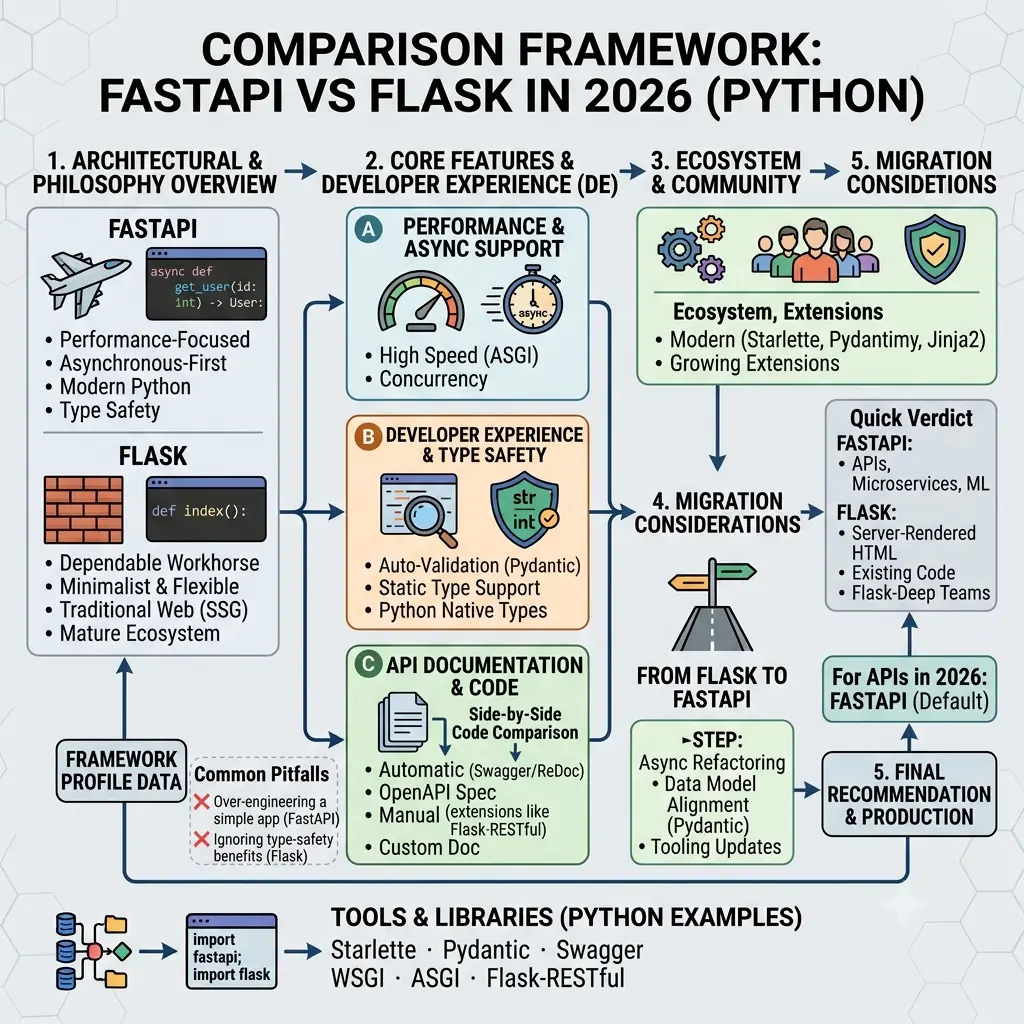
Performance and Async Support
FastAPI's performance advantage is real and comes from its foundation. Starlette, the ASGI framework underneath FastAPI, handles requests asynchronously. Multiple requests can be processed concurrently within a single worker process without blocking.
Flask's traditional WSGI model processes one request per worker at a time. To handle concurrency, you spin up multiple worker processes with Gunicorn. This works fine but is less efficient for I/O-heavy workloads — database calls, external API requests, file operations — where async shines.
| Scenario | Flask (WSGI) | FastAPI (ASGI) |
|---|---|---|
| CPU-bound tasks | Comparable | Comparable |
| High-concurrency I/O (DB, APIs) | Needs more workers | Handles natively |
| WebSockets / SSE | Requires extensions | Built-in |
| Background tasks | Celery required | Built-in BackgroundTasks |
| Memory per worker | Lower baseline | Slightly higher (Pydantic) |
A practical note: Flask 2.x added async route support, so you can write async def views in Flask. But Flask still runs on WSGI by default, which means async routes run in a thread pool rather than a true event loop. It's an improvement, not an architectural equivalence. For genuine async performance, you need an ASGI server — which means FastAPI, Starlette, or a similar framework.
When the performance gap actually matters
For most internal tools and low-traffic APIs, Flask's performance is entirely sufficient. The async advantage becomes meaningful when you're handling hundreds of concurrent I/O-bound requests — real-time dashboards, LLM streaming endpoints, high-throughput microservices. If you're serving 50 requests/day, pick the framework you know best.
Developer Experience and Type Safety
This is where FastAPI's advantage is most tangible in day-to-day work. The type hint system isn't just documentation — it does real work.
When you declare a FastAPI route parameter as int, the framework automatically rejects strings, converts numeric strings, and returns a descriptive 422 error to the caller if validation fails. When you declare a request body as a Pydantic model, you get parsing, validation, and serialization for free — no manual request.json.get() calls, no forgotten null checks.
Flask's approach is more explicit. You access request.args, request.json, and request.form directly. Validation is your responsibility. This is fine for simple endpoints but becomes genuinely tedious when you're building APIs with complex nested request bodies, query parameter coercion, and field-level error messages.
Editor Support
Because FastAPI is built around type hints, your editor knows what every variable is. Autocomplete works on request body fields. Mypy and Pyright can catch type errors before you run the app. Refactoring a field name propagates through your codebase.
Flask's untyped request object means editors can't help as much. request.json["user_id"] returns Any. You can add Flask-Pydantic or marshmallow to improve this, but it's optional plumbing that FastAPI includes by default.
Automatic API Documentation
FastAPI generates Swagger UI and ReDoc documentation automatically, derived directly from your route definitions and Pydantic models. Every endpoint, parameter, request body, and response schema is documented without you writing a single line of documentation code. The docs stay in sync with the code because they are the code.
This matters more than it might seem. In teams where frontend and backend developers work in parallel, accurate, always-current API docs save hours of back-and-forth every week. The OpenAPI spec FastAPI generates also works directly with tools like Postman, code generators, and contract testing frameworks.
Flask has no built-in equivalent. Flask-Swagger-UI, Flasgger, and Flask-RESTX fill this gap but require manual docstring annotations or separate schema definitions. Documentation drifts from reality because it's maintained separately from the code that actually runs.
Ecosystem, Extensions, and Community
Flask's extension ecosystem is one of its greatest strengths — and also a double-edged sword. There are Flask extensions for almost everything: Flask-SQLAlchemy, Flask-Login, Flask-WTF, Flask-Mail, Flask-Admin. Many of these have been battle-tested for years at significant scale.
The downside: extension quality varies enormously. Some are actively maintained; others haven't seen a commit in two years. Finding out which is which before you add a dependency to a production project takes time.
FastAPI's ecosystem is younger but growing fast. SQLAlchemy 2.0's async support works well with FastAPI. SQLModel (also from FastAPI's creator) gives you a Pydantic+SQLAlchemy hybrid that eliminates a lot of boilerplate. Authentication is handled through dependency injection rather than extensions. The pattern is different from Flask but often results in cleaner, more testable code.
| Need | Flask | FastAPI |
|---|---|---|
| ORM / Database | Flask-SQLAlchemy | SQLAlchemy 2.0 async / SQLModel |
| Authentication | Flask-Login, Flask-JWT-Extended | python-jose, fastapi-users |
| Admin panel | Flask-Admin (mature) | SQLAdmin, fastapi-admin (newer) |
| Forms / HTML rendering | Flask-WTF, Jinja2 (excellent) | Jinja2 (manual setup) |
| Rate limiting | Flask-Limiter | slowapi |
| Task queues | Celery + Flask context | Celery or built-in BackgroundTasks |
| Testing | Flask test client (simple) | httpx + pytest-asyncio |
| Migrations | Flask-Migrate (Alembic) | Alembic (direct) |
Both frameworks integrate easily with the broader Python ecosystem — Redis, Celery, S3, third-party APIs. The choice of framework rarely determines whether you can use a particular library; it determines how you wire things together.
Side-by-Side Code Comparison
The best way to feel the difference is to look at the same task written in both frameworks.
Creating a user and returning it as JSON
Flask
from flask import Flask, request, jsonify
from datetime import datetime

app = Flask(__name__)

@app.post("/users")
def create_user():
    data = request.get_json()

    # Manual validation
    if not data or "email" not in data:
        return jsonify({"error": "email required"}), 400
    if "name" not in data:
        return jsonify({"error": "name required"}), 400

    # No type guarantees on data values
    user = {
        "id": 1,
        "name": data["name"],
        "email": data["email"],
        "created_at": datetime.utcnow().isoformat(),
    }
    return jsonify(user), 201
FastAPI
from fastapi import FastAPI
from pydantic import BaseModel, EmailStr
from datetime import datetime

app = FastAPI()

class UserIn(BaseModel):
    name: str
    email: EmailStr

class UserOut(BaseModel):
    id: int
    name: str
    email: str
    created_at: datetime

@app.post("/users", response_model=UserOut)
async def create_user(user: UserIn):
    # Input already validated and typed
    return UserOut(
        id=1,
        name=user.name,
        email=user.email,
        created_at=datetime.utcnow(),
    )
The FastAPI version is shorter, but the more important difference is what you don't see: automatic 422 responses with field-level error messages if the request body is malformed; email format validation via EmailStr; response serialization that strips fields not in UserOut (useful for hiding internal fields); and a fully documented endpoint in the Swagger UI with zero additional code.
Dependency injection and shared logic
FastAPI's dependency injection system is one of its most underrated features. It replaces Flask's g object and before_request hooks with something more explicit and testable:
from fastapi import Depends, HTTPException, status
from fastapi.security import OAuth2PasswordBearer

oauth2_scheme = OAuth2PasswordBearer(tokenUrl="token")

async def get_current_user(token: str = Depends(oauth2_scheme)):
    user = verify_token(token)  # your auth logic
    if not user:
        raise HTTPException(
            status_code=status.HTTP_401_UNAUTHORIZED,
            detail="Invalid token",
        )
    return user

# Any route can declare this dependency — FastAPI wires it automatically
@app.get("/me")
async def read_me(current_user = Depends(get_current_user)):
    return current_user

@app.delete("/users/{user_id}")
async def delete_user(user_id: int, current_user = Depends(get_current_user)):
    # Only authenticated users reach this point
    ...
Testing this is clean: swap get_current_user for a mock in tests using app.dependency_overrides. No monkey-patching global state.
Which Framework Wins for Your Use Case
REST APIs and microservices
Automatic validation, serialization, and documentation make FastAPI the clear choice for API-first projects. Dependency injection handles auth and shared logic cleanly. The async foundation handles high concurrency without scaling to more workers.
ML model serving and LLM endpoints
The ML community has largely standardized on FastAPI for model serving. Streaming responses (Server-Sent Events) work natively for LLM token streaming. Background tasks handle post-inference logging. Pydantic models enforce input/output contracts between services.
Server-rendered web apps with HTML templates
Flask + Jinja2 is a mature, well-documented combination with years of community patterns, tutorials, and extensions. If you're building a traditional web app with forms, sessions, and HTML responses — not an SPA with a separate API — Flask's ergonomics are better suited to it.
Internal tools and admin dashboards
Flask-Admin is more mature and feature-rich than FastAPI's admin options. But if your team already knows FastAPI and you're comfortable building your own admin views, FastAPI's cleaner code structure pays dividends as the tool grows.
Existing Flask codebases
Don't migrate for migration's sake. A well-structured Flask app that's working in production doesn't need to be rewritten. The cost of rewriting rarely justifies the benefit unless you have specific async or documentation needs that Flask isn't meeting.
Teams new to Python web development
FastAPI's type-hint-driven approach produces habits that transfer well to larger codebases. New developers writing FastAPI get immediate feedback from validation errors and editor autocomplete. The learning curve is slightly steeper than Flask, but the patterns are more scalable.
Migrating from Flask to FastAPI
If you've decided to move an existing Flask project to FastAPI, the good news is that the concepts map cleanly. Routes, request handling, and middleware all have direct equivalents. The migration is an incremental process, not a big-bang rewrite.
Concept Mapping
| Flask | FastAPI equivalent |
|---|---|
| @app.route('/path', methods=['GET']) | @app.get('/path') |
| request.json | Body parameter (Pydantic model) |
| request.args.get('q') | Query parameter: q: str = Query(None) |
| request.headers.get('X-Token') | Header parameter: x_token: str = Header(None) |
| before_request / g | Depends() — dependency injection |
| jsonify(data) | Return dict directly — FastAPI serializes |
| abort(404) | raise HTTPException(status_code=404) |
| Blueprint | APIRouter |
| app.config | Pydantic BaseSettings + env vars |
Practical Migration Strategy
- Start with new endpoints. Add FastAPI alongside your Flask app (both can run behind nginx). New routes go in FastAPI; existing Flask routes stay until migrated.
- Define Pydantic models for your data shapes.This is the core investment — once your data contracts are modeled, migrating routes becomes mechanical.
- Convert Blueprints to APIRouters one at a time.The routing syntax is almost identical; the main work is converting request parsing to type-hinted parameters.
- Replace before_request hooks with dependencies.Auth and database session setup are the most common candidates.
- Convert synchronous DB calls to async last.SQLAlchemy 2.0 async support works well but requires some restructuring. Save this for after the route migration is done.
Final Recommendation
Both frameworks are mature, production-proven, and actively maintained. The question isn't which one is "better" — it's which one fits your project's needs and your team's skills.
For most new API projects in 2026, FastAPI is the right default. Automatic validation, great editor support, built-in async, and zero-effort documentation are genuinely meaningful quality-of-life improvements. The type-hint-first approach also produces code that scales better as teams grow and APIs evolve.
Flask remains the right choice for server-rendered web apps, teams with significant Flask expertise, and projects that rely heavily on Flask's mature extension ecosystem (particularly Flask-Admin). It's not going anywhere — Pallets actively maintains it, and its simplicity is a feature, not a limitation.
The worst outcome is spending weeks debating the choice instead of building. Pick the one that fits your constraints, write clean code, and ship.
Decision Checklist
Choose FastAPI if…
- ✓ Building a REST or GraphQL API
- ✓ Serving ML models or LLM outputs
- ✓ High concurrency or real-time features
- ✓ You want auto-generated API docs
- ✓ Greenfield project with modern Python
- ✓ Team uses type hints already
Choose Flask if…
- ✓ Building server-rendered HTML pages
- ✓ Existing Flask codebase in production
- ✓ Team knows Flask well
- ✓ Need Flask-Admin or Flask-WTF specifically
- ✓ Simple internal tool, low traffic
- ✓ Prefer explicit over convention

AI & Web Development Specialists
The Kodivio team covers AI tools, automation, and modern web development based on real-world testing and hands-on experience.
Learn more about us →