
The AI Architecture.
Deconstructing the mathematical and algorithmic layers of the modern machine intelligence revolution.
Artificial Intelligence in 2026 is no longer a science fiction trope; it is a rigorous discipline of matrix math, sequence prediction, and hardware-software orchestration.
For the average user, AI is a chat box. For the engineer, AI is a massive high-dimensional search problem. Understanding the architecture of these systems is no longer optional for technical decision-makers. Whether you are auditing a new SaaS integration or building local-first tools, you must understand the difference between Stochastic Parrots and Recursive Reasoning Engines.
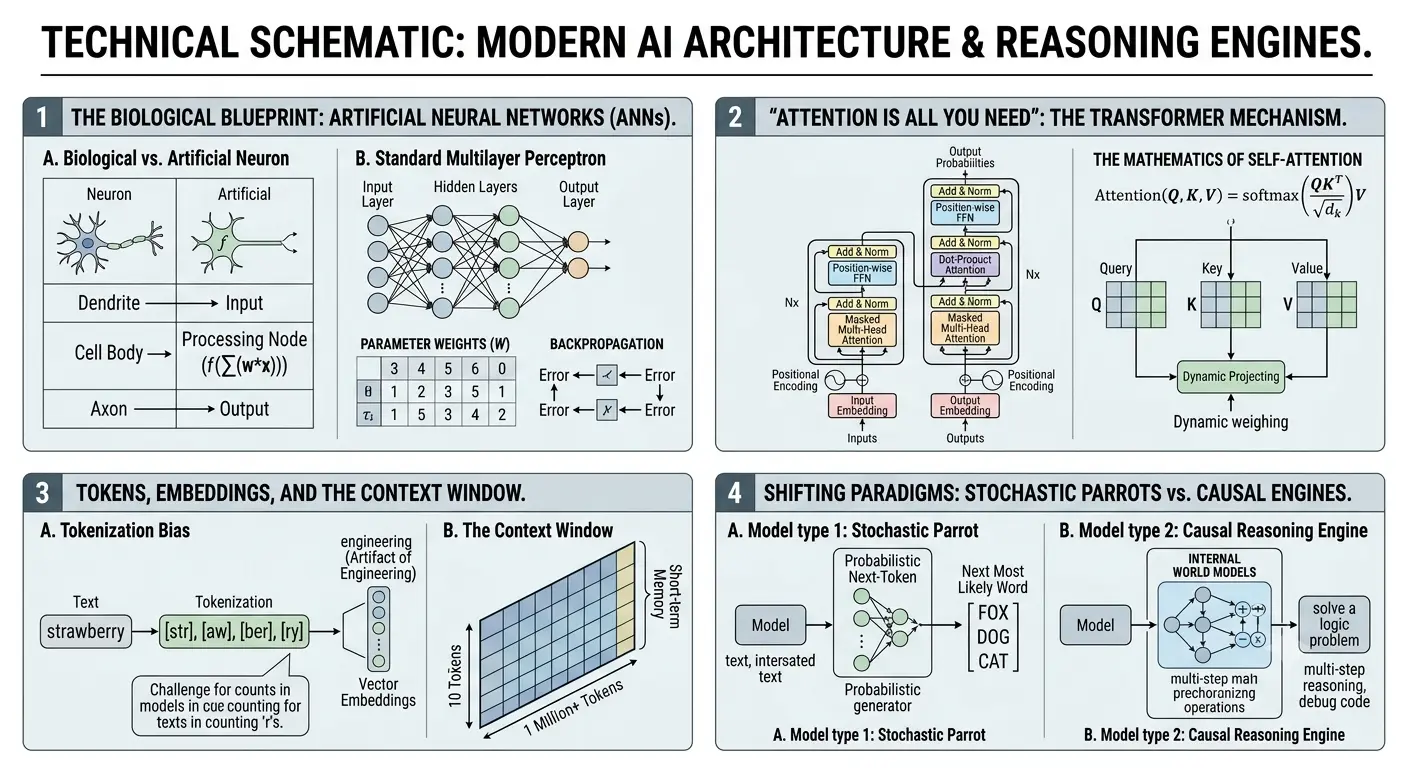
1. The Biological Blueprint: Neural Networks
Modern machine intelligence is built on Artificial Neural Networks (ANNs)—mathematical structures loosely inspired by the human brain. These networks are organized into layers: Input, Hidden, and Output. Data flows through these layers as a series of Matrix Multiplications.
When we say a model has "175 Billion Parameters," we are referring to the Weights. These are numbers that determine the strength of the connection between neurons. During training, the model uses Backpropagation to calculate its error and adjust these billions of weights until it can predict the next token in a sequence with high accuracy.
2. "Attention is All You Need": The Transformer
The total pivot in AI history occurred in 2017 with the invention of the Transformer architecture. Before Transformers, AI processed data sequentially (one word at a time). Transformers introduced Self-Attention, allowing the model to weigh the importance of every word in a paragraph relative to every other word simultaneously.
The Context Window: This is the model's "Short Term Memory." If you've ever had an AI forget the beginning of your conversation, you've hit the edge of its context window. In 2026, we are seeing windows expand to millions of tokens, allowing entire codebases or medical histories to be processed as a single unit of attention.
3. Stochastic Parrots vs. Causal Engines
A common critique of Large Language Models (LLMs) is that they are merely "Stochastic Parrots"—systems that predict the next most likely word without understanding meaning. While this was largely true for GPT-2 and early GPT-3, modern architectures have developed Emergent Abilities.
- The Reasoning Shift
Internal World Models: Deep models develop internal representations of logic and physics, allowing them to solve multi-step math problems or debug code by simulating the logic rather than just guessing the text.
- Tokenization Bias
Because AI reads "Tokens" (math chunks) rather than letters, they often struggle with simple tasks like counting the 'r's in "strawberry." This is an engineering artifact of how we represent human language to machines.
4. The Edge Revolution: Sovereign AI
The greatest threat to AI adoption is Privacy Leakage. Transmitting your sensitive business data or personal thoughts to a central server in a data center is a massive security risk. The future of AI is Local.
Thanks to Model Quantization (compressing weights from 16-bit to 4-bit) and specialized silicon (like Apple's Neural Engine or NVIDIA's Tensor Cores), 2026-era laptops can run powerful LLMs completely offline. This is Sovereign AI—intelligence that lives in your RAM, does not log your data, and requires zero network connection to function.
5. Engineering Reality Check: AI Phobia
Will AI's replace engineers? No. They will replace engineers who refuse to use AI. The true value of modern machine intelligence is Cognitive Offloading. By letting the AI handle the boilerplate (SQL generation, JSON mapping, unit conversions), the human engineer can focus on high-level architecture and Intent Engineering.
6. The GPU Arms Race: Silicon Economics of Intelligence
Behind every AI breakthrough is a hardware story. NVIDIA's H100 and B200 GPUs have become the most sought-after commodity in technology — with wait times exceeding 12 months for large orders. A single H100 GPU costs approximately $30,000, and training a frontier model requires thousands of them running in parallel for months. This has created a compute oligopoly where only a handful of companies (Google, Microsoft, Meta, OpenAI) can afford to train frontier models.
Understanding the capital requirements of the AI revolution is critical for investors. The intersection of high-performance computing and institutional finance is where the most significant value is being created in 2026.
Explore our Finance & Investing Masterclass →The counter-movement is Inference Democratization. While training requires massive GPU clusters, running (inferencing) a pre-trained model is far cheaper. Techniques like Quantization (compressing 16-bit weights to 4-bit), Speculative Decoding (using small models to draft and large models to verify), and KV-Cache Optimization have reduced inference costs by 10-50x since 2023. This is why consumer devices can now run 7B-parameter models locally — something that required a datacenter just two years ago.
AI Architecture FAQ
AI is the broadest term — any system that mimics human cognitive functions. Machine Learning (ML) is a subset of AI that learns from data without explicit programming. Deep Learning is a subset of ML that uses multi-layered neural networks with millions to trillions of parameters. In 2026, when people say "AI," they almost always mean Deep Learning — specifically Transformer-based Large Language Models.
OpenAI has not disclosed exact training data volumes, but estimates place it at 13 trillion tokens — roughly equivalent to 10 million books or the entire English Wikipedia 500 times over. The training data includes web crawls, books, academic papers, and code repositories. The quality and curation of this data is now considered more important than its volume, following research showing that data quality trumps data quantity for model performance.
Hallucination is when an AI generates plausible-sounding but factually incorrect information. It occurs because LLMs are statistical pattern matchers — they predict the most likely next word, not the most truthful one. Current mitigations include Retrieval-Augmented Generation (RAG), Constitutional AI guardrails, and Chain-of-Thought verification. Complete elimination remains an open research problem because the architecture fundamentally prioritizes fluency over factual accuracy.
Reinforcement Learning from Human Feedback (RLHF) is the technique used to align raw pre-trained models with human preferences. Human evaluators rank model outputs by helpfulness, harmlessness, and honesty. A "reward model" is trained on these rankings, which then guides the LLM to produce outputs humans prefer. Without RLHF, models would generate technically valid but often unhelpful, offensive, or dangerous content.
Yes — local inference is now practical for many use cases. Tools like Ollama, LM Studio, and llama.cpp allow you to run 7B-13B parameter models on consumer laptops with 16GB+ RAM. Apple Silicon (M2/M3/M4) Macs are particularly effective due to their unified memory architecture. For larger models (70B+), you'll need a dedicated GPU with 24GB+ VRAM (NVIDIA RTX 4090 or equivalent).
Kodivio embodies the Sovereign AI philosophy by ensuring all data processing happens locally. While our current tools use deterministic algorithms (not neural networks), the Zero-Server architecture is the same foundation that future local-first AI tools will use. Our JSON formatters, text analyzers, and data converters prove that powerful utility software doesn't require server infrastructure — a principle that extends naturally to local AI inference.
Intelligence Without Exposure.
At Kodivio, we believe your data is your sovereignty. Our tools are designed to facilitate your AI-driven workflow without ever transmitting your logic to our servers. Transform your data, local-first.

AI & Web Development Specialists
The Kodivio team covers AI tools, automation, and modern web development based on real-world testing and hands-on experience.
Learn more about us →