
Why Most People Stay Poor
Even With a High Income
Earning six figures used to mean financial security. Not anymore. We break down the behavioral traps, structural economic shifts, and quiet math errors that keep high earners perpetually broke — and show you exactly how to escape them.
Inside This Guide
- 01The Illusion of High Income
- 02Lifestyle Creep
- 03Debt Traps
- 04Taxes
- 05Assets vs Liabilities
- 06Social Pressure Tax
- 07Actionable Steps
"Society teaches you how to earn money. Almost nothing in our education system teaches you how to keep it. The difference between the wealthy and the highly-paid poor isn't the size of the paycheck — it's where the capital goes next."
1. The Illusion of High Income
There is a stubborn myth baked into modern ambition: if I could just earn more, everything would fall into place. Yet a growing demographic called HENRYs — High Earners, Not Rich Yet — earns $150,000 to $400,000 a year while quietly dreading their bank account balance.
The explanation isn't laziness or stupidity. It's that income is only half of the wealth equation. Wealth is the gap between what flows in and what flows out — and more importantly, how you deploy that gap. When spending scales with income, you're not building wealth; you're operating a bigger treadmill at a faster speed.
Think of it this way: two people each earn $200,000 a year. Person A spends $190,000 and invests $10,000. Person B earns $80,000, spends $55,000, and invests $25,000. Fifteen years from now, Person B — the "lower earner" — will almost certainly have a higher net worth. The lesson is uncomfortable but essential: your income is not your wealth. Your savings rate is.
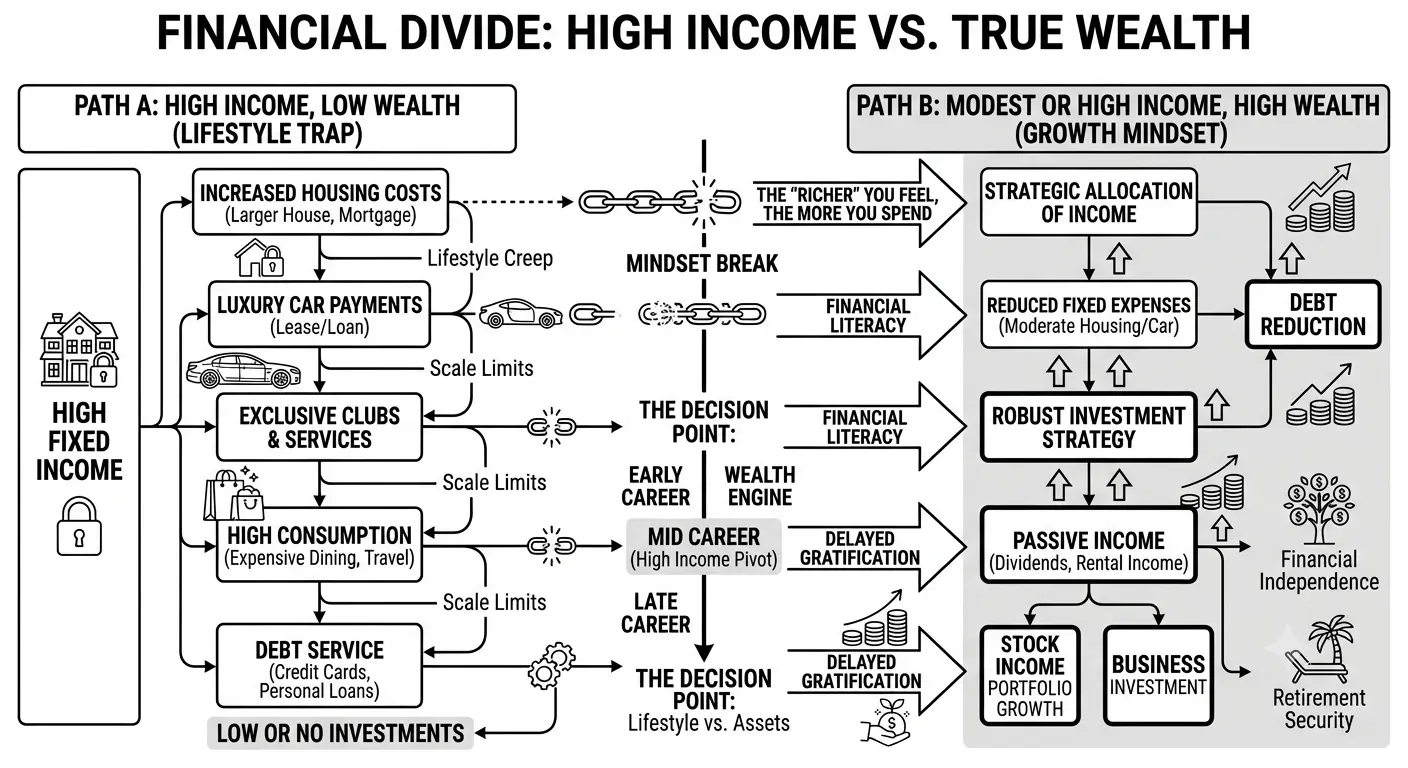
2. Lifestyle Creep: The Silent Wealth Killer
Lifestyle creep doesn't arrive with a warning label. It doesn't feel like a mistake in the moment — it feels like progress. You got the promotion, so you upgrade the apartment. The new title carries expectations, so a nicer car feels justified. You're working long hours, so ordering dinner three nights a week is practically a medical necessity.
The pattern is always the same. Each individual decision feels rational. Collectively, they guarantee that every raise you ever receive will be fully absorbed by a higher cost of living before it can compound.
The mechanism is largely psychological. When your peer group consists of other high earners, your reference point for "normal" spending recalibrates upward constantly. A $300 dinner used to feel extravagant. Now it's just Tuesday. This isn't a character flaw — it's how social comparison works. But recognizing the mechanism lets you design systems that protect against it.
The practical defense: When you receive a raise, implement the 70/20/10 split before the money hits your spending account. Route 20% automatically to investments and 10% to an emergency fund. Let yourself spend the 70%. You still feel the promotion — but you capture the majority of the capital where it can actually work for you. After a year, you won't miss the missing 30%; you'll have adapted to the new baseline. That's Parkinson's Law working in your favor.
3. Debt Traps Disguised as Good Credit
Here's something financial institutions will never say out loud: a high credit score is not a measure of financial health. It's a measure of how profitably you use debt products. A 780 FICO score means lenders trust you to keep paying them — not that you're wealthy.
High earners are uniquely attractive to lenders precisely because they have the cash flow to service massive debt loads. The modern financing apparatus is extraordinarily good at separating you from your future wealth one monthly payment at a time.
Dealerships and banks almost never sell you the total cost of something — they sell you a monthly payment. A $72,000 car feels impossible. But "$1,100 a month"? That sounds manageable to someone earning $18,000 a month take-home. The reframe is deliberate. It shifts your attention from net worth destruction to cash flow management. You stop asking "can I afford this asset?" and start asking "can I cover this payment?" Those are completely different questions — and only one of them leads to wealth.
The truly insidious trap is consumption debt: financing things that depreciate while you're paying for them. The $72,000 car doesn't just cost $72,000. It costs the compounded return on $72,000 over 15 years — which, at a modest 8% annual return, is roughly $229,000. That's the real price of the vehicle: not the sticker, not the interest, but the opportunity cost of the capital that was allocated to a depreciating asset instead of a growing one.
The rule worth memorizing: debt used to acquire income-producing assets can build wealth; debt used to finance consumption destroys it. Borrowing to buy a rental property with positive cash flow is qualitatively different from borrowing to lease a luxury SUV. Both involve monthly payments. Only one of them works for you.
4. Taxes: Your Largest Overlooked Expense
Ask most high earners what their single biggest expense is, and they'll say housing. They're wrong. For a W-2 employee earning $250,000 in a high-tax state like California or New York, federal income tax, state income tax, and payroll taxes can easily consume 38–42% of gross income. Nothing else comes close.
The deeper problem isn't just the amount — it's the asymmetry. Business owners and investors have access to a toolbox of legitimate deductions: depreciation, home office deductions, business expenses, carried interest, 1031 exchanges, and preferential long-term capital gains rates. The high-earning salaried professional pays ordinary income rates on nearly every dollar, with almost none of those tools available.
This isn't an argument to avoid working hard for a salary. It's an argument to think deliberately about tax efficiency, because the difference between a passive approach and an active one can amount to six figures over a career. Some concrete moves:
401(k)
Reduce taxable income immediately
HSA
Triple tax advantage
Roth Backdoor
Tax-free retirement growth
Real Estate
Depreciation benefits
5. The Asset vs. Liability Misunderstanding
The most costly financial mistake the high-earning middle class makes has nothing to do with budgeting apps or investment platforms. It's a definitional error: they consistently misidentify liabilities as assets.
Traditional accounting defines an asset as anything with positive book value — your car, your house, your watch. But from a wealth-building perspective, the only meaningful definition is this: an asset is something that puts money in your pocket. A liability is something that takes money out.
Mistaken Assets
House, luxury car, luxury goods, liabilities in disguise.
True Assets
Index funds, businesses, rental income, IP.
The critical insight is not that you should live in a cardboard box and never own anything nice. It's that you should sequence purchases correctly. Build income-producing assets first. Let the dividends, rents, and returns fund the luxuries. When your investment portfolio pays for your car instead of your paycheck, you've made the transition from high-earner to actually wealthy.
6. The Social Pressure Tax Nobody Talks About
There's a silent expense that doesn't appear on any budget template: the cost of maintaining the appearance of success. Call it the social pressure tax — the money spent not because you need something, but because your social environment demands you signal that you can afford it.
It shows up in the neighborhood you choose (because "that's where the people in my position live"), the vacations you take (because your colleagues are posting from Tuscany), the schools you send your children to, the events you attend, the gifts you give, the clubs you join. None of these purchases are forced on you. But the invisible social contract around high-income professional life makes them feel nearly mandatory.
If a high earner spends $3,000 per month on social signaling — the slightly nicer car, the dinners out with the right crowd, the wardrobe for the right occasions — that's $36,000 a year. Invested instead at 9% annual returns, that becomes roughly $1.7 million over 30 years. Not from massive raises. Not from hot stock tips. Just from redirecting the social pressure budget into a brokerage account.
The antidote isn't frugality or social isolation. It's developing a clear personal definition of what "enough" looks like for you — anchored to your own values, not your peer group's consumption patterns. That clarity is harder to build than any investment strategy, but it's ultimately what separates the people who look wealthy from those who actually are.
7. Actionable Steps to Break the Cycle
The solution isn't a side hustle, a new credit card with better cashback, or a higher salary. Those are inputs into a broken system. What's required are structural changes — rewriting the default rules so that wealth-building happens automatically, before you have a chance to spend the money.
Pay Yourself First
Auto-invest 20–25% before spending.
Track Expenses
Audit 60 days of spending.
Cap Housing
Max 25% of income.
Buy Assets First
Invest before lifestyle upgrades.
Your Income Is a Tool. Not a Destination.
The goal was never to earn a large paycheck. The goal is to use the capital generated from your labor to buy assets that eventually make the paycheck optional. Start by understanding where your money goes and creating a realistic savings plan.
Related guides

Finance & Fintech Research Team
The Kodivio team analyzes financial tools, investment platforms, and fintech trends based on independent research and market data.
Learn more about us →Frequently Asked Questions
Join Our Engineering Newsletter
Get high-signal insights on DevOps, AI architecture, and secure web development delivered straight to your inbox. No spam, just technical deep dives.
Continue Learning
M. Leachouri
Founder & Chief Architect"We built Kodivio because professional tools shouldn't come at the cost of your privacy. Our mission is to provide enterprise-grade utilities that process data exclusively in your browser."
M. Leachouri is an Expert Web Developer, Data Scientist Engineer, and Systems Architect with a deep specialization in DevOps and Cybersecurity. With over a decade of experience building scalable distributed systems and Zero-Trust architectures, he engineered Kodivio to bridge the gap between high-performance computing and absolute user sovereignty.