
Why Spring Boot 3
Breaks Things
at Scale.
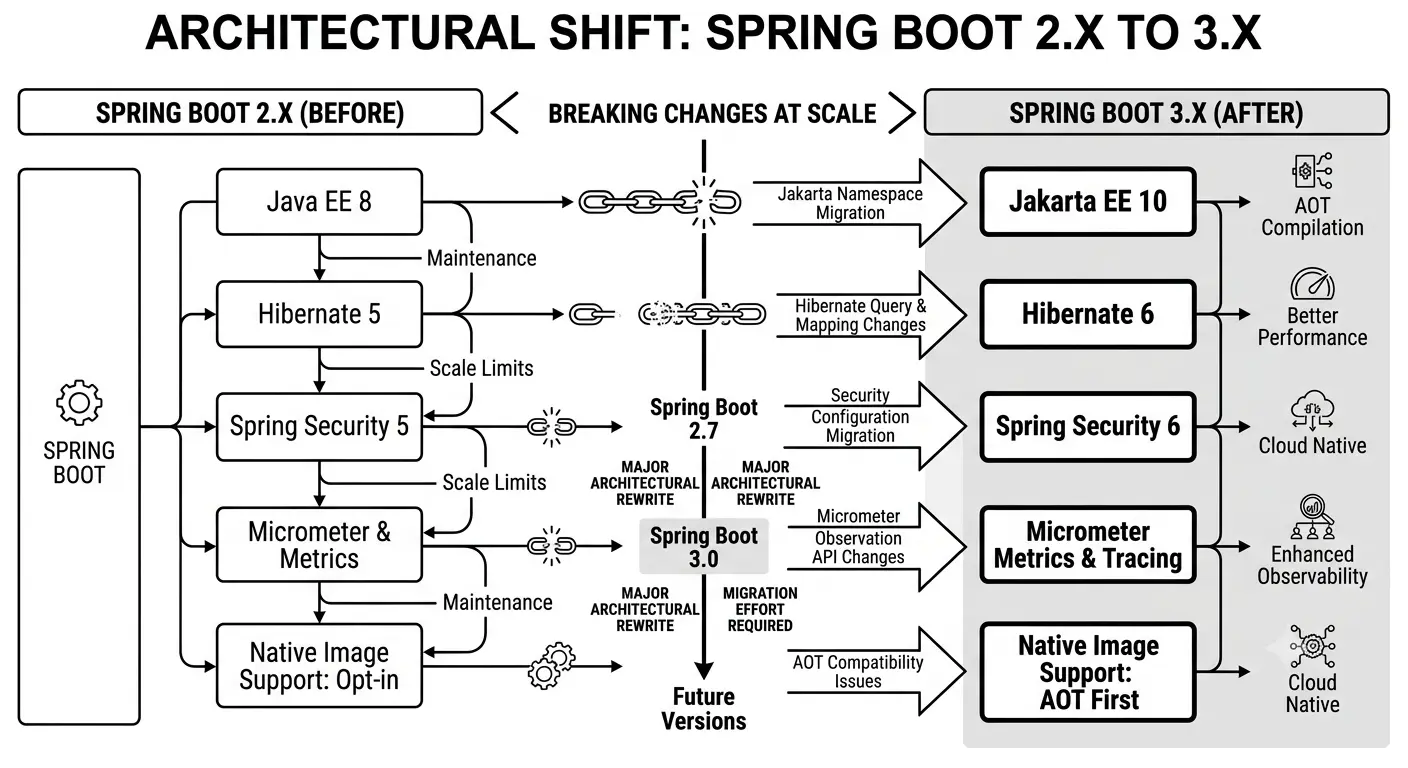
The jump from Spring Boot 2.x to 3.x is not a minor version bump. It represents the most significant architectural shift in the Spring ecosystem in a decade — driven by the migration from Java EE to Jakarta EE 10, the adoption of Hibernate ORM 6, and a complete redesign of the Spring Security filter chain.
Teams that treat this as a routine dependency upgrade discover the consequences in production: silent CSRF failures, LazyInitializationException cascades that never surfaced in development, and N+1 query storms that only appear under real traffic patterns.
This handbook exists because documentation explains the what but rarely the why. Every protocol here is rooted in production incidents, root-cause analysis, and the hard-won understanding that runtime failures follow predictable patterns — once you know what to look for.
Root Cause Distribution
Production incidentsOpen session anti-patterns, lazy loading outside transactions
Copy-pasted Boot 2.x config that silently fails in Boot 3
ThreadLocal leaks, synchronized blocks on virtual threads
N+1 queries, missing indexes, untuned HQL
CSRF/CORS errors, broken OAuth2 flows, exposed actuators
Error Protocols[8 available]
Virtual Thread Pinning in Spring Boot 3.2+
Virtual threads (Project Loom) are designed to be lightweight and massively scalable, supporting millions of concurrent tasks on a handful of OS threads. However, 'pinning' occurs when a virtual thread becomes stuck to its carrier (platform) thread — preventing the JVM scheduler from mounting other virtual threads onto it. This commonly happens inside synchronized blocks that perform blocking I/O, or when invoking native methods. The result is silent performance degradation: no exception thrown, just thread exhaustion.
LazyInitializationException Masterclass
LazyInitializationException is arguably the most misunderstood exception in the Spring/JPA ecosystem. It fires when your code accesses a Hibernate proxy (a lazily-loaded association) after the underlying Persistence Context has closed. This typically surfaces in the Controller or serialization layer, long after the @Transactional service method has committed. Left unchecked it causes intermittent failures that are notoriously hard to reproduce in development but brutal in production.
The N+1 Query Silent Killer
The N+1 query problem is a performance anti-pattern where an application executes N additional database queries to load child data it could have retrieved with the initial query. It produces no exceptions and works perfectly in development with small datasets — then silently destroys performance in production as data grows. A list of 500 orders loading their line items one-by-one becomes 501 database round-trips instead of 1.
CORS Security Deep Dive
Cross-Origin Resource Sharing (CORS) errors are among the most frustrating to diagnose because they masquerade as server authentication failures. In Spring Boot 3 / Spring Security 6, CORS must be configured at the Security Filter Chain level — not just via @CrossOrigin or WebMvcConfigurer. If Spring Security intercepts the OPTIONS preflight request before your application code runs, the browser reports a CORS violation regardless of your MVC configuration.
@Transactional Self-Invocation Trap
Spring's @Transactional is powered by AOP proxies: when you inject a @Service, you actually receive a CGLIB-generated subclass that wraps your bean. Every external method call goes through this proxy, which intercepts @Transactional methods and wraps them in a transaction. But when you call a @Transactional method from another method in the same class using 'this', you bypass the proxy entirely. The result is silent: no exception, no warning — just your changes not being committed to the database.
BeanDefinitionOverrideException in Boot 3
In Spring Boot 2.x, defining two beans with the same name caused the second to silently replace the first — a behavior that could hide serious misconfiguration. Spring Boot 3 disables this by default, converting silent overrides into a hard startup failure: BeanDefinitionOverrideException. This is a deliberate safety improvement that surfaces hidden bean conflicts during migration or when library auto-configurations clash with application beans.
Java Records & JPA: The Compatibility Guide
Java Records are a compelling choice for data-carrying types: concise, immutable, and expressive. But they are fundamentally incompatible with JPA's @Entity requirement. Hibernate needs to subclass your entity to create lazy-loading proxies, and it needs a no-args constructor to instantiate entities via reflection. Records are final classes with no no-args constructor — both requirements are violated. The good news: Records excel as DTOs and projections in Hibernate 6, where they are directly supported.
GraalVM Native Image Reflection Guide
GraalVM Native Image compiles your Spring Boot application into a standalone native binary. Startup drops from seconds to milliseconds; memory usage falls by 60-80%. The catch: Native Image performs a 'closed-world analysis' — it must know every class, method, and field your application will use at compile time. Java reflection operates at runtime, making it invisible to the compiler. Any reflective access to an unregistered class results in a hard crash in the native binary.
The 4 Errors That Kill Production
Expanded analysis with root causes, wrong patterns, production-safe fixes, and expert tips. Click any error to expand the full diagnostic.
The 6-Step
Diagnostic
Protocol.
Every engineer develops a debugging instinct over time. These six steps encode that instinct into a repeatable process you can apply to any Spring Boot runtime failure — regardless of how obscure the error message appears.
→ 90% of Spring Boot runtime failures are traceable to fewer than 15 root causes. Pattern recognition — not brute-force googling — is the skill that separates senior engineers from everyone else.
Java exceptions wrap root causes. Always scroll past the first line. The actual failure is usually 3–5 caused-by entries deep. In Spring, look for the InvocationTargetException → UndeclaredThrowableException → your actual cause.
Determine if the error originates in the persistence layer (Hibernate/JPA), security filter chain, AOP proxy, or application code. Stack frames tell you which Spring subsystem is involved.
Add logging.level.org.springframework.security=DEBUG or logging.level.org.hibernate.SQL=DEBUG to application-local.properties. Never commit DEBUG-level Hibernate SQL logging to production.
Write a failing @SpringBootTest or @DataJpaTest that isolates the problem. If you can reproduce it in a test, you can fix it safely and guard against regression.
Use the Trace Analyzer above or scan the Error Protocols index. 90% of Spring Boot runtime exceptions map to a finite set of known failure signatures with documented resolutions.
Never patch production without a passing test suite. Use @Transactional(propagation = REQUIRES_NEW) carefully — it commits immediately and can leave partial state on error.
Spring Boot 2.x → 3.x
Migration Checklist
A phased checklist for teams upgrading existing applications. Work through each phase sequentially — skipping ahead causes hard-to-debug cross-cutting failures.
Dependencies & Build
- Upgrade to Spring Boot 3.x (requires Java 17 minimum, Java 21 recommended)
- Replace javax.* imports with jakarta.* across all source files
- Update Hibernate ORM to 6.x — review @Type and custom UserType usage
- Replace deprecated spring-security-oauth2 with spring-security-oauth2-authorization-server
- Audit third-party dependencies for Jakarta EE 10 compatibility
Security Layer
- Remove all WebSecurityConfigurerAdapter subclasses — use SecurityFilterChain beans
- Replace antMatchers() with requestMatchers() in HttpSecurity DSL
- Migrate to Spring Authorization Server 1.x if using OAuth2
- Review CSRF configuration — defaults changed significantly in Security 6
- Update method security: @EnableGlobalMethodSecurity → @EnableMethodSecurity
Data & Persistence
- Audit all @OneToMany and @ManyToMany for N+1 risks with Hibernate 6
- Replace spring.jpa.open-in-view (now false by default) with proper fetch strategies
- Update JPQL queries — Hibernate 6 stricter about implicit joins
- Review @Column(columnDefinition) — H2 dialect changed for tests
- Migrate native queries using PostgreSQL-specific types if needed
Observability & Actuator
- Replace old Actuator endpoints — management.endpoints.web.exposure.include now required
- Update Micrometer dependencies for Prometheus/Grafana integration
- Configure new structured logging format (Spring Boot 3.4+)
- Enable virtual thread support: spring.threads.virtual.enabled=true
- Test GraalVM native image compilation if targeting serverless
Choosing the Right Fix Strategy
Not every Spring Boot problem requires the same tool. This matrix maps common failure categories to the most appropriate resolution strategy — and the tradeoffs of each approach.
Association Fetch Issues
LazyInitializationException, MultipleBagFetchException
Open Session in View, EAGER on @ManyToMany
JOIN FETCH is fastest but loads all data. BatchSize reduces queries without cartesian products.
High-Throughput Endpoints
Thread starvation, slow P99 latency, executor saturation
synchronized on virtual threads, ThreadLocal across requests
Virtual threads require no code changes but synchronized blocks cause carrier pinning.
Auth & Access Control
403 Forbidden on valid requests, CSRF token mismatch, CORS preflight failures
csrf().disable(), WebSecurityConfigurerAdapter
Stateless JWT eliminates CSRF concerns but requires token storage discipline on the client.
Query Performance
Slow endpoints under load, high DB connection pool usage, timeout errors
Loading full entities for read-only endpoints, count(*) without indexes
DTO projections are the fastest but lose dirty-checking. Measure before optimizing.
AOP Proxy Issues
Self-invocation bypass, @Transactional not applying, @Cacheable miss
this.method() calls expecting AOP interception
AspectJ weaving is the most complete solution but adds build complexity.
Context Startup Failures
NoSuchBeanDefinitionException, circular dependency, BeanCreationException
@Autowired on fields (hides circular deps), @Primary overuse
@Lazy breaks the eager-validation guarantee of Spring context startup.
The Platform
Has Changed.
Your Patterns Must Too.
Java 21 is not just another LTS release. Virtual Threads (Project Loom), Structured Concurrency, Record Patterns, and Sequenced Collections represent a generational shift in how performant Java applications are written.
Million-scale concurrency without reactive programming
Treat concurrent tasks as a single unit of work
Deconstruct records in pattern matching expressions
Type-safe string interpolation (replaces String.format)
Defined encounter order for all Collection types