
The Physics of Finance.
Why interest rates are the "gravity" of the economic universe, dictating the flow of billions in capital across time.
Interest rates are not just numbers set by a bank; they are the fundamental cost of time.
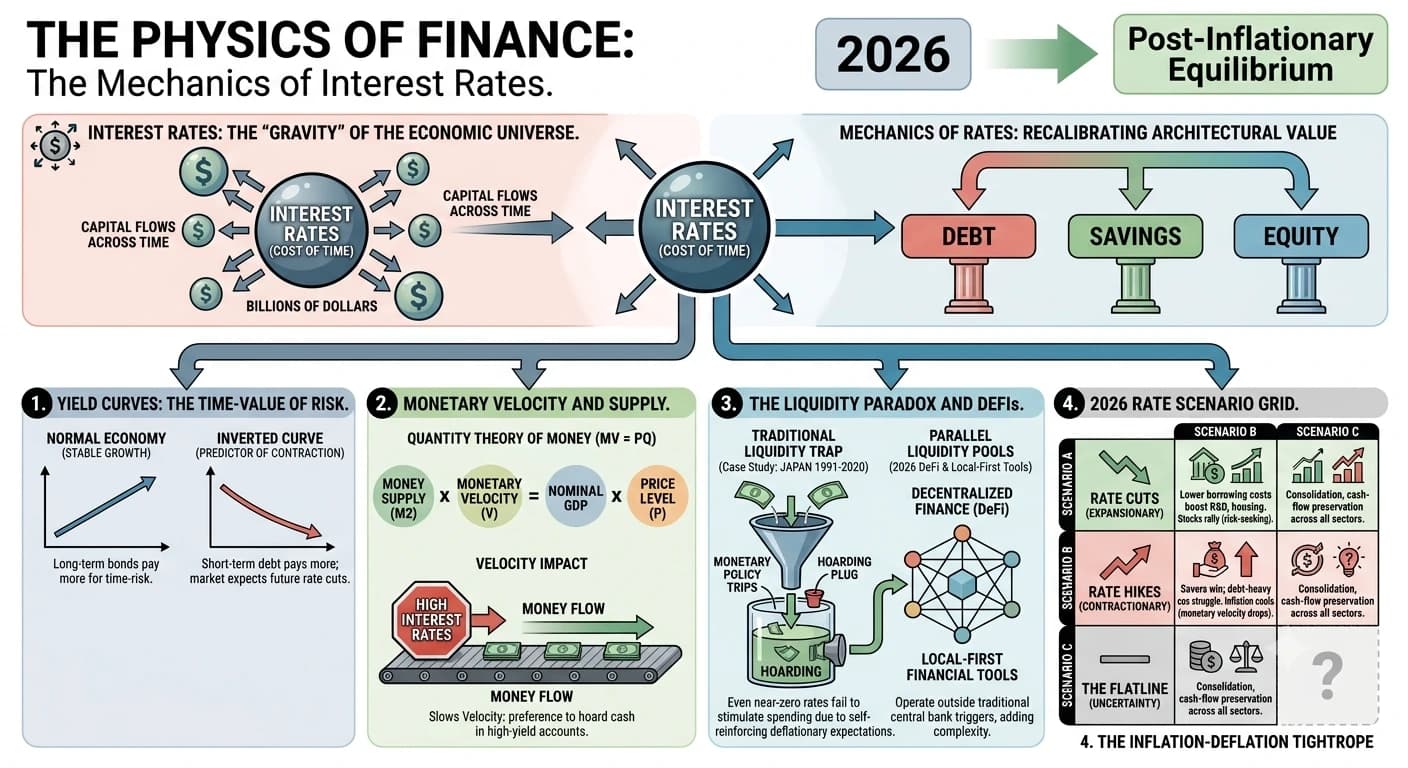
In 2026, as global markets transition toward a Post-Inflationary Equilibrium, understanding the Mechanics of Rates is no longer optional for the modern engineer or entrepreneur. When the "Cost of Money" changes, the entire architectural value of your debt, your savings, and your equity is recalibrated. To navigate this, we must understand the three pillars of monetary physics: Velocity, Yield, and Liquidity.
1. Yield Curves: The Time-Value of Risk
The Yield Curve is a graphical representation of the interest rate on bonds with different maturity dates. In a "Normal" economy, long-term bonds pay more than short-term ones to compensate for the risk of time. An Inverted Yield Curve—where short-term debt pays more—is the most reliable predictor of economic contraction. It signals that the market expects rates to fall in the future as growth slows.
2026 Rate Scenario Grid
- SCENARIO A:Rate Cuts (Expansionary). Lower borrowing costs boost R&D and housing. Stocks usually rally as capital seeks risk.
- SCENARIO B:Rate Hikes (Contractionary). Savers win; debt-heavy companies struggle. Inflation cools as monetary velocity drops.
- SCENARIO C:The Flatline. Uncertainty leads to consolidation and cash-flow preservation across all sectors.
2. Monetary Velocity and Supply
Economic health is not just about the *amount* of money in the system (M2 Supply), but how fast that money changes hands—known as Monetary Velocity. High interest rates often slow down velocity, as consumers prefer to stash cash in high-yield accounts rather than circulating it into the economy.
3. The Liquidity Paradox
A "Liquidity Trap" occurs when even at extremely low interest rates, consumers and businesses continue to hoard cash, rendering monetary policy ineffective. By 2026, decentralized finance (DeFi) and local-first financial tools have created new Parallel Liquidity Pools that operate outside traditional central bank triggers, adding a new layer of complexity to personal wealth management.
Japan's experience from 1991-2020 remains the canonical case study. Despite decades of near-zero rates, consumer spending stagnated because deflationary expectations became self-reinforcing — people delayed purchases expecting lower future prices. The lesson for 2026 savers: interest rate levels alone don't determine economic behavior. Expectations about future rates are equally powerful, which is why central bank "forward guidance" (communicating future intentions) has become as important as rate decisions themselves.
4. The Inflation-Deflation Tightrope
In 2026, central banks face an unprecedented dilemma: Structural Inflation driven by deglobalization, energy transition costs, and aging demographics collides with Technological Deflation driven by AI automation and zero-marginal-cost digital services. This creates a bifurcated economy where essential goods (housing, healthcare, food) continue inflating at 4-6% annually while technology products deflate at 10-20%.
For the individual saver, this means a single inflation number (like CPI) is increasingly misleading. Your personal inflation rate depends on your spending composition. A 25-year-old spending primarily on technology and digital services may experience net deflation, while a 65-year-old spending primarily on healthcare and housing faces 5%+ inflation. Understanding your personal rate exposure is the first step to intelligent financial planning.
A 1% shift in the Fed Funds rate can alter the lifetime cost of a standard 30-year mortgage by over $100,000. On a $400,000 loan at 6.5% vs. 7.5%, the difference in total interest paid over 30 years exceeds $95,000. This is why timing your rate lock to within a single quarter can have generational wealth implications.
When rates remain high, 'Cash is King'. Use high-yield environments to build a runway for the next expansionary cycle. In 2026, high-yield savings accounts are offering 4.5-5.2% APY — essentially paying you to wait while asset valuations adjust downward.
Federal student loan rates are directly pegged to the 10-year Treasury yield. When rates rise, new student borrowers face higher lifetime repayment costs. A 1.5% rate increase on a $50,000 student loan adds approximately $9,000 in total interest payments over a standard 10-year repayment period.
Small businesses operating on revolving credit lines are the most rate-sensitive entities in the economy. A 2% rate hike can increase annual financing costs by $20,000-$50,000 for a typical SMB with $1M in outstanding credit, often making the difference between expansion and contraction.
Interest Rate FAQ for Strategic Planners
The neutral rate (r*) is the theoretical interest rate where monetary policy is neither stimulating nor restricting economic growth. In 2026, the Fed estimates r* at approximately 2.5-3.0%. When actual rates exceed r*, policy is contractionary; below r*, it's expansionary. Understanding where current rates sit relative to r* tells you whether the central bank is stepping on the brakes or the gas.
Stocks are valued using Discounted Cash Flow (DCF) models where future earnings are divided by (1 + discount rate). Higher interest rates increase the discount rate, mathematically reducing the present value of future earnings. Growth stocks (tech) are disproportionately affected because their value is concentrated in distant future earnings, while value stocks with near-term dividends are more resilient.
If rates are near their cyclical peak (as many economists believe in mid-2026), locking in a fixed rate protects you from current levels while variable rates will benefit as cuts begin. The mathematical breakeven point: if you expect rates to drop more than 1.5% within 3 years, a variable rate typically wins. Kodivio's Mortgage Calculator can model both scenarios precisely.
QT is the reverse of Quantitative Easing (QE). Instead of the central bank buying bonds to inject money into the economy, QT allows bonds to mature without replacement — effectively draining liquidity from the financial system. The Fed's QT program has been reducing its balance sheet by ~$60B/month since 2022, creating a "shadow rate hike" effect that operates independently of the official interest rate.
Countries with higher interest rates attract foreign capital seeking better returns, increasing demand for their currency and strengthening its exchange rate. This is the "carry trade" — borrowing in low-rate currencies (JPY, CHF) and investing in high-rate currencies (USD, BRL). For travelers and importers, this means a strong-rate-environment domestic currency makes foreign goods cheaper but domestic exports less competitive.
Kodivio's suite of financial calculators allows you to model interest rate scenarios with absolute precision — entirely offline. Compare mortgage payments across rate environments, calculate compound interest on savings, and project debt payoff timelines without sending your sensitive financial data to any server. All calculations execute in your browser's local JavaScript engine.
Conclusion: Strategic Position
Interest rates are the gravity that keeps the economic orbit stable. By tracking these metrics and using precision-grade calculators, you move from a passive observer of market forces to a strategic engineer of your own financial future.

Finance & Fintech Research Team
The Kodivio team analyzes financial tools, investment platforms, and fintech trends based on independent research and market data.
Learn more about us →