
Engineering Intelligence 2030.
Transitioning from statistical chatbots to the deterministic orchestration of the physical and digital worlds.
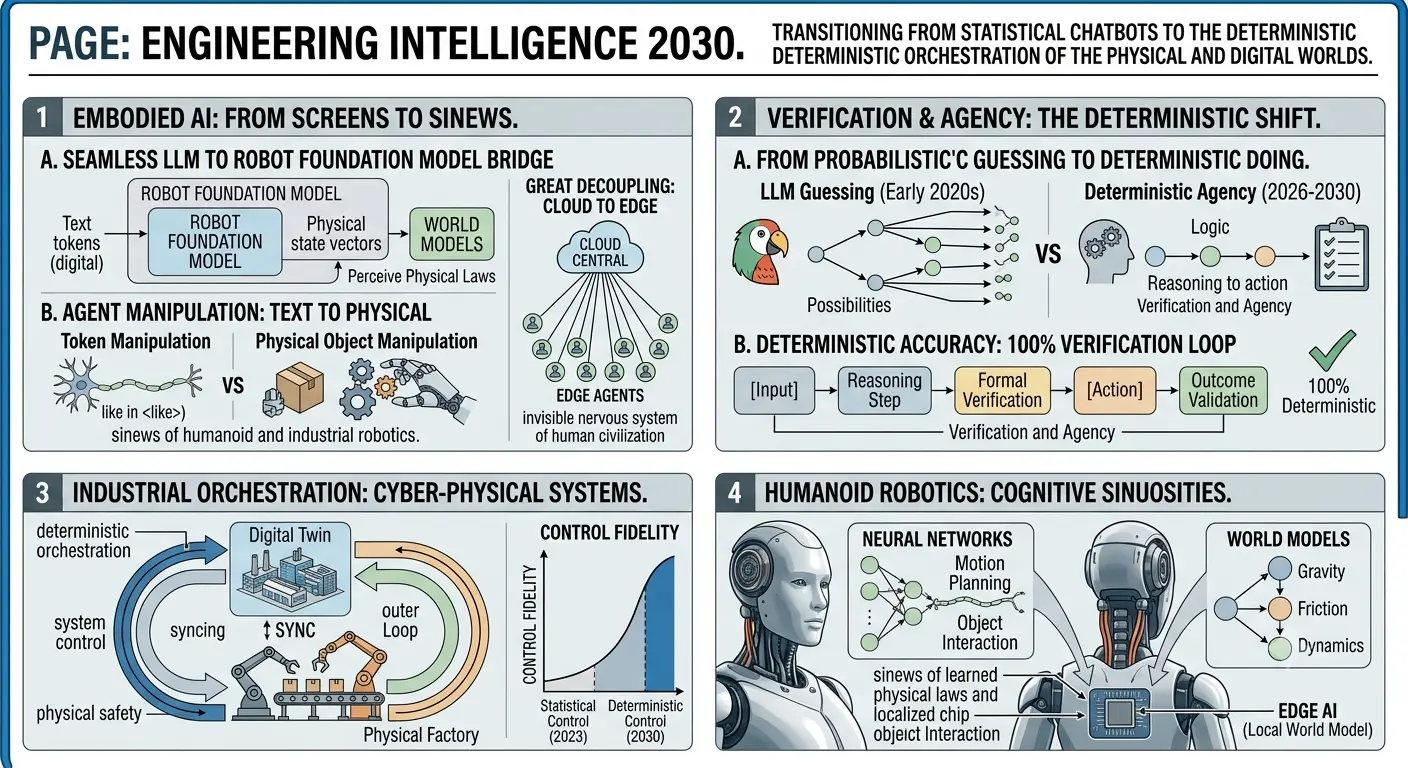
The year 2030 marks the completion of the "Great Decoupling"—where artificial intelligence moves from the cloud to the edge, becoming the invisible nervous system of human civilization.
If the early 2020s were defined by the "Magic of Chat," 2026-2030 will be defined by Verification and Agency. We are no longer content with an LLM that "guesses" the next word; we are building systems that "do" the work with 100% deterministic accuracy.
1. Embodied AI: From Screens to Sinews
By 2030, the bridge between Large Language Models and Robot Foundation Models will be seamless. AI will no longer be trapped in our screens; it will inhabit the sinews of humanoid and industrial robotics. This transition involves "World Models" that perceive physical laws, allowing agents to manipulate physical objects with the same ease they currently manipulate text tokens.
Milestone Tracker: 2027-2030
- 2027:The death of the 'Prompt'. Interfaces move to intention-based orchestration.
- 2028:Sovereign Local Models outpace GPT-4 scale in consumer-grade hardware.
- 2030:AGI parity in specialized STEM domains (Physics, Architecture, Medicine).
2. The Rise of Sovereign AI
As privacy regulations (GDPR 2028) tighten worldwide, the era of "Cloud-Centric AI" will conclude. By 2030, every individual will maintain a Personal Memory Core—a locally-hosted vector database containing their entire life's knowledge, guarded by zero-knowledge encryption. Your AI won't be a subscription; it will be a digital extension of your private self.
3. The Orchestration Layer
We are moving toward the Multi-Agent Orchestration era. Instead of one large model doing everything, thousands of tiny, specialized models (Expert LLMs) will collaborate. One model handles the math, another handles the creative writing, and a "Controller" model ensures they stay on track and don't hallucinate.
In practice, this resembles a digital version of a corporate org chart. A "CEO Agent" decomposes complex tasks into subtasks, distributes them to specialist agents (legal, financial, creative), and aggregates their outputs. The key breakthrough is Inter-Agent Communication Protocols — standardized message formats that allow agents built by different teams, on different frameworks, to collaborate without human intermediation. Google's A2A (Agent-to-Agent) and Anthropic's MCP standards are the leading contenders for this interoperability layer.
AI will spend the late 2020s redesigning humanity's response to pathogens, mapping every protein folding event in real-time. AlphaFold-3 and its successors have already reduced protein structure prediction from months to minutes, enabling rapid vaccine candidate screening during emerging outbreaks.
By 2030, 90% of web content will be synthetic. The most valuable commodity will be 'Proof of Personhood' (PoP). Cryptographic attestation frameworks — combining biometric hashing with zero-knowledge proofs — will allow humans to prove content authenticity without revealing personal identity.
Adaptive AI tutors will replace the one-size-fits-all lecture model. Each student receives a unique curriculum path generated in real-time based on their knowledge gaps, learning speed, and preferred modalities — visual, auditory, or kinesthetic. Early deployments in South Korea and Finland have shown 40% improvement in standardized test scores.
AI-powered predictive load balancing will reduce grid waste by 25-35% by 2030. Neural networks trained on weather patterns, industrial demand cycles, and EV charging schedules will enable utilities to preemptively reroute power, preventing brownouts and optimizing renewable energy integration.
4. The Hardware Inflection: Silicon Meets Intelligence
Software breakthroughs alone cannot deliver the 2030 vision. The hardware substrate must evolve in parallel. Three concurrent revolutions are reshaping the compute landscape:
- Neuromorphic Chips: Unlike traditional GPUs that simulate neural networks digitally, neuromorphic processors (Intel's Loihi 3, IBM's NorthPole) physically mirror the brain's spiking neural architecture. They consume 100-1000x less power than equivalent GPU inference, making always-on edge AI viable in devices without active cooling — from hearing aids to agricultural drones.
- RISC-V AI Accelerators: The open-source RISC-V instruction set architecture is enabling a wave of custom AI silicon. Startups can now design purpose-built inference chips without paying ARM licensing fees, democratizing hardware innovation in the same way that Linux democratized operating systems.
- Optical Computing: Research labs at MIT and Stanford are demonstrating photonic neural networks that process matrix multiplications at the speed of light. While still 5-8 years from commercial deployment, optical AI processors promise to break through the thermal and power limits constraining electronic chips.
The convergence of these hardware trends with software advances in model compression (4-bit quantization, speculative decoding) means that by 2029, a $500 consumer device will deliver inference performance equivalent to a 2024-era datacenter GPU cluster. This is the Hardware Democratization thesis — and it is the foundation upon which Sovereign AI becomes practical for billions of users.
Expert Questions: AI 2030
Most researchers place AGI probability at 15-30% by 2030 under the "narrow" definition (human-level performance across all cognitive tasks). The more likely outcome is Artificial Specialized Superintelligence — AI systems that vastly exceed human capability in specific domains (protein folding, code generation, materials science) while remaining incapable of general reasoning across all contexts simultaneously.
McKinsey's 2025 report estimates 30% of work hours across occupations could be automated by 2030. However, history shows that technology creates more jobs than it destroys — the roles simply change. The fastest-growing job categories will be AI Trainers, Prompt Engineers, Alignment Researchers, and Human-AI Interaction Designers.
Training GPT-4-class models requires approximately 50 GWh of electricity — equivalent to powering 4,500 US homes for a year. This energy concern is driving three responses: more efficient architectures (Mixture of Experts reduces compute by 4-8x), renewable-powered datacenters, and the shift to inference-optimized local models that amortize the training cost across billions of edge devices.
Model Collapse occurs when AI models are trained on AI-generated content, creating a feedback loop that degrades output quality. Research from Oxford (2024) showed that after 5 generations of self-training, model outputs converge to repetitive, low-diversity text. Prevention requires maintaining curated human-authored training datasets and provenance tracking.
Not directly in the near term. Current quantum computers excel at specific problem classes (factoring, optimization) but lack the error correction needed for general neural network training. The more realistic 2030 scenario is Quantum-Inspired Classical Algorithms — mathematical techniques borrowed from quantum computing that improve classical optimization by 10-50x without requiring quantum hardware.
Kodivio's architecture is a practical implementation of the Sovereign AI thesis. By processing all data locally in the browser, we demonstrate that powerful utility tools don't require cloud infrastructure. As edge AI matures by 2030, the same principle will extend to complex inference tasks — your personal AI assistant running entirely on your device, with zero data leakage.
Conclusion: The Great Adaptation
The path to 2030 is not about robots replacing humans, but about humans adapting to a reality where "intelligence" is a utility as common as electricity. To survive this shift, we must double down on Strategic Agency—the ability to set meaningful goals for the machines we build.

AI & Web Development Specialists
The Kodivio team covers AI tools, automation, and modern web development based on real-world testing and hands-on experience.
Learn more about us →