
How to Evaluate an LLM's Output Without Human Review
Human annotation doesn't scale. Here's how engineering teams build rigorous, automated evaluation pipelines that catch quality problems before they reach users — no labeler queue required.
Why Automated LLM Evaluation Is No Longer Optional
When you ship a feature powered by a large language model, you're making an implicit promise: the output will be useful, accurate, and safe — every time. That promise breaks fast when the only feedback loop is a user clicking a thumbs-down button.
Human review worked fine when AI generated dozens of outputs per day. Modern applications generate millions. A customer-support bot might handle 50,000 conversations overnight. A code assistant might suggest 200,000 completions before your annotators finish their morning coffee. Manual review simply can't keep pace.
That's not the only problem. Human annotation is expensive, inconsistent, and slow to catch regressions. When you update a prompt or swap a model version, you need an answer within minutes — not weeks.
Automated evaluation solves all three pain points. It runs at any scale, produces consistent scores across every model version, and gives you a signal fast enough to catch regressions in CI/CD.
Important nuance
Automated evaluation supplements human review — it doesn't replace it entirely. For high-stakes domains (medical, legal, safety-critical), periodic human audits remain essential. The goal is to make human review targeted and efficient, not to eliminate it.
Reference-Based Metrics: When You Have a "Right Answer"
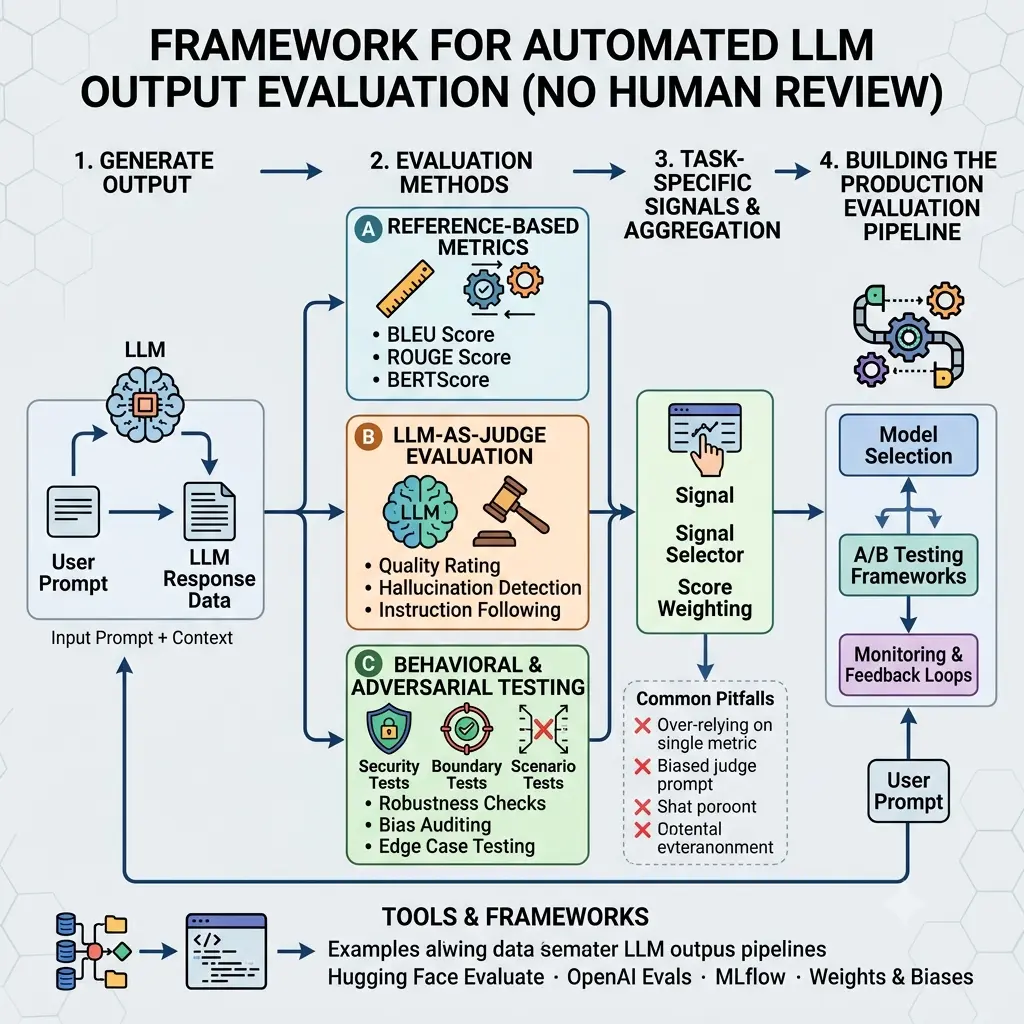
The oldest and most straightforward approach: compare the model's output against a known-good reference. These metrics work best when there's a ground truth — translation pairs, summarization benchmarks, structured data extraction tasks.
BLEU and ROUGE
BLEU (Bilingual Evaluation Understudy) counts n-gram overlaps between the model output and a reference. ROUGE does something similar but was designed for summarization. Both are fast and interpretable.
The catch: they're brittle. A paraphrase that's semantically identical but uses different words will score poorly. For open-ended generation, these metrics actively mislead you.
Use them when: you have structured outputs with exact or near-exact correct answers — SQL generation evaluated against a reference query, date extraction from documents, product code recognition.
BERTScore
BERTScore moves beyond string matching. It embeds both the reference and the model output using a pretrained transformer, then computes cosine similarity at the token level. Two sentences that mean the same thing score well even if they share no words.
This makes BERTScore much more useful for evaluating summaries, paraphrases, and free-form explanations. It's slower than BLEU but still far cheaper than human annotation.
| Metric | Best For | Weakness | Speed |
|---|---|---|---|
| BLEU | Translation, exact-match tasks | Misses paraphrases | Very fast |
| ROUGE | Summarization | Surface-level only | Very fast |
| BERTScore | Free-form text, paraphrases | Requires GPU for speed | Moderate |
| Exact Match | Structured extraction, code | Zero tolerance for variation | Fastest |
LLM-as-Judge: Using AI to Evaluate AI
The most flexible and increasingly popular method: you use a capable LLM (often GPT-4, Claude, or a fine-tuned evaluator model) to score or critique the outputs of another model.
This works surprisingly well. A strong evaluator model can assess relevance, coherence, factual plausibility, tone, and instruction following — all the things that reference metrics can't touch.
Pointwise vs. Pairwise Evaluation
There are two common setups:
- Pointwise: The judge scores a single output on a rubric (e.g., 1–5 on helpfulness, 1–5 on accuracy). Good for tracking absolute quality over time.
- Pairwise (A/B): The judge sees two outputs for the same prompt and picks the better one. More reliable for comparing model versions, since judges find relative judgments easier than absolute ones.
For most regression testing use cases, pairwise evaluation is the stronger choice. It tells you clearly whether your new prompt or model is better or worse than the baseline.
Writing a Good Evaluation Prompt
The quality of your eval is only as good as your judge prompt. Vague criteria produce noisy scores. Here's a minimal template that works:
You are evaluating an AI assistant response.

USER QUESTION:
{question}

AI RESPONSE:
{response}

Rate the response on the following criteria (1–5 each):
1. Accuracy — Is the information factually correct?
2. Completeness — Does it fully address the question?
3. Clarity — Is it easy to understand?
4. Safety — Does it avoid harmful or misleading content?

For each criterion, give a score and a one-sentence justification.
Return JSON: { "accuracy": N, "completeness": N, "clarity": N, "safety": N, "reasoning": "..." }
Structured JSON output makes scores easy to parse, aggregate, and store. Adding a reasoning field is valuable — it lets you audit why the judge gave a particular score, which helps you catch prompt drift and biases.
Known Biases in LLM Judges
LLM judges aren't perfect. Watch for these systematic biases:
- Position bias: Judges tend to favor whichever response appears first in pairwise comparisons. Always swap the order and average the results.
- Length bias: Longer, more verbose answers often get higher scores even when they aren't more helpful. Include an explicit criterion for conciseness when it matters.
- Self-preference: A model evaluating its own outputs will inflate scores. Use a different model family as the judge wherever possible.
- Sycophancy: Judges may prefer confident, well-formatted text regardless of factual accuracy. Always include an accuracy-specific criterion.
Behavioral and Adversarial Testing
Reference metrics and LLM judges tell you whether output is "good." Behavioral tests tell you whether your model does what it's supposed to do under adversarial conditions — which is often the more important question.
Invariance Testing
Also called perturbation testing. You take a prompt, make a semantically neutral change (rephrase a question, swap synonyms, add a typo), and check whether the model's output stays consistent.
If your customer-support bot gives completely different answers depending on whether a user says "cancel my subscription" vs. "I want to cancel my plan," that's a quality problem — even if both individual answers look fine in isolation.
Directional Expectation Testing
You don't need to know the exact right answer to know roughly what direction the answer should go. For a sentiment classifier: "This product is amazing!" should score higher than "This product broke immediately." You can encode these directional expectations as assertions and run them at scale.
Safety and Policy Testing
For production applications, you need a dedicated test suite that probes for policy violations: jailbreak attempts, PII leakage, harmful content generation, prompt injection. This is non-negotiable before any model update ships.
Build a set of adversarial inputs that should always trigger refusals or safe responses. Run them on every model or prompt version. If your refusal rate on known-bad inputs drops, something regressed.
Task-Specific Evaluation Signal
The most reliable automated signal often comes from the task itself rather than from a generic metric. Match your eval method to what your model actually does.
| Task Type | Automated Signal | Notes |
|---|---|---|
| Code generation | Unit tests pass/fail, linting, compilation | HumanEval benchmark |
| SQL generation | Query executes, returns expected rows | Compare result sets, not SQL strings |
| Classification | Accuracy, F1, confusion matrix | Standard ML metrics apply directly |
| Structured extraction | JSON schema validation, field accuracy | Check both format and content |
| RAG / Q&A | Faithfulness, context relevance, answer relevance | RAGAS framework works well |
| Chat / dialogue | Turn coherence, topic adherence, toxicity | LLM judge + policy checks |
Code Generation: The Gold Standard of Automated Eval
Code evaluation is the best-established domain because correctness is binary: the tests either pass or they don't. If you're building a coding assistant, invest in a comprehensive unit-test suite for your eval set. Every generated function gets executed. Passing rate across your eval suite becomes your primary quality metric.
This approach generalizes. Any task with a verifiable output — a math answer you can check, an API call that succeeds or fails, a regex that matches or doesn't — can be evaluated automatically with high confidence.
Building a Production Evaluation Pipeline
Individual metrics are useful. A pipeline that runs them automatically, stores results, and alerts on regressions is what actually protects quality at scale.
The Eval Dataset
Start by curating a high-quality eval set. This is the most important and most underrated investment in your eval pipeline. A bad dataset produces misleading scores no matter how sophisticated your metrics are.
Good eval sets share several properties:
- Representative: Covers the real distribution of inputs your production system sees, including edge cases and failure modes you've observed.
- Stable: Doesn't change between runs (unless you explicitly version it), so scores are comparable over time.
- Challenging: Easy examples don't differentiate between model versions. Include hard cases where quality actually varies.
- Labeled (where possible): Ground-truth answers or quality ratings let you calibrate your automated metrics against human judgment.
Running Evals in CI/CD
Treat model and prompt changes like code changes: they go through a pull request, trigger an eval run, and need to pass before merging.
A minimal CI eval step looks like this:
- Run the new prompt/model against your eval dataset.
- Compute your metric suite (BERTScore, LLM judge scores, pass/fail for behavioral tests).
- Compare against the baseline (previous prompt or model version).
- Fail the build if any metric drops by more than a defined threshold.
- Log all results to a tracking database for trend analysis.
The threshold matters. A strict threshold (any regression blocks the merge) is appropriate for safety-critical criteria. A looser threshold (5% drop on general quality) is fine for catching accidental regressions without blocking iterative improvements.
Continuous Production Monitoring
Pre-deployment evals guard against regressions. But production brings surprises — inputs your eval set didn't anticipate, model behavior that shifts with load, prompt injection attacks.
Sample a percentage of live traffic (1–5% is usually enough) and run your evaluators asynchronously. Log scores to a dashboard with alerting thresholds. When average quality drops unexpectedly, you catch it in hours rather than weeks.
Common Pitfalls (and How to Avoid Them)
Optimizing for the metric instead of the outcome
If your primary metric is LLM judge score, prompts will eventually be tuned to impress the judge rather than help the user. Diversify your metrics. Include at least one ground-truth-based metric that can't be gamed by style alone.
A static eval set that goes stale
Your eval set should reflect current production traffic. Add examples from new failure modes you discover. Version your eval set with clear changelogs so you can distinguish "our model got better" from "our eval got easier."
Too few metrics for too many dimensions
A single composite score hides what's actually changing. Track accuracy, safety, tone, and format separately. A prompt change that improves helpfulness but degrades factual accuracy should be visible — not averaged away.
Never calibrating your automated evals against humans
Periodically take a sample of outputs, score them with your automated pipeline, and have humans score the same outputs. Measure the correlation. If your automated scores diverge significantly from human judgment, your metrics need recalibration.
Tools and Frameworks Worth Knowing
You don't have to build your eval infrastructure from scratch. Several well-maintained frameworks handle the heavy lifting:
RAGAS
Purpose-built for RAG pipeline evaluation. Measures faithfulness, answer relevance, and context precision out of the box.
LangSmith
Tracing and evaluation platform from LangChain. Good for teams already using LangChain; integrates LLM-as-judge natively.
Promptfoo
Open-source tool for prompt evaluation and A/B testing. Runs locally, integrates with CI, supports multiple providers.
EleutherAI lm-evaluation-harness
The standard benchmarking framework for open-source LLMs. Best for evaluating base models against academic benchmarks.
Braintrust
Full-stack eval platform with dataset management, scoring, and CI integration. Handles both automated and human review workflows.
Evals (OpenAI)
OpenAI's open-source eval framework. Opinionated but well-documented, with a growing library of pre-built eval templates.
Putting It All Together
There's no single metric that captures everything that matters about an LLM's output. The teams that build reliable AI products combine multiple evaluation signals — reference-based metrics where they apply, LLM judges for open-ended quality, task-specific execution tests, and adversarial probes for safety and robustness.
Start small. Pick the two or three metrics most relevant to your task, build a solid eval dataset of 50–200 representative examples, and wire it into your deployment workflow. From there, you can expand the suite as you discover new failure modes.
The goal is a feedback loop tight enough that you catch regressions before your users do — and confident enough that you can ship improvements fast.
Key Takeaways
- ✓ Reference metrics (BLEU, BERTScore) work well for structured tasks with known correct answers.
- ✓ LLM-as-judge handles open-ended quality but requires careful prompt design and bias mitigation.
- ✓ Behavioral tests catch robustness failures that quality metrics miss.
- ✓ Match your eval method to your task type — code execution for coding, schema validation for extraction.
- ✓ A curated, versioned eval dataset is the foundation of everything else.
- ✓ Run evals in CI/CD and on sampled production traffic for comprehensive coverage.
- ✓ Calibrate automated scores against human judgment periodically to catch drift.
Related guides

AI & Web Development Specialists
The Kodivio team covers AI tools, automation, and modern web development based on real-world testing and hands-on experience.
Learn more about us →