
Why 2026 Is the Hardest Tax Year to Automate
Most tax calculators are calibrated to a world that no longer exists. On January 1, 2026, the Tax Cuts and Jobs Act's individual-side provisions expired — not due to a dramatic legislative vote, but because they were always written with a built-in clock. The sunset was the law. What followed is the most significant simultaneous change to the US tax code since 2018 itself.
For a developer or financially independent professional building a tax estimation engine, this creates a specific challenge: every constant you relied on is wrong. The bracket thresholds changed. The standard deduction changed. Personal exemptions returned from an eight-year suspension. The top marginal rate climbed from 37% to 39.6%. And the interaction between these changes — especially for filers who hovered near bracket boundaries under TCJA — is non-linear and harder to reason about than adjusting a single number.
This guide is not a simplification of those changes. It is an engineering blueprint that walks through each one with enough precision to translate directly into working code. We'll cover the core progressive bracket engine first, then layer in each complexity in the order a real 1040 encounters it: gross income, above-the-line adjustments, deductions (both paths), personal exemptions, QBI for self-employed filers, regular tax, AMT, FICA/SE tax, and finally credits and estimated payments.
Scope Note
This guide targets federal estimation for US individual filers — single and married filing jointly — for the 2026 tax year. State tax is addressed via architecture pattern in Section 9. All dollar thresholds reference IRS Rev. Proc. 2025-38 projections; actual 2026 figures should be verified against official IRS publications before production use.
The Progressive Bracket Algorithm — Deep Dive
The first confusion most people bring to tax automation is the marginal rate fallacy: the belief that earning $200,001 and crossing into a higher bracket means your entire income gets taxed at the new rate. It does not. US federal income tax is a series of independent rate buckets, each filling in sequence. Only the income inside a given bucket is taxed at that bucket's rate. The $1 that crosses a threshold is taxed at the new rate; the $199,999 below it remains in its own buckets.
The algorithm that implements this is sometimes called the "cascading bucket" or "marginal tier" method. Here is the complete 2026 bracket table for single filers, post-TCJA sunset, and the canonical implementation:
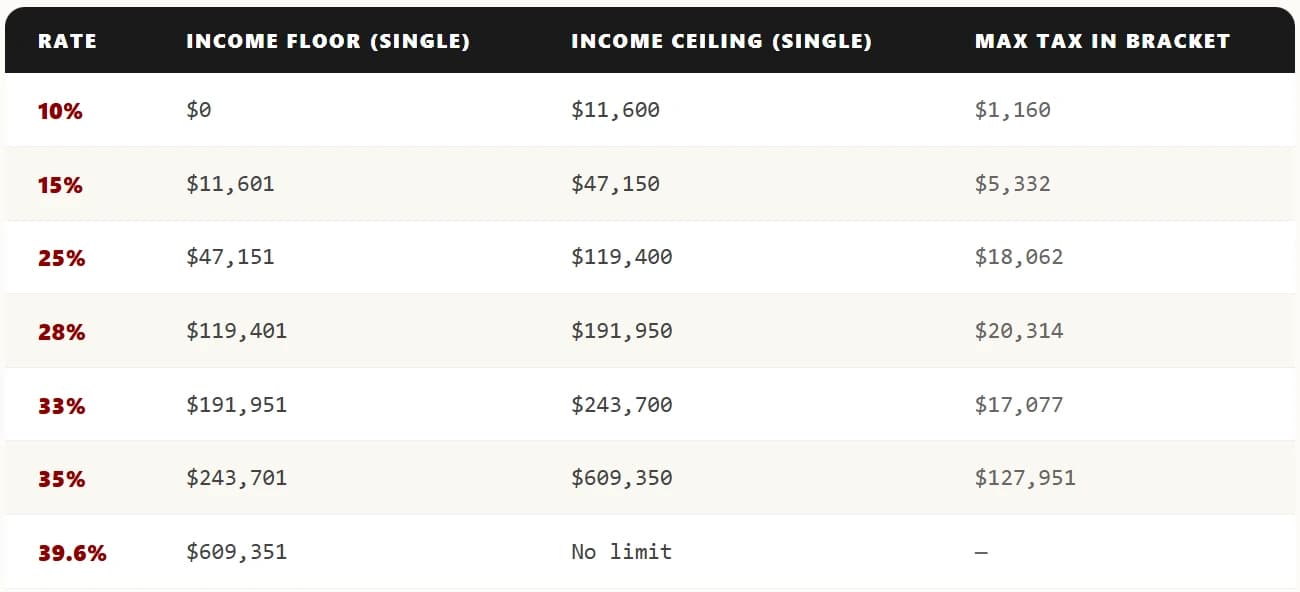
Projected 2026 figures based on IRS Rev. Proc. 2025-38 inflation-adjustment methodology. Verify against final IRS publication before use.
const BRACKETS_2026_SINGLE = [
  { low: 0,       high: 11600,   rate: 0.10  },
  { low: 11601,   high: 47150,   rate: 0.15  },
  { low: 47151,   high: 119400,  rate: 0.25  },
  { low: 119401,  high: 191950,  rate: 0.28  },
  { low: 191951,  high: 243700,  rate: 0.33  },
  { low: 243701,  high: 609350,  rate: 0.35  },
  { low: 609351,  high: Infinity, rate: 0.396 },
];

/**
 * Computes federal income tax using the cascading-bucket method.
 * @param {number} taxableIncome  - Income after all deductions & adjustments
 * @param {Array}  brackets       - Ordered bracket array for the filing status
 * @returns {{ tax: number, effectiveRate: number, marginalRate: number }}
 */
function computeFederalTax(taxableIncome, brackets) {
  if (taxableIncome <= 0) return { tax: 0, effectiveRate: 0, marginalRate: 0 };

  let totalTax = 0;
  let marginalRate = 0;

  for (const tier of brackets) {
    if (taxableIncome <= tier.low) break;

    // Only the income inside this tier is taxed at tier.rate
    const incomeInTier = Math.min(taxableIncome, tier.high) - tier.low;
    totalTax += incomeInTier * tier.rate;
    marginalRate = tier.rate;
  }

  const effectiveRate = totalTax / taxableIncome;
  return { tax: Math.round(totalTax), effectiveRate, marginalRate };
}

// Example: $150,000 taxable income, single filer
const result = computeFederalTax(150_000, BRACKETS_2026_SINGLE);
// → { tax: 32_268, effectiveRate: 0.215, marginalRate: 0.28 }
//   → Effective rate 21.5%, though marginal rate is 28%
The result object returns both the effective rate and the marginal rate deliberately. Understanding the gap between these two figures is one of the most valuable insights a tax engine can surface. Seeing that you're in the 28% marginal bracket but only paying 21.5% overall tells a fundamentally different story than any summary label. It tells you exactly how much each additional dollar of income costs — and how much a deduction at your marginal rate is actually worth.
TCJA Sunset: What Every Constant in Your Code Must Change
The TCJA sunset is not a philosophical shift — it's a diff against a constants file. Here is the precise before/after for every value your 2025 code held that is now wrong.
Standard Deduction — Single
high impact2025 (TCJA)
$15,000
2026 (Post-TCJA)
~$8,300
Inflation-adjusted pre-TCJA baseline. More filers will itemize.
Standard Deduction — MFJ
high impact2025 (TCJA)
$30,000
2026 (Post-TCJA)
~$16,600
Also approximately halved. Dramatically affects dual-income households.
Top Marginal Rate
medium impact2025 (TCJA)
37%
2026 (Post-TCJA)
39.6%
Applies above $609,350 (single). 2.6pp increase on every dollar above threshold.
Personal Exemption
medium impact2025 (TCJA)
$0 (suspended)
2026 (Post-TCJA)
~$5,300/person
Returns after 8-year suspension. Must be subtracted from AGI per qualifying person.
25% Bracket Floor
medium impact2025 (TCJA)
22% at $47,151
2026 (Post-TCJA)
25% at $47,151
The same income band now costs 3pp more. Middle-income filers feel this directly.
Child Tax Credit
high impact2025 (TCJA)
$2,000/child
2026 (Post-TCJA)
~$1,000/child
The TCJA doubling expires. Families lose $1,000 per qualifying child.
AMT Exemption — Single
medium impact2025 (TCJA)
$88,100
2026 (Post-TCJA)
~$70,300
Lower exemption means more middle-income earners become AMT-liable.
Estate Tax Exemption
low impact2025 (TCJA)
$13.61M
2026 (Post-TCJA)
~$7M
Approximately halved. Critical for estate planning automation.
FICA and Self-Employment Tax Automation
For W-2 employees, FICA is largely invisible — split between employer and employee and withheld automatically. For the self-employed, it is a separate, highly visible tax that must be calculated before the income tax itself, because the deduction for half of SE tax affects your AGI, which affects your income tax. This creates a circular dependency that requires a two-pass approximation.
The 2026 Social Security wage base is projected at $174,900. Every dollar of net self-employment income up to that ceiling is subject to the 12.4% Social Security portion of FICA. The 2.9% Medicare portion has no ceiling — and above $200,000 for single filers ($250,000 MFJ), an additional 0.9% Additional Medicare Tax (AMT) applies. Here is the complete SE tax implementation:
const SE_CONSTANTS_2026 = {
  SS_WAGE_BASE:     174_900,    // Social Security ceiling
  SS_RATE:          0.124,      // 12.4% — employer + employee combined
  MEDICARE_RATE:    0.029,      // 2.9%
  ADDITIONAL_MED:   0.009,      // 0.9% above income threshold
  ADD_MED_THRESHOLD_SINGLE: 200_000,
  NET_EARNINGS_FACTOR: 0.9235,  // 92.35% — removes the "employer half" before calculation
};

function computeSelfEmploymentTax(netProfitFromBusiness, filingStatus = "single") {
  // Step 1: Net earnings from self-employment (92.35% of net profit)
  const netEarnings = netProfitFromBusiness * SE_CONSTANTS_2026.NET_EARNINGS_FACTOR;

  // Step 2: Social Security component — capped at wage base
  const ssEarnings = Math.min(netEarnings, SE_CONSTANTS_2026.SS_WAGE_BASE);
  const ssTax = ssEarnings * SE_CONSTANTS_2026.SS_RATE;

  // Step 3: Medicare — no ceiling
  const medicareTax = netEarnings * SE_CONSTANTS_2026.MEDICARE_RATE;

  // Step 4: Additional Medicare Tax on earnings above threshold
  const threshold = filingStatus === "mfj"
    ? 250_000
    : SE_CONSTANTS_2026.ADD_MED_THRESHOLD_SINGLE;

  const addlMedBase = Math.max(0, netEarnings - threshold);
  const addlMedicareTax = addlMedBase * SE_CONSTANTS_2026.ADDITIONAL_MED;

  const totalSETax = ssTax + medicareTax + addlMedicareTax;

  // Step 5: The deductible portion — half of SE tax reduces AGI
  const deductibleHalf = totalSETax / 2;

  return {
    totalSETax: Math.round(totalSETax),
    deductibleHalf: Math.round(deductibleHalf),
    ssComponent: Math.round(ssTax),
    medicareComponent: Math.round(medicareTax + addlMedicareTax),
  };
}

// The two-pass approach for circular dependency:
// Pass 1: Estimate SE tax ignoring the deductible half
// Pass 2: Subtract deductible half from AGI, recompute
// Converges in ≤3 iterations for all practical inputs
Why the Two-Pass Matters
The deductible half of SE tax is an above-the-line adjustment — it reduces your AGI before any bracket computation. But you cannot know your SE tax until you know your net earnings, and your net earnings affect your AGI, which is used to determine QBI phase-outs, itemized deduction floors, and AMT. This creates a loop. The practical solution is a two-iteration approximation: compute SE tax with no deduction (Pass 1), deduct half, recompute (Pass 2). The result is accurate to within pennies for virtually all real-world inputs.
QBI Deduction: Three-Zone Conditional Logic
The Section 199A Qualified Business Income deduction is the most complex single item on the modern 1040. Legislated in 2017 as a rough parity mechanism between C-Corps (which got the flat 21% rate) and pass-through entities, it allows eligible sole proprietors, S-Corp shareholders, and partnership members to deduct up to 20% of their qualified business income from taxable income — reducing their effective rate substantially.
The challenge is that the deduction is not simply 20% of profit. It operates across three distinct zones based on total taxable income, and within the upper zone, it splits into two sub-paths depending on whether the business is a Specified Service Trade or Business (SSTB) — lawyers, consultants, financial advisors, healthcare professionals — or a non-SSTB.
Below Threshold
Under $191,950 single / $383,900 MFJ
Deduction = min(20% × QBI, 20% × (taxable income − net capital gains))
Phase-Out Range
$191,950–$241,950 single / $383,900–$483,900 MFJ
W-2 wage and SSTB limitations phase in linearly across this $50K window.
Above Threshold
Over $241,950 single / $483,900 MFJ
SSTBs: deduction eliminated. Non-SSTBs: capped by the greater of (a) 50% of W-2 wages paid or (b) 25% of W-2 wages + 2.5% of UBIA of qualified property.
const QBI_THRESHOLDS_2026 = {
  single:  { low: 191_950, high: 241_950 },
  mfj:     { low: 383_900, high: 483_900 },
};

function computeQBIDeduction({
  qualifiedBusinessIncome,   // Net QBI from Schedule C / K-1
  taxableIncome,             // AFTER standard or itemized deduction
  w2WagesPaid,              // W-2 wages paid by the business (non-SSTBs above threshold)
  ubiaQualifiedProperty,    // Unadjusted Basis Immediately After Acquisition
  isSST B = false,           // Is this a Specified Service Trade or Business?
  filingStatus = "single",
}) {
  const { low, high } = QBI_THRESHOLDS_2026[filingStatus];

  // Zone 1: Below threshold — simple 20% of QBI
  if (taxableIncome <= low) {
    return Math.max(0, qualifiedBusinessIncome * 0.20);
  }

  // Zone 3 upper bound for SSTB: full phase-out
  if (isSSTB && taxableIncome >= high) return 0;

  // Reduction ratio for phase-out range (Zones 2 and partial 3)
  const ratio = Math.min(1, (taxableIncome - low) / (high - low));

  // W-2 wage limitation (for above-threshold non-SSTBs)
  const w2Limit       = w2WagesPaid * 0.50;
  const combinedLimit = (w2WagesPaid * 0.25) + (ubiaQualifiedProperty * 0.025);
  const wageCap       = Math.max(w2Limit, combinedLimit);

  // Tentative deduction without wage cap
  const tentative = qualifiedBusinessIncome * 0.20;

  // Phase in the wage limitation across the phase-out window
  const limitedDeduction = tentative - ratio * Math.max(0, tentative - wageCap);

  // For SSTBs: scale down by (1 - ratio) for phase-out window
  if (isSSTB) return Math.max(0, tentative * (1 - ratio));

  return Math.max(0, limitedDeduction);
}The AMT Parallel Track
The Alternative Minimum Tax was created in 1969 to ensure that high-income taxpayers using legal deductions couldn't reduce their tax burden to zero. Its basic mechanism is elegant: compute a separate taxable income by adding back certain "preference items" that the regular code allows you to deduct, apply lower flat rates, and pay whichever of (regular tax, AMT) is higher.
The TCJA dramatically narrowed the AMT's reach by raising exemptions substantially. The sunset reverses that. In 2026, AMT exemptions fall back to approximately $70,300 for single filers and $109,400 for MFJ — down from $88,100 and $137,000. The phase-out thresholds also drop, meaning AMT liability extends significantly deeper into upper-middle income territory.
The key AMT preference items you must add back to regular taxable income to compute AMTI (Alternative Minimum Taxable Income):
- +
State and Local Tax (SALT) deduction
The $10,000 SALT cap remains for regular tax, but for AMT, the entire SALT deduction is a preference item — add it all back.
- +
Incentive Stock Option (ISO) spreads
The spread between exercise price and FMV at exercise is not regular income but is an AMT preference item. A significant ISO exercise year may trigger AMT liability even at moderate incomes.
- +
Accelerated depreciation
Excess of MACRS depreciation over ADS (Alternative Depreciation System) depreciation on certain assets. Relevant for real estate investors and equipment-heavy businesses.
- +
Percentage depletion excess
Relevant for extractive industries. Excess of percentage depletion over adjusted basis is an AMT preference item.
const AMT_2026 = {
  EXEMPTION_SINGLE:  70_300,
  EXEMPTION_MFJ:     109_400,
  PHASEOUT_SINGLE:   626_350,   // exemption reduces by $0.25 per $1 above this
  PHASEOUT_MFJ:      1_252_700,
  RATE_LOW:          0.26,      // On AMTI ≤ $232,600
  AMTI_TIER_BREAK:   232_600,
  RATE_HIGH:         0.28,
};

function computeAMT({
  regularTaxableIncome,
  saltDeductionTaken,       // full amount, not capped — added back in full
  isoSpread = 0,
  acceleratedDepreciation = 0,
  filingStatus = "single",
}) {
  // Step 1: Build AMTI by adding preference items back
  const amti = regularTaxableIncome
    + saltDeductionTaken
    + isoSpread
    + acceleratedDepreciation;

  // Step 2: Compute phased-out exemption
  const { EXEMPTION_SINGLE, EXEMPTION_MFJ, PHASEOUT_SINGLE, PHASEOUT_MFJ } = AMT_2026;
  const rawExemption = filingStatus === "mfj" ? EXEMPTION_MFJ : EXEMPTION_SINGLE;
  const phaseoutFloor = filingStatus === "mfj" ? PHASEOUT_MFJ : PHASEOUT_SINGLE;
  const phaseoutReduction = Math.max(0, (amti - phaseoutFloor) * 0.25);
  const exemption = Math.max(0, rawExemption - phaseoutReduction);

  // Step 3: Taxable AMTI after exemption
  const taxableAMTI = Math.max(0, amti - exemption);
  if (taxableAMTI === 0) return 0;

  // Step 4: Apply 26%/28% two-tier rates
  const lowTier = Math.min(taxableAMTI, AMT_2026.AMTI_TIER_BREAK);
  const highTier = Math.max(0, taxableAMTI - AMT_2026.AMTI_TIER_BREAK);
  const tentativeMinTax = (lowTier * AMT_2026.RATE_LOW) + (highTier * AMT_2026.RATE_HIGH);

  return Math.round(tentativeMinTax);
}

// The caller pays max(regularTax, amtLiability):
// const finalTax = Math.max(regularTax, computeAMT({ ... }))Standard vs. Itemized: Running Both Paths
Under the TCJA (2018–2025), approximately 90% of American taxpayers took the standard deduction because it was simply larger than what they could accumulate through itemized deductions. The 2026 sunset changes this arithmetic dramatically. With the standard deduction approximately halved, itemizing will be financially superior for a significantly larger share of filers — particularly homeowners with mortgages, those in high-tax states, and significant charitable contributors.
Your automation should never assume which path is correct. It should compute both and select the higher deduction. Here are the key components of the itemized path for 2026:
Mortgage Interest
Deductible on acquisition debt up to $750,000 ($1M for pre-2018 loans). Fully itemizable in 2026.
State and Local Tax (SALT)
Capped at $10,000 for regular tax (not AMT). The cap's political future is uncertain; code it as an adjustable parameter.
Charitable Contributions
Cash donations to qualified organizations up to 60% of AGI. Carryforward provisions apply for excess amounts.
Medical Expenses
Only the portion exceeding 7.5% of AGI is deductible. Automate with: Math.max(0, medicalTotal - AGI * 0.075).
Casualty and Theft Losses
Federally declared disaster losses exceeding 10% of AGI plus $100 per incident. Narrow eligibility — model as optional input.
Miscellaneous (2% floor)
Certain unreimbursed employee expenses and investment expenses exceeding 2% of AGI. Status for 2026 pending legislative clarification.
Quarterly Estimated Payments and Safe Harbor
The IRS collects tax as income is earned, not as a lump sum at filing. For employees, withholding handles this automatically. For the self-employed, that responsibility falls on the filer via quarterly estimated payments (Form 1040-ES). Miss the deadlines or underpay each quarter and the IRS charges interest on the shortfall — currently at the federal short-term rate plus 3 percentage points, calculated per period independently.
The safe harbor rules define the minimum you must pay to avoid those penalties — not the minimum you legally owe for the year. There are two safe harbors; your automation should compute both and flag the lower required payment:
Safe Harbor A
90% of Current Year
Pay at least 90% of your actual 2026 liability across the four payment periods. This requires estimating your current-year income with reasonable accuracy. Best for filers whose income is stable or declining.
Safe Harbor B
100% of Prior Year (110% if AGI > $150K)
Pay 100% of your 2025 tax liability in four equal installments. If your 2025 AGI exceeded $150,000, the threshold rises to 110%. This is the "no-surprise" option — regardless of how much your income grows in 2026, no penalty applies.
const PAYMENT_DATES_2026 = [
  { period: "Q1", due: "2026-04-15", incomeMonths: [1, 2, 3]     },
  { period: "Q2", due: "2026-06-16", incomeMonths: [4, 5]        },
  { period: "Q3", due: "2026-09-15", incomeMonths: [6, 7, 8]     },
  { period: "Q4", due: "2027-01-15", incomeMonths: [9, 10, 11, 12] },
];

function computeEstimatedPayments({
  estimatedCurrentYearTax,   // Your best estimate of 2026 federal tax
  priorYearTax,              // Actual 2025 federal tax from prior return
  priorYearAGI,              // 2025 AGI — determines whether 100% or 110% applies
}) {
  // Safe Harbor B multiplier
  const safeHarborBRate = priorYearAGI > 150_000 ? 1.10 : 1.00;

  // Safe Harbor A: 90% of current year, spread evenly across 4 payments
  const safeHarborA_annual = estimatedCurrentYearTax * 0.90;
  const safeHarborA_quarterly = safeHarborA_annual / 4;

  // Safe Harbor B: 100% (or 110%) of prior year, evenly spread
  const safeHarborB_annual = priorYearTax * safeHarborBRate;
  const safeHarborB_quarterly = safeHarborB_annual / 4;

  // The lower quarterly payment satisfies one safe harbor — choose lower
  const recommendedQuarterly = Math.min(safeHarborA_quarterly, safeHarborB_quarterly);

  return {
    quarterlyPayment: Math.ceil(recommendedQuarterly),
    annualRequired: Math.ceil(recommendedQuarterly * 4),
    safeHarborAQuarterly: Math.ceil(safeHarborA_quarterly),
    safeHarborBQuarterly: Math.ceil(safeHarborB_quarterly),
    paymentSchedule: PAYMENT_DATES_2026.map(p => ({
      ...p,
      amount: Math.ceil(recommendedQuarterly)
    })),
  };
}State Tax via the Strategy Pattern
State income taxes range from zero (Florida, Texas, Nevada, and six others) to progressive schedules with thirteen brackets (California, top rate 13.3%). Hardcoding all 41 states with income taxes into a single monolithic function is a maintenance nightmare — one legislature change requires touching the core engine. The Strategy Pattern solves this by separating the interface from the implementation.
// Base interface — all state strategies must implement this shape
class StateTaxStrategy {
  calculate(federalAGI, filingStatus) { return 0; }
  get name() { return "Base"; }
}

// No-income-tax states (Florida, Texas, Nevada, etc.)
class NoIncomeTaxStrategy extends StateTaxStrategy {
  calculate() { return 0; }
  get name() { return "No State Income Tax"; }
}

// California 2026 — 13 progressive brackets, top rate 13.3%
class CaliforniaStrategy extends StateTaxStrategy {
  get name() { return "California"; }

  calculate(federalAGI, filingStatus) {
    const brackets = filingStatus === "mfj"
      ? CA_BRACKETS_2026_MFJ
      : CA_BRACKETS_2026_SINGLE;

    // SDI (State Disability Insurance): 1.1% on all wages, no cap in 2026
    const sdi = federalAGI * 0.011;

    return runBracketEngine(federalAGI, brackets) + sdi;
  }
}

// North Carolina 2026 — flat 4.5%
class NorthCarolinaStrategy extends StateTaxStrategy {
  get name() { return "North Carolina"; }
  calculate(federalAGI) {
    const NC_STANDARD_DEDUCTION_SINGLE = 10_750;
    return Math.max(0, federalAGI - NC_STANDARD_DEDUCTION_SINGLE) * 0.045;
  }
}

// TaxEngine consumes any strategy via dependency injection
class TaxEngine {
  constructor(stateStrategy = new NoIncomeTaxStrategy()) {
    this.stateStrategy = stateStrategy;
  }

  computeTotal({ taxableIncome, federalAGI, brackets, filingStatus }) {
    const federal = computeFederalTax(taxableIncome, brackets);
    const state   = this.stateStrategy.calculate(federalAGI, filingStatus);
    return { federal, state, total: federal.tax + state };
  }
}

// Swap states without touching TaxEngine:
const engine = new TaxEngine(new CaliforniaStrategy());Privacy-First Architecture: Zero-Server Design
The conventional online tax tool requires a trust relationship between you and its operator. When you enter your W-2 income, freelance revenue, mortgage interest, and dependent information into TurboTax, H&R Block, or similar platforms, that data traverses a network, reaches a server, gets stored in a database, and — in most cases — is retained beyond your filing session under terms buried in a privacy policy.
TaxAct sold user data to Meta for ad targeting. H&R Block shared tax return information with analytics partners. These are not hypothetical risks; they are documented events. For high-net-worth individuals, freelancers with complex income streams, and anyone who considers their financial profile sensitive information, the architectural alternative is a zero-server model: all computation happens in the browser's JavaScript engine, and no data crosses a network boundary.
Cloud Tax Tool Architecture
User enters W-2, 1099, deductions in browser form
Form data transmitted over HTTPS to company server
Server computes tax, stores data in user database
Analytics events fire to Google, Meta, partners
Results returned to browser
Data retained per privacy policy (often indefinitely)
Zero-Server Architecture (Kodivio)
User enters financial data in browser form
JavaScript engine computes all bracket logic locally
QBI, AMT, FICA calculated in browser RAM
No network request is made — no data leaves device
Results displayed immediately from local computation
Closing the tab erases all data — zero retention
Testing Financial Logic: The Edge-Case Protocol
Financial logic is a domain where "probably correct" is unacceptable. The canonical off-by-one error in a bracket engine — using > instead of >= at a tier boundary — silently mis-taxes a single dollar in the wrong bracket. Compounded across millions of calculations, this produces systematic error. Unit tests against boundary values are not optional.
| Persona | Taxable Income | What to Test | Expected Complexity |
|---|---|---|---|
| Bracket Boundary Single | $47,150 / $47,151 | One dollar crosses the 15%→25% boundary. Confirm tax difference is exactly $0.25 — the new marginal rate on one dollar. | Low |
| Low-Income Single Filer | $28,000 gross, $8,300 std. deduction | Taxable income $19,700. Verify only the 10% and 15% buckets are used. No QBI, no AMT, no SE. | Low |
| W-2 Freelancer Hybrid | $90,000 W-2 + $40,000 Schedule C net | SE tax on $40K, deductible half, QBI below threshold, combined AGI, FICA withheld on W-2 portion. | Medium |
| High-Income SSTB | $280,000 consulting income | QBI phase-out eliminates deduction entirely. AMT may trigger. Quarterly payment safe harbor calculation. | High |
| ISO Exercise Year | $120,000 salary + $150,000 ISO spread | Regular tax may be low; AMT liability likely triggers due to ISO preference item addition. Test both paths. | High |
| Multi-State W-2 | $200,000 W-2, lived in CA Jan–June, TX Jul–Dec | Apportioned CA income for 6 months. TX zero-state portion. Federal unchanged. | High |
Technical Implementation Q&A
Should I itemize or take the standard deduction in 2026?
With the TCJA sunset, the standard deduction falls to roughly $8,300 single / $16,600 MFJ. This threshold is crossed by any homeowner paying more than $8,300 in mortgage interest alone — before SALT or charitable contributions. Your automation should always compute both paths and take the higher. Assume the majority of homeowners in high-tax states (CA, NY, NJ, IL, MA) will now itemize.
What is a 1040 Algorithm, and how do I structure my code around it?
The 1040 Algorithm is a computational model that mirrors the sequence of the IRS Form 1040 exactly. Start with all income sources (gross), subtract above-the-line adjustments (SE tax half, student loan interest, HSA contributions, IRA deductions), arrive at AGI. From AGI subtract personal exemptions, then the higher of standard or itemized deduction to reach taxable income. Run the bracket engine. Compute QBI deduction separately and subtract from taxable income before applying brackets. Run AMT in parallel. Add SE tax. Subtract credits. The sequence matters — each step is an input to the next.
How do I handle the personal exemptions that return in 2026?
Personal exemptions ($5,300 per qualifying person, inflation-adjusted) are subtracted from AGI before computing taxable income. For a married couple with two children, that's $21,200 in additional deductions the TCJA eliminated in 2018 and 2026 restores. In code, add a personalExemptions input (count of qualifying persons × $5,300) and subtract it from AGI before running the deduction comparison.
How does Kodivio ensure my tax data stays private?
All bracket logic, FICA calculations, QBI computation, and deduction comparisons execute in your browser's JavaScript engine. Your salary, business income, deductions, filing status, and estimated tax liability are never transmitted to any server, API, or analytics service. The computation is stateless — closing the browser tab returns the device to its pre-input state with nothing persisted.
What floating-point precision issues should I watch for?
JavaScript's 64-bit float arithmetic can produce artifacts: 0.1 + 0.2 === 0.30000000000000004. In financial code, always round monetary results with Math.round() before displaying or comparing. Use integer arithmetic where possible (work in cents, divide by 100 for display). Never compare floating-point tax amounts with ===; use Math.abs(a - b) < 0.01 for equality checks.
Can I automate the Net Investment Income Tax (NIIT)?
Yes. The 3.8% NIIT applies to the lesser of (a) net investment income or (b) the excess of MAGI over $200,000 single / $250,000 MFJ. Investment income includes dividends, interest, capital gains, rental income, and passive activity income. Compute: Math.max(0, Math.min(netInvestmentIncome, MAGI - threshold) * 0.038). This is additive to regular income tax and AMT.
Apply This Guide
Run These Calculations
Right Now. Privately.
Every algorithm in this guide powers the Kodivio Tax Engine — a browser-only calculator that runs entirely on your device. No accounts. No data transmission. Just math.