
AI Agents Explained: The Future of Automation
A standard language model can answer a question. An AI agent can go answer the question, come back, take action on what it found, verify the result, and fix its own mistakes — without being asked twice.
In This Article
- 01The Shift: From Copilots to Agents
- 02What Exactly Is an AI Agent?
- 03The Anatomy of an Agent: Memory, Tools, Planning
- 04Real-World Agentic Workflows
- 05Multi-Agent Systems: How Teams of AI Work Together
- 06The Honest Limitations in 2026
- 07How to Start Building with Agents Today
- 08What Comes Next
"The difference between a language model and an agent is the difference between a consultant who gives you a report and one who actually executes the work. Both are valuable. Only one changes what's possible."
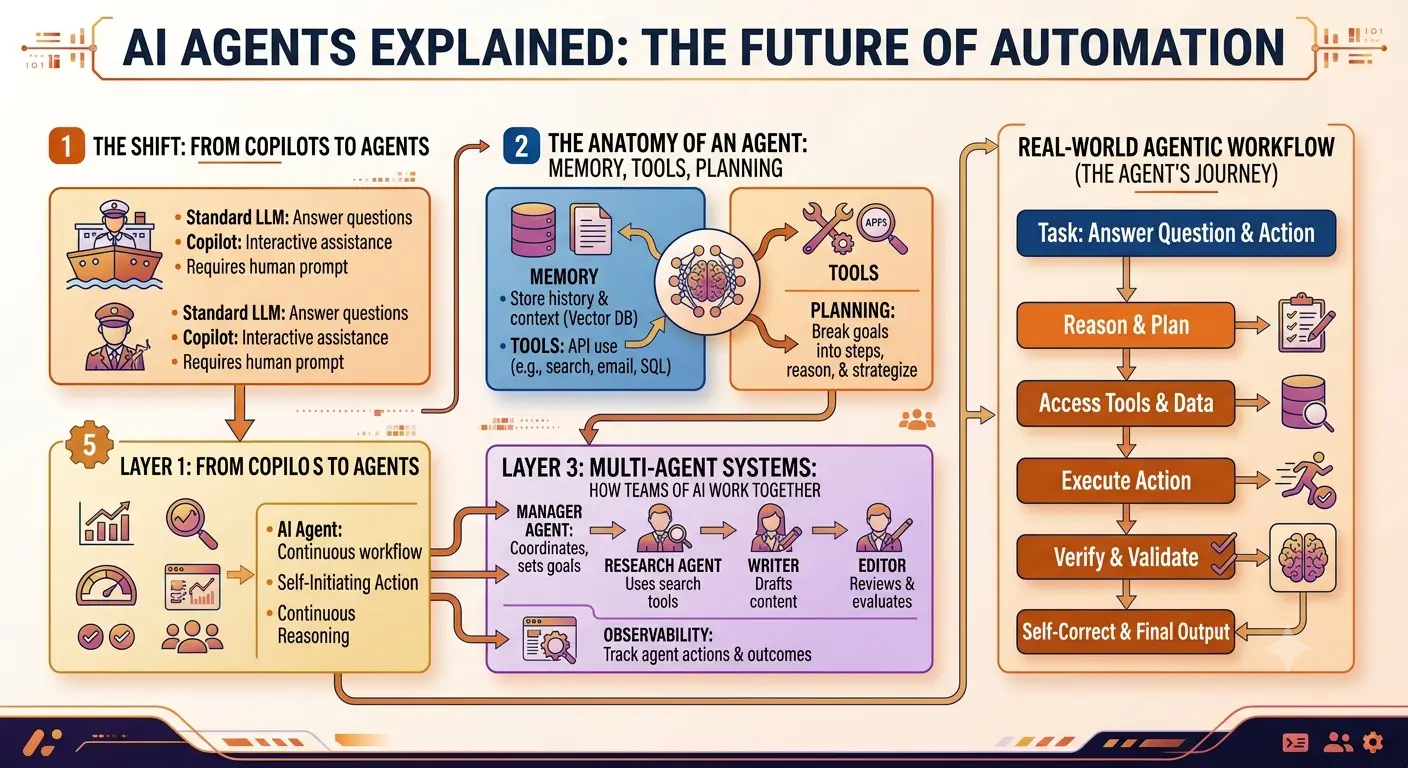
1. The Shift: From Copilots to Agents
When large language models first entered mainstream use, the interaction pattern was simple: you typed something, the model responded, you acted on the response. The model was helpful in the way a very well-read colleague is helpful — knowledgeable, available, patient — but fundamentally passive. It waited to be asked. It answered in text. It didn't do anything.
This became known as the "copilot" model of AI — you were still the pilot, making every decision and taking every action. The AI was the voice in your ear helping you make better decisions faster. For a lot of use cases, that's exactly what you need. But it has a structural ceiling: every step in a workflow still requires a human to prompt, review, and act. At scale, the bottleneck moves from "can we produce this output?" to "can humans process the AI's outputs fast enough to get value from them?"
AI agents are designed to break that bottleneck. Instead of operating at the level of a single question and answer, an agent operates at the level of a goal. You specify what you want achieved. The agent works out how to achieve it, executes the necessary steps, handles the failures and edge cases that come up along the way, and delivers a result. The human's role shifts from operating the tool to directing and reviewing it.
That's not a small shift. It's the difference between a tool and a worker.
2. What Exactly Is an AI Agent?
Definitions in AI get slippery fast, so here's a precise one: an AI agent is a system that uses a language model as its reasoning core, has access to tools it can invoke to interact with external systems, maintains some form of memory across steps, and operates in a loop — perceiving the current state, deciding what to do next, acting, observing the result, and repeating — until the goal is met or a stopping condition is reached.
The Core Architecture
Agent =
LLM (the reasoning engine)
+ Tools (functions it can call to act on the world)
+ Memory (context it maintains across steps)
+ Planning (the loop that connects them)
The key distinction from a standard LLM call is the loop and the tools. A single LLM call takes an input, produces an output, and stops. An agent takes a goal, produces a sequence of actions over time, and only stops when the goal is achieved or it determines it can't proceed. This makes agents capable of tasks that would require dozens of back-and-forth manual prompts to accomplish otherwise — but it also means their failure modes are more complex and their costs are harder to predict upfront.
3. The Anatomy of an Agent
Three components turn a language model into an autonomous agent. Understanding each one separately is what lets you design them well.
Planning & Reasoning
When you give an agent a complex goal, the first thing it does is decompose it. Not all at once — it thinks one step at a time, takes an action, observes the result, and decides what to do next based on what it just learned. This loop is formalized in a pattern called ReAct (Reasoning and Acting), where the model alternates between a Thought step (what do I need to do?), an Action step (call this tool with these parameters), and an Observation step (here's what the tool returned).
What this means in practice
The quality of an agent's planning is largely determined by how well its tools are defined, not how capable the underlying model is. An agent with a vague tool description will waste steps trying to figure out how to use it. An agent with a precise, well-constrained tool description will execute cleanly on the first try. Most agent reliability problems trace back to this.
Tool Use (Function Calling)
A language model alone is trapped in text. It can describe what it would do, but it can't actually do it. Tool use changes that. You provide the model with a catalog of available functions — search_web, query_database, send_email, run_python, read_file — each with a name, description, and parameter schema. When the model determines it needs to use one, it generates the correct JSON payload, the system executes the function, and the output is fed back into the model's context. The model never sees code; it just decides which tool to invoke and what arguments to pass.
What this means in practice
Tool design is underappreciated. The most effective agent tools are narrow — they do exactly one thing and return a clean, predictable output. Tools that are too broad (a 'do_anything' tool that accepts free-text instructions) introduce ambiguity at every call. Tools that return unstructured text force the model to parse output before it can act. Clean input, clean output, one responsibility per tool.
Memory
An agent that forgets everything between steps can't handle tasks that take more than one or two actions. Memory architecture is how agents maintain continuity across a workflow that might span minutes, hours, or days. There are two distinct memory types: short-term memory lives in the context window and holds the current task thread — what steps have been taken, what tools returned, what the current state is. Long-term memory lives outside the model, in a vector database or key-value store, and holds information the agent has accumulated across past interactions.
What this means in practice
Long-term memory is still one of the harder engineering problems in agent design. Retrieving the right memories at the right time — not too much (context bloat), not too little (missing relevant context) — requires the same RAG discipline as document retrieval. Many early agent systems skip long-term memory entirely and get away with it for narrow tasks. The ones that need it tend to discover the hard way that bolting it on later is messier than designing for it from the start.
4. Real-World Agentic Workflows
What does this actually look like when it's deployed? Four real patterns, with an honest assessment of where each one works well and where it still falls short.
Software Engineering
The workflow
A developer assigns a bug ticket to an agent rather than picking it up themselves. The agent reads the ticket description, clones the relevant repository, navigates the codebase using file-reading and search tools to locate the affected function, writes a targeted fix, runs the test suite, reads the failure output if tests don't pass, revises the fix, and submits a pull request — including a written summary of what was changed and why.
Reality check
This is not hypothetical. GitHub Copilot Workspace and Devin-style systems are running versions of this workflow in production at engineering teams today. The catch: agents still struggle with large, poorly documented codebases where understanding the code requires institutional knowledge that isn't written down anywhere.
Financial Research
The workflow
An analyst at a fund triggers an agent to produce a sector earnings summary. The agent navigates SEC EDGAR, downloads the 10-Q filings for six companies, uses a PDF parsing tool to extract the revenue and guidance tables, runs a Python script to calculate quarter-over-quarter changes, drafts a comparative narrative, and generates a formatted chart — all before the analyst has finished their morning coffee.
Reality check
The data retrieval and calculation steps are highly reliable. The narrative synthesis is good but still requires human review before it goes to clients. The current pattern: agents handle 80% of the mechanical work, analysts handle the 20% that requires judgment about what the numbers actually mean.
Customer Operations
The workflow
A support agent handles a refund request end-to-end: reads the customer's email, looks up the order in the database, checks the return policy rules, determines eligibility, generates a personalized response, triggers the refund in the payment system, and logs the resolution — with no human in the loop for standard cases.
Reality check
Companies running agents in customer support gate them carefully: agents handle rule-based decisions autonomously, but anything outside the decision tree — angry customers, ambiguous policies, edge cases involving legal exposure — routes to a human with the agent's work summarized as context. The human handles the exception; the agent handles the volume.
Content & Research Ops
The workflow
A marketing team deploys a research agent that monitors competitor announcements, new regulatory filings, and industry news daily. When it finds something relevant, it summarizes the key points, maps them to the company's product positioning, flags potential threats or opportunities, and drops a brief into a shared Slack channel with supporting source links.
Reality check
The summarization and classification quality here is strong. Where agents still fall short is novelty: identifying something genuinely surprising or strategically significant that falls outside established patterns. That still needs a person who understands the business context well enough to know why something unusual actually matters.
5. Multi-Agent Systems: How Teams of AI Work Together
A single agent can handle a lot. But some tasks are too large, too complex, or too multi-disciplinary for a single agent to handle well. The same way human organizations split work across specialized roles, multi-agent systems split work across specialized agents that communicate with each other.
The basic pattern: you have an orchestrator agent that receives the top-level goal and breaks it into subtasks, worker agents that handle specific subtasks with focused tools and prompts, and a review mechanism — sometimes another agent, sometimes a rule-based check — that validates outputs before they move forward. Frameworks like CrewAI, AutoGen, and LangGraph all implement variations of this pattern.
A practical example: a competitive intelligence system might have a Researcher agent that gathers data from web search and document tools, an Analyst agent that synthesizes findings and identifies patterns, a Writer agent that formats the output into a structured brief, and a Critic agent that checks the brief for unsupported claims and flags anything that needs a source before it goes out. Each agent has a narrow job, focused tools, and a clear output format. The orchestrator moves work between them.
The design principle that makes multi-agent systems work
Each agent should have one job, tools that only serve that job, and an output format that the next agent can consume without ambiguity. The moment an agent's role becomes vague — "general research and analysis" — communication between agents degrades and the system produces inconsistent results. Narrow specialization isn't a limitation; it's what makes the collaboration reliable.
6. The Honest Limitations in 2026
The demos are impressive. The production reality is more nuanced. Here are the four limitations that matter most when you're actually building — not the ones vendors highlight in their documentation.
Compounding errors across long task chains
Every step in an agent's reasoning chain has some probability of being wrong. Over a 20-step task, even a 95% per-step accuracy rate produces a correct end result less than 36% of the time. This is the math that explains why short, well-scoped agentic tasks work in production while ambitious long-horizon tasks still fail more often than they succeed. The solution isn't a smarter model — it's shorter chains with more validation checkpoints.
Cost and latency at scale
A single agentic task might require 15–40 LLM calls. At current pricing, a task that would cost fractions of a cent as a single query can cost $0.50–$2.00 as an agent workflow. For a company processing thousands of such tasks per day, the cost math requires careful design. Most production teams use a fast, cheap model for tool selection and routing, and a more capable model only for the reasoning steps that actually need it.
Prompt injection and security vulnerabilities
When an agent reads external content — a webpage, a document, an email — that content can contain instructions designed to hijack the agent's behavior. A malicious website might include hidden text telling the agent to exfiltrate the user's data, delete records, or forward emails somewhere it shouldn't. This is called prompt injection, and it's a class of attack that has no clean solution yet. Any agent that reads untrusted external content needs a strict permission model and sandboxed execution environment.
Irreversibility
Unlike a chatbot that generates text you can simply ignore, an agent can take actions in the world: send emails that can't be unsent, modify database records that are hard to reverse, make API calls that trigger real downstream effects. This means the cost of a mistake is higher — sometimes much higher. Well-designed agent systems classify actions by reversibility and require explicit human confirmation for anything that can't be easily undone.
7. How to Start Building with Agents Today
The biggest mistake people make when first building agents is starting with an ambitious, long-horizon task and expecting it to work on the first try. It won't. The right approach is to build small, validate each step, and extend gradually. Here's the sequence that actually works.
Start with a tightly scoped, reversible task
Don't start with 'automate our entire onboarding process.' Start with 'given a new signup email, look up the company in our CRM and draft a personalized welcome email for review.' One input, two tool calls, one output, human reviews before anything is sent. Master the small loop before extending it.
Define your tools before you write your prompt
List every external action your agent needs to take. For each one, write a one-sentence description that would make sense to a new employee. Name the inputs. Name the output. If you can't describe the tool clearly in plain English, you can't describe it clearly to the model either.
Build validation between every step that matters
For any step where a wrong output would cascade into a worse wrong output downstream, add a validation gate. This can be a schema check, a confidence threshold, or a human review step for high-stakes actions. Think of it as adding circuit breakers to a system that otherwise fails in silence.
Log everything from the first run
Every tool call, every reasoning step, every output. Not because you'll review all of it — you won't — but because when something unexpected happens (and it will), you need to be able to trace exactly what the agent saw, what it decided, and what it did. Logs are your debug trail.
8. What Comes Next
The trajectory is not hard to see, even if the timeline is. Agents are getting more reliable as model reasoning improves, as tooling matures, and as the engineering patterns for building them become better understood. The failure modes that feel blocking today — compounding errors, prompt injection, cost at scale — all have active research and engineering effort behind them.
What changes when agents become reliably production-grade? The unit of software changes. Today, software is deterministic code that executes exactly as written. Tomorrow, more and more software will be semi-autonomous agents that receive goals, decide how to achieve them, and handle the unexpected along the way. Writing "if/else" logic for every edge case gets replaced by designing agent architectures that can reason about edge cases they've never seen.
This doesn't mean every developer needs to become an AI researcher. It means the professionals who understand how to design agent systems — how to scope their goals, define their tools, constrain their actions, and evaluate their outputs — will be the ones building the software that matters in the next decade. That skillset is still early enough that there's real first-mover advantage in developing it now.
The frame that matters
The companies that navigate the next decade well will not necessarily be the ones with the most engineers. They will be the ones that learn how to effectively direct, evaluate, and govern digital agent workforces — treating agent design as an organizational capability, not just a technical experiment.
Continue Learning
Go Deeper Into the Full AI Stack
Agents are Layer 3 of a five-layer architecture. Understanding how they connect to the retrieval layer below and the observability layer above is what turns a working demo into a production system.
FAQ
Frequently Asked Questions
Expert answers regarding autonomous agent architecture and production execution.
ArchitectureWhat is the primary difference between a basic LLM prompt and an AI agent?
↓
What is the primary difference between a basic LLM prompt and an AI agent?
A standard LLM operates on a single input-output turn. An AI agent uses an LLM as a reasoning engine within a continuous ReAct loop—evaluating state, invoking external tools (like APIs or databases), parsing responses, and self-correcting until a multi-step goal is fulfilled.
SecurityHow do AI agents handle tool execution safety?
↓
How do AI agents handle tool execution safety?
Production agents restrict high-stakes function execution through granular API scopes, schema validation gates, deterministic fallback functions, and mandatory human-in-the-loop approval checkpoints for irreversible actions.
EngineeringWhat is the ReAct design pattern in agentic workflows?
↓
What is the ReAct design pattern in agentic workflows?
ReAct (Reasoning + Acting) is a foundational framework introduced by Princeton & Google Research where the language model alternates between Thought (decomposing the goal), Action (calling a specific tool), and Observation (analyzing tool output) before proceeding.
ReliabilityWhy do long agentic task chains fail in production?
↓
Why do long agentic task chains fail in production?
Compounding errors limit long-horizon chains. If each step maintains 95% reliability, a 20-step chain yields under 36% total task accuracy. Production systems mitigate this with short subtask chains, state persistence, and validation gates.
FrameworksWhat frameworks are recommended for building multi-agent systems in 2026?
↓
What frameworks are recommended for building multi-agent systems in 2026?
Leading production frameworks include LangGraph for stateful cyclic graphs, AutoGen for multi-agent conversational routing, and CrewAI for role-based task delegation.
Building the Future of Autonomous Work
As foundation models mature, developing scalable AI agents relies heavily on strong engineering patterns—tight tool schemas, failure validation gates, and deterministic logging. Start by testing small, reversible functions before deploying complex multi-agent architectures.
To deepen your architectural foundation, learn more about system design principles in our guide to thinking like an AI system designer.

AI & Web Development Specialists
The Kodivio team covers AI tools, automation, and modern web development based on real-world testing and hands-on experience.
Learn more about us →Frequently Asked Questions
Join Our Engineering Newsletter
Get high-signal insights on DevOps, AI architecture, and secure web development delivered straight to your inbox. No spam, just technical deep dives.
Continue Learning
M. Leachouri
Founder & Chief Architect"We built Kodivio because professional tools shouldn't come at the cost of your privacy. Our mission is to provide enterprise-grade utilities that process data exclusively in your browser."
M. Leachouri is an Expert Web Developer, Data Scientist Engineer, and Systems Architect with a deep specialization in DevOps and Cybersecurity. With over a decade of experience building scalable distributed systems and Zero-Trust architectures, he engineered Kodivio to bridge the gap between high-performance computing and absolute user sovereignty.